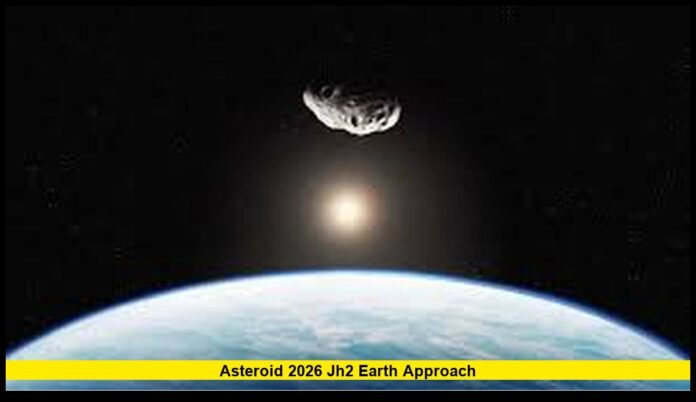

Asteroid 2026 JH2 Earth approach has become one of the most talked-about space events of May 2026 after astronomers confirmed the object will pass unusually close to Earth without posing any danger. The newly discovered asteroid is expected to make its closest approach on May 18, drawing attention from scientists, skywatchers, and space agencies around the world.
NASA continues monitoring the object as telescopes collect new data ahead of the flyby. Although the asteroid will travel closer than many near-Earth objects, experts say its orbit remains safely away from Earth. The event has still sparked major interest because of the asteroid’s size, speed, and late discovery timeline.
The close pass is also giving researchers another opportunity to study how smaller asteroids move through Earth’s neighborhood. Scientists believe observations gathered during this event could help improve future tracking and planetary defense efforts.
What Is Asteroid 2026 JH2?
Asteroid 2026 JH2 is classified as a near-Earth asteroid, meaning its orbit around the Sun brings it relatively close to Earth’s orbital path. NASA tracks thousands of objects like this every year through its near-Earth object monitoring programs.
Current estimates suggest asteroid 2026 JH2 measures somewhere between 50 and 115 feet across. That makes it large enough to gain scientific attention but still much smaller than the giant asteroids often shown in disaster movies.
Astronomers discovered the object only days before its closest flyby. That short observation period immediately pushed the asteroid into global headlines because scientists had limited time to refine its orbital calculations before the encounter.
The asteroid’s rapid movement through space also adds to the challenge. Smaller asteroids often appear faint and difficult to detect until they move relatively close to Earth.
How Close Will Asteroid 2026 JH2 Come to Earth?
NASA calculations show asteroid 2026 JH2 will pass roughly 91,000 kilometers from Earth’s center during its closest approach. That equals about 56,700 miles.
For comparison, the Moon orbits Earth at an average distance of around 384,000 kilometers. This means the asteroid will pass at roughly one-quarter of the Moon’s distance from Earth.
Here is a simple comparison:
| Object | Average Distance From Earth |
|---|---|
| Moon | 384,000 km |
| Asteroid 2026 JH2 | 91,000 km |
In space terms, that counts as a very close flyby.
The asteroid’s path will place it within the region where some satellites orbit Earth. However, scientists say there is no collision threat to satellites or the planet itself.
Close flybys like this are uncommon enough to attract major attention but common enough that astronomers routinely monitor them. NASA’s systems continuously track near-Earth objects to ensure no dangerous orbital changes occur.
Why Scientists Say Earth Is Safe
Despite dramatic online headlines, asteroid 2026 JH2 does not threaten Earth. Scientists have confirmed that the asteroid will safely pass by the planet.
Astronomers calculate asteroid trajectories using repeated telescope observations. Every new observation helps improve the precision of the asteroid’s projected path.
As of today, the orbital data shows no risk of impact.
NASA’s monitoring systems automatically analyze known asteroids for possible future collisions. The agency’s Sentry system constantly updates calculations whenever fresh observations become available.
This process allows experts to quickly identify any object that might deserve closer attention.
In the case of asteroid 2026 JH2, all current projections show a safe encounter.
Why This Flyby Matters to Researchers
The asteroid 2026 JH2 Earth approach offers scientists an important observation opportunity. Researchers rarely get the chance to study a newly discovered asteroid passing this close to Earth.
Astronomers hope to collect data involving:
- Rotation speed
- Surface brightness
- Shape
- Size estimates
- Orbital behavior
- Reflective properties
Every close flyby helps researchers improve asteroid tracking systems. Scientists also use these events to test how quickly observatories can respond when a new near-Earth object appears.
The short notice surrounding this discovery highlights why asteroid detection programs remain so important.
How Asteroids Are Detected
Modern asteroid discoveries rely heavily on automated telescope systems. These observatories scan huge portions of the night sky searching for moving objects.
When astronomers detect something unusual, they compare images to confirm whether the object is moving relative to the stars. Computers then begin calculating the object’s orbit.
Once scientists confirm the discovery, the information is shared with global monitoring networks.
The process usually includes:
- Initial detection
- Follow-up telescope observations
- Orbit calculations
- Risk analysis
- Continuous tracking
Asteroid 2026 JH2 moved through this process rapidly because of its close upcoming approach.
Can Americans See Asteroid 2026 JH2?
Most people in the United States will not see asteroid 2026 JH2 with the naked eye. The object remains too faint for ordinary viewing conditions.
However, astronomers say advanced amateur telescopes may detect the asteroid under favorable skies.
Several online observatories are expected to livestream the flyby, allowing skywatchers to follow the asteroid’s movement in real time.
People interested in astronomy often use events like this to learn more about near-Earth objects and planetary science.
Even though the asteroid itself may not become visible to casual observers, the event still creates excitement within the astronomy community.
Why Smaller Asteroids Often Go Undetected Until Late
Large asteroids are usually easier to discover because they reflect more sunlight. Smaller objects like 2026 JH2 remain harder to spot until they move closer to Earth.
Astronomers continue improving telescope technology to increase early detection capabilities.
Several factors affect visibility:
- Asteroid size
- Surface reflectivity
- Speed
- Direction of travel
- Distance from Earth
- Viewing angle from telescopes
Because smaller asteroids can approach from difficult viewing angles near the Sun, some remain hidden until the final days before close flybys.
That reality explains why asteroid discoveries occasionally appear suddenly in news headlines.
The Growing Importance of Planetary Defense
Planetary defense has become one of the fastest-growing areas of modern space science. Governments and research organizations now invest heavily in asteroid detection systems.
NASA and international partners continue working on ways to improve warning times for potentially hazardous objects.
Programs focus on:
- Earlier asteroid discovery
- Better orbit prediction models
- Improved sky survey coverage
- International coordination
- Deflection research
The goal is simple: identify any potentially dangerous asteroid as early as possible.
Scientists say early detection provides the best chance for effective response planning.
NASA’s DART Mission Changed Asteroid Defense
Public interest in asteroid defense increased dramatically after NASA’s DART mission successfully altered the orbit of a small asteroid moonlet in 2022.
The mission demonstrated that spacecraft can intentionally change the path of an asteroid under controlled conditions.
Although asteroid 2026 JH2 poses no threat, events like this remind researchers why continued investment in planetary defense matters.
Future missions may build on the lessons learned from DART as scientists refine asteroid deflection strategies.
How Often Do Close Asteroid Flybys Happen?
Close asteroid flybys happen more frequently than many people realize.
NASA tracks thousands of near-Earth objects every year. Smaller asteroids often pass Earth at safe distances without drawing widespread attention.
A handful of objects pass closer than the Moon annually. Most remain harmless.
Improved telescope systems now detect far more asteroids than scientists could identify decades ago.
That increase does not necessarily mean Earth faces greater danger. Instead, it reflects better observation technology and more advanced monitoring systems.
Read More – Asteroid 2032
What Would Happen If an Asteroid Like This Entered Earth’s Atmosphere?
Scientists say an asteroid measuring between 15 and 35 meters wide could create a powerful airburst if it entered Earth’s atmosphere.
Smaller asteroids often break apart before reaching the ground. However, the resulting shockwave can still cause damage.
The 2013 Chelyabinsk event in Russia remains one of the best-known examples. That asteroid exploded high in the atmosphere and shattered windows across a wide area.
Researchers stress that asteroid 2026 JH2 is not expected to enter Earth’s atmosphere.
Its projected orbit safely misses the planet.
How NASA Calculates Asteroid Paths
Orbit prediction relies on advanced mathematics and repeated observations.
Scientists measure:
- Position
- Speed
- Direction
- Brightness
- Motion relative to stars
Computers then create orbital models predicting where the asteroid will travel in the future.
Every additional telescope observation reduces uncertainty in the calculations.
This process allows astronomers to determine whether an asteroid might approach Earth again in the future.
For asteroid 2026 JH2, updated calculations continue confirming a safe flyby.
Why Public Interest in Asteroids Keeps Growing
Asteroid stories consistently attract strong public attention online.
People remain fascinated by objects traveling through space near Earth. Social media discussions often increase rapidly whenever NASA announces a close approach.
Movies and television have also shaped public curiosity about asteroid impacts and planetary defense.
Scientists say this interest can help encourage broader support for astronomy and space research.
Educational organizations often use asteroid flybys as opportunities to explain how scientists track objects moving through the solar system.
The Role of International Telescope Networks
Asteroid monitoring depends on cooperation between observatories around the world.
Astronomers share measurements through international databases so researchers can refine orbital predictions quickly.
This cooperation allows scientists in different countries to continue tracking asteroids even when weather or daylight limits observations in one region.
Global teamwork plays a critical role in near-Earth object research.
Without international coordination, scientists would struggle to gather enough observations to accurately predict asteroid paths.
What Happens After the Closest Approach?
Once asteroid 2026 JH2 passes Earth, it will continue orbiting the Sun.
Astronomers will likely continue observing the object for days or weeks afterward, depending on visibility conditions.
These post-flyby observations help improve future orbit calculations.
Researchers also compare actual measurements to earlier predictions to improve asteroid tracking models.
Eventually, the asteroid will move farther away and become too faint for most telescopes to observe easily.
Timeline of the Asteroid 2026 JH2 Earth Approach
| Date | Event |
|---|---|
| May 10, 2026 | Asteroid discovered |
| May 12, 2026 | Orbit confirmed |
| May 13–17, 2026 | Global tracking intensifies |
| May 18, 2026 | Closest approach to Earth |
| After May 18 | Continued scientific observations |
Why This Event Stands Out
Several factors make asteroid 2026 JH2 different from many routine flybys.
The asteroid:
- Was discovered shortly before closest approach
- Will pass unusually close to Earth
- Remains relatively small and fast-moving
- Generated heavy online attention
- Offers valuable observation opportunities
Scientists say these events help improve emergency tracking procedures and observation coordination.
The close approach also demonstrates how active Earth’s surrounding space environment really is.
Future Asteroid Monitoring Will Continue Expanding
Astronomers expect asteroid detection systems to become even more advanced during the next decade.
New telescopes and automated survey programs will likely increase discovery rates for smaller near-Earth objects.
Future systems may provide earlier warnings and more precise orbit calculations.
Researchers also hope to improve computer modeling tools used for tracking asteroid movement.
Space agencies worldwide continue emphasizing the importance of planetary defense research.
Astronomers Continue Watching the Flyby
As the asteroid 2026 JH2 Earth approach continues drawing attention, astronomers around the world remain focused on gathering as much information as possible before the object speeds away from Earth’s neighborhood.
Researchers may still refine details involving the asteroid’s size, brightness, and rotation during the coming days. However, scientists remain confident that the flyby poses no threat to Earth.
The event serves as another reminder that Earth shares its cosmic neighborhood with countless moving objects, many of which scientists continue discovering every year.
Space watchers across the United States will be following asteroid 2026 JH2 closely this week as one of the year’s most talked-about near-Earth flybys unfolds safely above our planet.