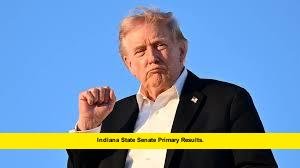

The Indiana state Senate primary results are in — and they are sending shockwaves through the Republican Party. Held on Tuesday, May 5, the primary elections across seven key state Senate districts became one of the most closely watched political contests of the midterm cycle, transforming what are normally quiet local races into a high-stakes national referendum on President Donald Trump’s political power.
The Backstory: Why These Primaries Mattered So Much
President Donald Trump launched a retribution campaign against fellow Republicans ahead of the Indiana primary. Seven GOP state senators who blocked his push to redraw the state’s congressional districts found themselves facing primary challengers carrying Trump’s personal endorsement.
The conflict traces back to December, when twenty-one Republican state senators joined Democrats to vote down a new congressional map — a map Trump had championed as a vehicle to give Republicans a strong shot at winning all nine of Indiana’s U.S. House seats. Trump, furious at the outcome, made good on his promise to back primary challengers against those who defied him.
The seven incumbents targeted were sitting in Districts 1, 11, 19, 21, 23, 38, and 41 — each home to a senator who voted against redistricting and each now facing a well-funded, Trump-endorsed opponent.
The Money Behind the Races
These were no ordinary state Senate primaries. Trump’s intervention turned typically sleepy local contests into a flood of national money and media attention. Roughly $12 million was spent on advertising across the seven races, the vast majority coming from Trump-allied outside groups working to unseat the incumbents.
The Club for Growth, a Washington D.C.-based political action committee, poured approximately $2 million into mailers and advertising efforts in support of the challengers. Two super PACs connected to Indiana Gov. Mike Braun and U.S. Sen. Jim Banks combined to spend more than $8.3 million across the seven races, according to ad-tracking data. In the District 23 race alone — covering a population of roughly 135,000 people — more than $3 million was spent on advertising.
Key Race Results: Who Won and Who Lost
District 19 — Blake Fiechter Defeats Travis Holdman
In one of the night’s most significant upsets, Trump-endorsed Blake Fiechter defeated incumbent state Sen. Travis Holdman, who had served in the Senate since 2008 and held the position of the chamber’s third-most powerful Republican. Fiechter, a real estate agent who also serves on the Bluffton City Council, was endorsed by Trump before he had even officially announced his candidacy. Gov. Mike Braun also backed Fiechter. Holdman, who chaired the Senate’s Tax and Fiscal Policy Committee, was one of the 21 Republican senators who voted against Trump’s redistricting push.
District 41 — Michelle Davis Defeats Greg Walker
Trump-backed Michelle Davis won the Republican primary for District 41, defeating incumbent Sen. Greg Walker. The race was one of the most emotionally charged of the cycle. Walker, a 20-year Senate veteran who had originally planned to retire, reversed course and ran again amid the redistricting fight — notably breaking down in tears on the Senate floor while speaking about his fear for the future if his party caved to Trump’s pressure. Walker’s campaign spent just $73,000 on advertising, while outside groups funneled more than $1.3 million into ads backing Davis. Davis became the third Trump-backed challenger on the night to defeat a redistricting opponent incumbent.
District 21 — Tracey Powell Defeats Jim Buck
Tracey Powell, a Tipton County Commissioner with Trump’s endorsement, defeated state Sen. Jim Buck, an 80-year-old legislator who had served in the Indiana General Assembly since 1994. The race drew notable outside attention when former Vice President Mike Pence publicly endorsed Buck — openly breaking with Trump in his home county’s Senate primary. Pence called Buck “a man of integrity and one of Indiana’s most conservative state legislators.” Despite that backing, Powell prevailed.
District 38 — Greg Goode Survives
Not every incumbent fell. Sen. Greg Goode defeated Trump-backed challenger Brenda Wilson in District 38, becoming a notable exception to the night’s broader trend. Goode was the only one of the targeted Republican senators who had hosted a public listening session in his district ahead of the December redistricting vote, spending hours hearing directly from constituents in Terre Haute. The voters who attended urged him to vote no — which he did. That community engagement appeared to provide him a layer of political insulation that his colleagues lacked.
What Voters Were Saying
The on-the-ground sentiment from Indiana voters painted a nuanced picture. In Columbus, one voter said she cast her ballot for Trump-backed challenger Michelle Davis because she had been influenced by the advertising blitz against incumbent Greg Walker — but she was careful to note that Trump’s endorsement alone was not the deciding factor for her. “That doesn’t always mean anything,” she said.
Other voters in the same area said they had never previously voted in a Republican primary but felt compelled to participate because of the redistricting issue. Several voters across the state mentioned high gas prices and the cost of living as top concerns — indicating that the race was not entirely consumed by national politics, even if Washington money drove much of the campaign messaging.
One voter who cast a ballot for a Trump challenger said he “never really even considered” Trump’s endorsement as a factor. Another said she was influenced by the wave of television and mailer advertising rather than by the president’s personal backing.
The Broader Significance: A Test of Trump’s Power
Political observers across the country were watching Indiana closely as a barometer of Trump’s continued sway over the Republican base heading into the midterm cycle. Normally, state Senate primaries in Indiana attract little attention beyond local communities. This year, they became something else entirely — a live test of whether a presidential endorsement could topple entrenched members of a state legislative chamber.
The results delivered a mixed but broadly favorable verdict for Trump. Multiple incumbents who defied him were ousted. One survived. The pattern suggested that Trump’s endorsement carries significant weight, particularly when paired with millions of dollars in outside advertising — but that incumbents who maintain strong community ties and grassroots engagement are not automatically doomed.
Supporters of the Trump challengers framed the races as a matter of loyalty to a president fighting for Republican majorities in Congress. Critics, including some of the targeted incumbents themselves, argued that the real issue was about whether Indiana voters could choose their own leaders without interference from Washington.
What Comes Next
With primary results now in from one of the most nationally watched state-level contests in recent memory, the general election landscape for Indiana’s Senate districts is beginning to take shape. Several Trump-endorsed challengers will now advance to November, where they are expected to face Democratic opponents in races that will contribute to the broader battle for state legislative control.
The redistricting fight that ignited this entire cycle is not settled. The same congressional map debate that fueled these primaries remains part of a wider national effort by Republicans to redraw district lines ahead of the fall midterm elections, when control of the narrowly divided U.S. House will be decided. Indiana’s results will almost certainly influence how Republicans in other states approach similar redistricting battles — and how far Trump is willing to go to enforce party loyalty on issues he considers essential to Republican power.
The Indiana state Senate primary results have confirmed one unmistakable truth: in today’s Republican Party, a single vote against the president’s agenda can carry consequences that reach all the way down to a local district race. Whether that dynamic strengthens or fractures the party in the months ahead remains the defining question of the midterm season.