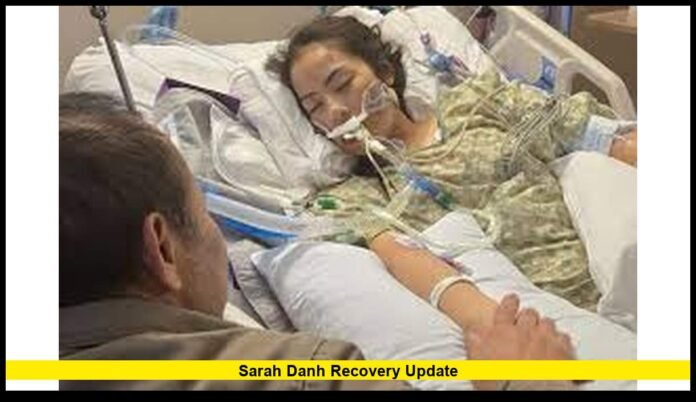

The sarah danh recovery update now reflects a meaningful shift from a life-threatening medical crisis to early-stage recovery, with confirmed improvements in breathing, movement, and awareness following weeks of intensive care.
Latest Condition Shows Clear Progress
Recent developments indicate that Sarah Danh has reached a crucial turning point in her recovery journey. After a period of critical instability, she is now breathing without life support and showing physical and neurological responses that were once uncertain.
She has begun to:
- Breathe independently without mechanical assistance
- Move parts of her body, including her arms and toes
- Stand and take a few assisted steps
- Respond emotionally to people around her
These milestones mark a transition from survival to recovery. While she remains under close medical supervision, her condition has improved enough to begin focusing on rehabilitation rather than emergency stabilization.
How the Medical Crisis Unfolded
Sarah Danh’s health emergency began suddenly during what was expected to be a routine honeymoon trip. Within a short period, her condition deteriorated rapidly, leading to multiple organ failures.
Her medical complications included:
- Acute liver failure, affecting her body’s ability to filter toxins
- Hepatic encephalopathy, which impacted brain function
- Kidney failure, requiring careful monitoring and support
- Increased pressure in the brain
- A stroke, adding serious neurological complications
This combination created a highly complex medical situation. Each condition alone can be life-threatening. Together, they placed her in an extremely critical state.
Doctors had to act quickly to stabilize her. Intensive care measures were implemented immediately, and her condition required continuous monitoring.
Emergency Transfer and Critical Care
As her condition worsened, it became clear that she needed advanced medical care. She was transported back to the United States for specialized treatment.
Upon arrival, she was admitted to an intensive care unit, where doctors focused on:
- Stabilizing organ function
- Reducing brain pressure
- Supporting breathing
- Preventing further complications
At this stage, her condition was described as critical. The focus was on survival, and the outlook remained uncertain.
Early Signs of Recovery
After several days in intensive care, small but important signs of improvement began to appear. These early changes offered the first indication that her body was responding to treatment.
Initial responses included:
- Slight movements in response to touch
- Weak attempts at independent breathing
- Subtle reactions to voices
These moments were significant. In cases involving both organ failure and neurological injury, even minor responses can signal potential recovery.
Emerging From a Coma
One of the most important milestones came when she began to regain consciousness. Moving out of a coma is a complex process that can happen gradually.
As she became more responsive, she showed:
- Increased awareness of her surroundings
- Emotional reactions, such as smiling or crying
- More consistent responses to family members
This stage marked a major shift in her condition. It showed that her brain was beginning to recover, even though the extent of that recovery remained unclear.
Current Physical and Neurological Status
Today, Sarah Danh’s condition reflects both progress and ongoing challenges.
Physical Improvements
- She is breathing independently
- She has begun assisted standing and walking
- Her organ function, especially liver activity, is improving
Neurological Condition
- She is awake and responsive at times
- She shows emotional awareness
- Her cognitive responses remain inconsistent
While these developments are encouraging, she is not yet able to:
- Speak clearly
- Eat or drink on her own
- Perform fine motor tasks
These limitations highlight the need for continued care and rehabilitation.
Life in the Intensive Care Unit
Despite her progress, Sarah Danh remains in intensive care. This environment allows doctors to closely monitor her condition and respond quickly to any changes.
Her daily care includes:
- Neurological assessments
- Organ function monitoring
- Physical support and positioning
- Prevention of complications such as infections
The goal at this stage is to ensure stability while preparing for the next phase of recovery.
Transition Toward Rehabilitation
As her condition continues to improve, doctors are planning for her transition out of intensive care. This step will depend on her ability to maintain stable vital signs without constant intervention.
Once she is ready, she will enter a structured rehabilitation program.
Key Areas of Rehabilitation
Physical Therapy
- Rebuilding muscle strength
- Improving balance and coordination
- Increasing mobility
Speech Therapy
- Restoring communication abilities
- Improving swallowing function
- Strengthening vocal control
Cognitive Therapy
- Enhancing memory and focus
- Improving response time
- Rebuilding problem-solving skills
Rehabilitation will be a long-term process. Progress is expected to come gradually, with each milestone building on the last.
Timeline of Events
| Stage | Development |
|---|---|
| Early April | Onset of illness during travel |
| Mid-April | Rapid decline and organ failure |
| Late April | Transfer to U.S. for treatment |
| Late April | Early signs of awareness |
| Early May | Off life support and assisted movement begins |
This timeline shows how quickly her condition escalated and how steadily recovery is now progressing.
Emotional Milestones in Recovery
Beyond physical improvements, emotional responses are playing an important role in tracking her progress.
Recent milestones include:
- Recognizing familiar voices
- Reacting to touch
- Displaying facial expressions such as smiling
These responses indicate that parts of her brain responsible for emotion and recognition are functioning.
Even small improvements in this area are meaningful and often signal deeper neurological recovery.
Support From Family and Community
Throughout her recovery, support from family and the broader community has remained strong.
Family members have:
- Stayed closely involved in her care
- Shared updates to keep others informed
- Encouraged continued awareness of her situation
Community support has also been significant, with many people following her journey and offering encouragement.
This support system plays an important role in recovery, providing emotional strength during a difficult process.
Why This Recovery Is Significant
Sarah Danh’s case stands out because of the severity and complexity of her condition.
Multiple organ failures occurred rapidly, creating a critical situation that required immediate intervention. The addition of a stroke increased the risk of long-term neurological damage.
Early expectations included serious concerns about survival and recovery. In many cases, similar conditions can lead to permanent impairment.
Her current progress, including breathing independently and taking assisted steps, represents a meaningful turnaround. It shows that her body is responding to treatment and that recovery is possible, even after severe complications.
Challenges Ahead
Recovery remains complex and uncertain.
Key Concerns
Long-Term Brain Recovery
The extent of full cognitive recovery is still unknown. Functions such as memory, attention, and consistent awareness may take time to return.
Speech and Mobility
While she has begun moving, regaining full mobility and speech will require extensive therapy. These abilities often recover slowly and at different rates.
Length of Rehabilitation
The recovery timeline is expected to be long. Progress may include periods of rapid improvement followed by slower phases.
Doctors remain cautiously optimistic. However, they emphasize that each recovery journey is different and cannot be predicted with certainty.
What Comes Next
The next phase of the sarah danh recovery update will focus on continued stabilization and gradual progress.
Doctors are working toward transitioning her out of intensive care as her condition allows. This step will depend on consistent improvements in breathing, organ function, and neurological responses.
Rehabilitation will become the primary focus. Early therapy efforts will aim to rebuild strength, improve coordination, and support cognitive recovery.
Medical teams will closely monitor:
- Her ability to follow commands
- Improvements in awareness and memory
- Progress in communication skills
Each small step forward will be important. Recovery at this stage often happens in gradual increments rather than sudden changes.
A Long Road to Recovery
Sarah Danh’s journey highlights the complexity of recovering from severe illness involving multiple systems in the body.
Her progress so far reflects:
- Effective medical intervention
- Strong physical resilience
- Ongoing support from caregivers
At the same time, her condition reminds us that recovery is rarely straightforward. It requires time, patience, and consistent care.
Every milestone, no matter how small, represents movement in the right direction.
Final Thoughts
The sarah danh recovery update now tells a story of resilience, progress, and ongoing effort, as she moves from critical illness toward long-term recovery.
Follow her journey and share your thoughts as new milestones continue to shape this developing story.