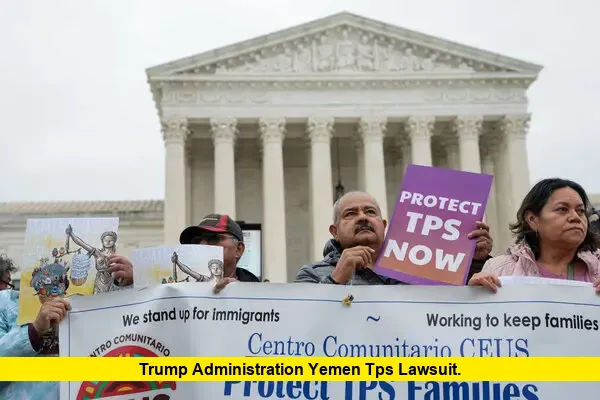

A breaking federal court ruling has halted the Trump administration’s termination of Temporary Protected Status for Yemeni nationals, just days before protections were set to expire — with a Supreme Court showdown looming.
What Is Temporary Protected Status (TPS)?
Temporary Protected Status (TPS) is a humanitarian immigration program created by Congress in 1990. As per the National Immigration Forum, TPS temporarily shields foreign nationals from deportation when they cannot safely return to their home countries due to armed conflict, natural disasters, or other extraordinary conditions. The program also provides recipients a pathway to legal work authorization in the United States.
According to The Hill, the program currently covers more than one million people, making it one of the most significant humanitarian protections in U.S. immigration law.
Yemen’s TPS History
Yemen was first designated for TPS in 2015 during the Obama administration, following the Houthi seizure of the country’s capital, Sanaa, which plunged the nation into a devastating civil war. As reported by CBS News, the Obama and Biden administrations extended the designation multiple times, with the most recent redesignation occurring in 2024, citing ongoing armed conflict and severe humanitarian crises. The last extension estimated that approximately 2,300 Yemenis were eligible to re-register, with an additional 1,700 newly eligible applicants.
Notably, TPS protections for Yemen were also maintained during the first Trump administration, underscoring the bipartisan recognition of conditions on the ground.
The Trump Administration’s Decision to Terminate Yemen TPS
According to CBS News, former Department of Homeland Security (DHS) Secretary Kristi Noem announced on February 13 that Temporary Protected Status for Yemen would be terminated, declaring that allowing Yemeni nationals to remain in the United States was “contrary to our national interest.” A formal federal notice published in March by DHS acknowledged that Yemen still experiences extraordinary conditions but argued the termination was nonetheless required.
The program was scheduled to end on May 4, giving approximately 3,235 Yemeni immigrants — including both current TPS holders and applicants — just 60 days to leave the country voluntarily or face arrest and deportation.
As per the National Immigration Forum, Yemen is one of 13 countries from which the Trump administration has moved to remove TPS, as part of a sweeping immigration crackdown that began when President Trump retook office in January 2025. The other countries targeted include Haiti, Venezuela, Syria, Honduras, Nepal, Nicaragua, Afghanistan, Cameroon, South Sudan, Myanmar, Somalia, and Ethiopia.
The Lawsuit: Who Sued and Why
Two separate lawsuits were filed on behalf of Yemeni TPS holders and applicants. According to Newsweek, the consolidated cases were led by the Center for Constitutional Rights. A class of approximately 3,200 plaintiffs sued, arguing that the termination decision was not based on an objective review of country conditions as required by statute, but was instead part of what they described as a “predetermined presidential agenda to end TPS.”
According to Law & Crime, the plaintiffs’ 68-page petition argued the decision violated both the TPS statute and the Administrative Procedure Act (APA), which requires meaningful agency consultation before major policy decisions.
One plaintiff, identified as Hadeel Doe in court documents, described the personal impact of the lawsuit to The Hill: the decision to block the termination was described as “a lifeline for my family” and the moment after “months of existential anxiety.” She said her U.S. citizen children would not be forced back into an environment of violence or forced recruitment.
The Federal Court Ruling: Judge Dale Ho’s Decision
On May 1, U.S. District Judge Dale E. Ho of Manhattan — appointed by former President Joe Biden — issued an emergency order blocking the Trump administration from proceeding with the Yemen TPS termination.
As reported by CBS News, Judge Ho found that former DHS Secretary Kristi Noem likely violated the law when she failed to follow the procedural requirements mandated by Congress before terminating a country’s TPS designation. In his 36-page ruling, the judge wrote that the department “acted unlawfully by terminating TPS in clear disregard of the procedural requirements established by Congress.”
According to Newsweek, the court found that DHS did not follow the statutory duty to meaningfully consult with other federal agencies about country conditions in Yemen before making its termination decision. According to Law & Crime, the government’s evidence of consultation amounted to a single email thread in which no information about conditions in Yemen — including armed conflict or safety risks — was actually requested or provided by the State Department.
Judge Ho was particularly pointed in his defense of the affected individuals. According to The Associated Press, the judge wrote directly in his conclusion that TPS holders from Yemen are “ordinary, law-abiding people” whom the government itself had repeatedly determined could face serious threats to their safety if returned to a country in the grip of ongoing armed conflict.
The judge highlighted specific plaintiffs to illustrate the human stakes: a 33-year-old pregnant woman in Detroit whose unborn child has a congenital heart condition untreatable in Yemen, and a 50-year-old former human rights worker in Brooklyn who is a target of Houthi-aligned militias.
The State Department Travel Advisory Contradiction
One of the most striking elements of the court’s reasoning involves the contradiction between DHS’s termination decision and the State Department’s own travel advisory for Yemen.
As per CBS News, the State Department maintains a Level 4 — Do Not Travel advisory for Yemen, its highest possible threat classification, citing terrorism, unrest, crime, health risks, kidnapping, and landmines. Judge Ho pointed directly to this inconsistency in his opinion, noting that DHS’s decision appeared to disregard the government’s own expert assessment of conditions on the ground.
According to Newsweek, the judge wrote that if DHS had genuinely consulted with the State Department, the agency’s interlocutors would have had to grapple with that Level 4 classification when assessing whether Yemen was still unsafe for TPS holders to return.
DHS and the Trump Administration’s Response
The Department of Homeland Security responded to the ruling with a defiant statement, according to the Associated Press, declaring that “temporary means temporary” and that “the final word will not be from activist judges legislating from the bench.”
DHS maintained it had reviewed conditions in Yemen and consulted with relevant agencies before concluding that Yemen no longer met the legal requirements for TPS. According to Newsweek, the Trump administration’s broader legal argument across all TPS cases is that the statute bars judicial review entirely — meaning courts have no authority to intervene in the Secretary’s termination decisions, regardless of the reasoning or process used.
The Broader TPS Battle: 16 Courts Against the Administration
The Yemen ruling is far from an isolated legal skirmish. According to Newsweek, sixteen lower courts have unanimously ruled against the Trump administration on the question of whether the judiciary has authority to review TPS terminations. Shayana Kadidal, Senior Managing Attorney at the Center for Constitutional Rights, stated following the ruling that “the ball is now firmly in the Supreme Court’s court.”
As per The Hill, the Trump administration has terminated TPS for nationals from nine countries since taking office, including Haiti, Venezuela, and Ethiopia, with the Yemen termination being among the most recent halted by courts.
According to Axios, there are approximately 1.3 million people currently living in the United States under TPS designations across all nationalities. The Trump administration has moved to end protections for 11 of 15 nationalities, with the remaining four set to expire later this year.
The Supreme Court Showdown
The Yemen ruling arrives at a critical moment, as the U.S. Supreme Court is expected to deliver a landmark decision on TPS this summer that could determine the fate of hundreds of thousands of immigrants.
According to the National Immigration Forum, the Supreme Court agreed in March to hear expedited oral arguments on whether the Trump administration can terminate TPS for Haiti and Syria, with arguments taking place the week of April 27. As per Al Jazeera, the cases were brought as class action lawsuits by Haitian and Syrian TPS holders who charged that the department failed to follow proper procedures when terminating their status.
According to The Hill, Solicitor General D. John Sauer argued before the Supreme Court that lower courts had no authority to block the terminations, contending that allowing judicial review would impermissibly allow courts to second-guess national security judgments that the Constitution vests in the President.
As per The Hill, several conservative justices appeared open to the administration’s argument at oral arguments, raising concerns among immigrant advocates about the eventual ruling. A decision is expected by early summer, and could have sweeping implications for all pending TPS lawsuits — including Yemen.
What Happens Next for Yemeni TPS Holders
For now, the roughly 3,235 Yemeni TPS holders and applicants can remain in the United States and retain their work authorization while the lawsuit proceeds. However, the court’s order is not permanent — it is a preliminary injunction holding the termination in place while the case plays out.
As per Law & Crime, the court made clear that it was not ruling that Yemen must retain TPS indefinitely, but that the procedures required by Congress had not been properly followed. The ruling leaves open the possibility that DHS could revisit the decision through a lawful process.
The ultimate fate of Yemen’s TPS — along with that of over a million other TPS holders nationwide — may hinge on what the Supreme Court decides in the Haiti and Syria cases in the weeks ahead.
Sources: The Hill, CBS News, Newsweek, Associated Press, Law & Crime, Al Jazeera, National Immigration Forum, Axios