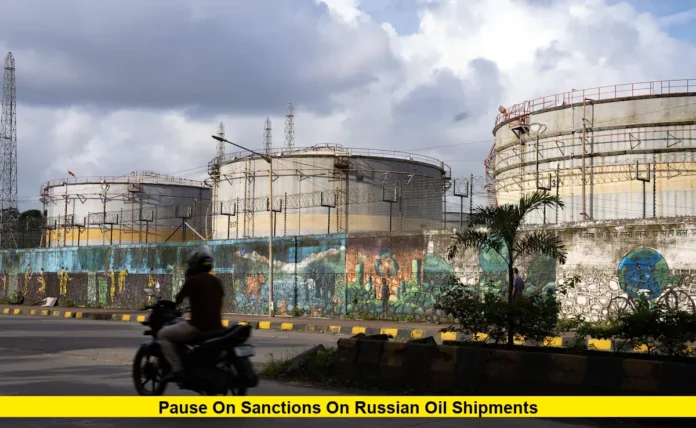

The pause on sanctions on Russian oil shipments has returned to the center of global energy policy after the U.S. Treasury Department unexpectedly extended a temporary waiver—despite earlier signals that no such move would happen. The decision highlights how geopolitical realities, especially the ongoing Iran-related conflict, are reshaping economic strategy in ways that challenge long-standing sanctions frameworks.
The extension allows certain Russian oil shipments already at sea to continue reaching global markets without triggering U.S. sanctions. While the move is officially framed as a short-term measure to stabilize supply, it reveals a deeper shift: energy security is temporarily outweighing strict enforcement of sanctions.
If you want clear, fact-based updates on how global policy shifts affect oil prices and U.S. consumers, keep reading as we break down what this means now and what could come next.
A Sudden Policy Reversal in Washington
Just days before the announcement, Treasury Secretary Scott Bessent publicly stated that the U.S. would not renew waivers related to Russian and Iranian oil. That position aligned with the broader sanctions strategy aimed at limiting revenue streams for both countries.
However, the Treasury reversed course and extended the waiver for Russian oil shipments, allowing transactions tied to oil already loaded onto vessels to proceed for another limited period.
This shift was not accompanied by a detailed public explanation, but the timing speaks volumes. The decision came amid escalating disruptions in global oil supply linked to the Iran conflict and instability around key shipping routes.
Why the U.S. Extended the Pause
At its core, the move reflects a simple but powerful reality: global oil markets cannot absorb sudden shocks without consequences.
Several factors pushed the U.S. toward extending the waiver:
- Supply disruptions linked to the Iran conflict
- Volatility in the Strait of Hormuz, a critical global shipping lane
- Rising global oil prices impacting U.S. consumers
- Pressure from major oil-importing countries
The Iran conflict has disrupted one of the world’s most important oil transit corridors. Even temporary closures or threats around the Strait of Hormuz can remove millions of barrels per day from the global supply chain.
By allowing Russian oil already in transit to reach buyers, the U.S. effectively injected additional supply into the market without formally lifting sanctions.
Understanding the Mechanism: What the Waiver Actually Does
This is not a blanket removal of sanctions. Instead, it is a targeted, time-limited exception.
Here’s how it works:
- Applies only to oil already loaded onto ships by a specific deadline
- Does not authorize new purchases or long-term contracts
- Designed to prevent stranded oil from tightening supply further
- Automatically expires unless renewed again
This structure allows policymakers to maintain pressure on Russia while avoiding immediate economic fallout.
Real-World Impact: What Happens When Supply Tightens
To understand the importance of this decision, consider what happens when oil supply is suddenly restricted.
Earlier in the conflict, disruptions in shipping routes caused oil prices to spike sharply. Countries heavily dependent on imports—especially in Asia—faced immediate challenges securing energy supplies.
For example:
- Refineries struggled to maintain output
- Fuel prices surged in domestic markets
- Shipping costs increased due to risk premiums
By temporarily easing restrictions on Russian oil shipments, the U.S. helped offset some of that pressure, preventing a more severe energy crunch.
A Strategic Trade-Off: Sanctions vs. Stability
This move highlights a fundamental tension in U.S. foreign policy:
Should sanctions remain strict, even if they worsen global economic conditions?
Or:
Should flexibility be allowed when global stability is at risk?
The extension suggests that, at least for now, stability is taking priority.
Comparison: Then vs. Now
| Policy Phase | Approach | Outcome |
|---|---|---|
| Early sanctions period | Strict enforcement | Reduced Russian revenues but tighter global supply |
| Iran conflict escalation | Temporary waivers introduced | Stabilized prices but diluted sanctions impact |
| Current phase | Waiver extended again | Balancing act between pressure and practicality |
This evolution shows how sanctions are no longer static tools—they are being adjusted in real time based on global conditions.
How the Iran Conflict Changed Everything
The Iran-related conflict has become a major variable in global energy markets.
Key developments include:
- Disruptions to shipping routes
- Threats to close or restrict the Strait of Hormuz
- Increased risk for oil tankers
- Sudden price swings in global markets
These factors created a situation where removing even a small amount of oil from the market could have outsized effects.
In that context, allowing Russian oil shipments to proceed—under strict limitations—became a pragmatic decision.
Unexpected Consequence: Strengthening Russia’s Position
One of the more complex outcomes of this policy is that it may indirectly benefit Russia, even if that is not the intention.
Here’s why:
- Increased demand for available oil raises prices
- Russian oil becomes more attractive when supply is tight
- Temporary waivers create windows for continued exports
This creates a paradox: a policy designed to stabilize markets can also provide economic breathing room for the very country it targets.
Domestic Implications for the United States
The decision is not just about global markets—it has direct implications at home.
1. Gas Prices
Higher oil prices translate quickly into higher gasoline costs. By stabilizing supply, the waiver helps prevent sudden spikes at the pump.
2. Inflation Pressure
Energy costs affect nearly every sector, from transportation to manufacturing. Keeping oil prices in check helps manage broader inflation.
3. Political Considerations
Energy prices are a major concern for voters, especially in an election cycle. Policy decisions around oil often carry political weight beyond economics.
Global Reactions and Concerns
The extension has drawn mixed reactions internationally.
- Some countries welcome the move as a necessary step to stabilize energy markets
- Others worry it weakens sanctions enforcement
- European allies remain cautious, given their continued efforts to limit Russian revenues
This divergence highlights how energy policy often creates friction between short-term needs and long-term goals.
What Happens Next?
The waiver is temporary, and its future remains uncertain.
Several scenarios could unfold:
- Another extension if supply disruptions persist
- Return to strict sanctions if markets stabilize
- Broader policy adjustments if geopolitical tensions escalate
Much will depend on:
- Developments in the Iran conflict
- Stability of global shipping routes
- Trends in oil prices
A Deeper Look: Why This Moment Matters
This decision represents more than just a technical policy change. It signals a shift in how economic tools are being used in a complex, interconnected world.
Sanctions are no longer purely punitive—they are now part of a broader system that must account for:
- Supply chains
- Market reactions
- Political pressures
- Global interdependence
In that sense, the pause on sanctions on Russian oil shipments reflects a new kind of policymaking—one that is reactive, flexible, and deeply tied to real-world conditions.
Opinion: A Necessary Compromise or Strategic Weakness?
From an analytical standpoint, this move can be seen in two ways.
The Case for the Waiver
- Prevents economic shocks
- Protects consumers from price spikes
- Stabilizes global markets during crisis
The Case Against It
- Undermines sanctions credibility
- Sends mixed signals to allies
- Potentially benefits adversaries
The truth likely lies somewhere in between. In a world where energy markets are tightly interconnected, absolute policies often give way to practical compromises.
Conclusion
The extension of the waiver on Russian oil shipments underscores how quickly global priorities can shift. What began as a strict sanctions regime has evolved into a flexible strategy shaped by war, supply disruptions, and economic realities.
As the situation continues to unfold, one thing is clear: energy policy is no longer just about economics—it is a central tool of global strategy.
If you want to stay informed on how these decisions impact oil prices, global politics, and your daily costs, follow ongoing updates and share your thoughts below.
What do you think—should the U.S. prioritize strict sanctions or global energy stability? Share your perspective and stay informed as this story develops.