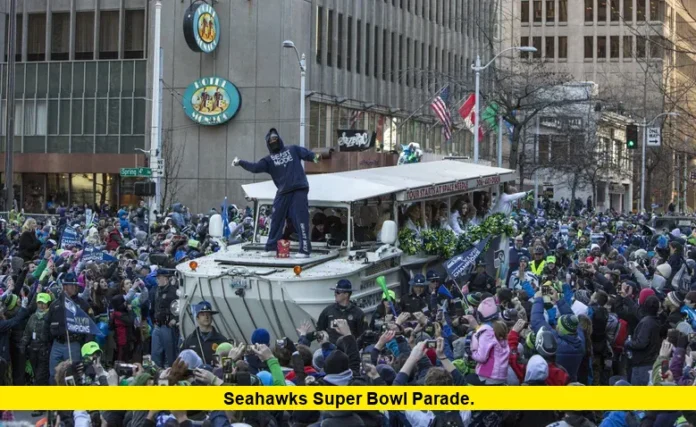

The Seahawks Super Bowl parade was more than a championship celebration—it became a powerful economic engine that revealed how sports-driven civic events can reshape a city, even if only for a day.
When Seattle’s streets filled with fans in February 2026, the energy wasn’t just emotional—it was financial. The Downtown Seattle Association (DSA) said the city generated about $16 million in economic activity tied directly to the parade, underscoring how large-scale sports moments can translate into measurable local impact.
Want more breakdowns like this on sports, money, and cities? Keep reading as we unpack what really happened behind the scenes.
A Million Fans, One City: The Scale of the Event
The parade quickly became one of the largest public gatherings in Seattle’s history.
- Close to 1 million fans flooded downtown streets
- The celebration began near Lumen Field before moving through the city core
- The route extended roughly two miles along Fourth Avenue
- The event lasted several hours, drawing crowds from across Washington and beyond
This turnout exceeded expectations and even surpassed Seattle’s 2014 Super Bowl parade attendance, signaling just how much the city—and its fan base—has grown over the past decade.
Breaking Down the $16 Million Impact
As per Downtown Seattle Association (DSA), the $16 million estimate reflects a combination of direct and indirect spending tied to parade day.
Where the money flowed
The economic boost came from multiple channels:
- Restaurants and bars: Packed throughout the day with long wait times
- Retail: Surge in Seahawks merchandise and impulse purchases
- Transportation: Increased use of buses, light rail, parking, and rideshares
- Hotels: Visitors traveling into Seattle for the celebration
This kind of spending pattern highlights how a single event can activate nearly every part of a city’s economy at once.
Unique Explanation: The “Compressed Economy” Effect
What makes this event especially interesting is what economists often describe as a compressed economy effect.
Instead of steady, predictable spending:
- Thousands of people spend heavily within a short time window
- Businesses experience peak demand all at once
- Supply chains, staffing, and logistics are pushed to their limits
In simple terms, the parade turned a normal weekday into something resembling a major holiday—economically speaking.
Real-World Example: A Day in Downtown Seattle
Consider a small restaurant in downtown Seattle.
On a typical weekday:
- Serves a few hundred customers
- Operates within predictable staffing levels
On parade day:
- Customer volume can double or triple
- Inventory sells out quickly
- Staff work extended shifts to meet demand
Multiply this scenario across hundreds of businesses, and the $16 million figure becomes far more tangible. It’s not just a statistic—it’s a collection of real transactions happening across the city.
Civic Pride vs. Economic Reality
The parade delivered more than financial benefits—it reinforced Seattle’s identity.
The emotional return
- Massive crowd participation
- Shared celebration across communities
- A sense of unity that extended beyond sports
The financial limits
- Economic gains were short-term
- Costs included security, traffic control, and cleanup
- Not all spending represented new money—some was simply shifted from other days
As per local coverage, city crews worked late into the evening to restore downtown after the event, highlighting the operational cost behind such celebrations.
Comparison: 2014 vs. 2026 Parade
The 2026 parade offers a clear contrast with Seattle’s last Super Bowl celebration.
| Factor | 2014 Parade | 2026 Parade |
|---|---|---|
| Attendance | ~700,000 | Near 1 million |
| Planning | Limited crowd forecasting | Advanced coordination |
| Economic framing | Less emphasis | $16M estimate highlighted |
| Infrastructure | Strained in areas | Improved flow and control |
This comparison shows how cities evolve in managing large-scale events. Seattle applied lessons from 2014 to better handle crowd safety, transit, and logistics.
Urban Strategy: Why Events Like This Matter
From a broader perspective, the parade serves multiple strategic purposes:
1. Tourism positioning
It showcases Seattle as a destination capable of hosting large gatherings.
2. Economic stimulation
Short bursts of spending can benefit small businesses, especially in dense urban areas.
3. Brand identity
The event strengthens Seattle’s image as a passionate sports city.
Opinion: The Hidden Value Beyond $16 Million
The $16 million figure is significant—but it likely doesn’t capture the full picture.
What the number misses
- Long-term tourism interest sparked by media exposure
- Increased fan engagement and merchandise sales over time
- Strengthening of local business visibility
At the same time, it’s important to stay grounded.
Economists often point out:
- Some spending is redistributed, not entirely new
- Public resources used for events may offset gains
The true value lies somewhere between immediate revenue and long-term intangible benefits.
Logistics and Planning: Managing a Citywide Event
Handling such a large crowd required detailed coordination:
- Early road closures across downtown
- Strong reliance on public transit systems
- Strategic crowd control along the parade route
Compared to past events, officials implemented more structured planning, helping the parade run smoothly despite its scale.
Why This Parade Matters Beyond Football
This wasn’t just about a championship—it was about how a city responds to a shared moment.
The event demonstrated:
- How public spaces can transform instantly
- How community energy translates into economic activity
- How sports serve as a unifying force across diverse populations
It became a real-world example of how culture and commerce intersect in modern cities.
Can Other Cities Replicate This Success?
Seattle’s experience raises an important question: can this model work elsewhere?
The answer depends on several factors:
- Strong fan engagement
- Centralized urban infrastructure
- Efficient public transportation
- A culture that supports large gatherings
Cities lacking these elements may not see the same level of impact.
Final Takeaway
The Seahawks Super Bowl parade was both a celebration and a case study in urban economics.
It showed how:
- A single day can generate millions in activity
- Emotional moments can drive financial outcomes
- Cities can harness large events for short-term gains
The $16 million figure is just one piece of the story. The real impact lies in how Seattle brought together people, businesses, and infrastructure into one shared moment.
If you experienced the parade or have thoughts on whether events like this truly benefit cities, share your perspective and stay tuned for more insights like this.