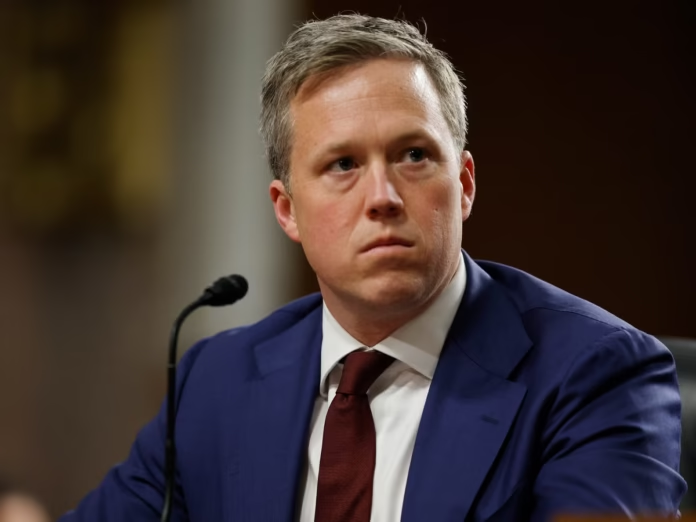

The power struggle that has been quietly rattling the corridors of the Pentagon has finally exploded into full public view. The Dan Driscoll Pete Hegseth clash is no longer a matter of whispered speculation among Washington insiders — it is a full institutional standoff between two of the most powerful civilian officials at the Department of Defense, and it is playing out in real time while American forces remain engaged in an active military conflict abroad.
Army Secretary Dan Driscoll has made one thing unmistakably clear: he is not going anywhere. Despite months of mounting pressure, the forced departure of his closest military allies, and persistent reports that Defense Secretary Pete Hegseth wants him gone, Driscoll has publicly declared that he has no plans to resign or leave his post. He released a statement emphasizing that serving under President Trump has been the honor of his lifetime and that his sole focus remains building the strongest ground fighting force the United States has ever fielded.
Keep reading — this story goes much deeper than a standard Washington personnel dispute.
How a Rivalry Was Born Inside the Pentagon
To understand how this standoff reached its current intensity, it helps to go back to when the friction first began to surface. The tension between Hegseth and Driscoll did not begin with a single argument or policy disagreement. It grew gradually from a combination of professional competition, differing visions for the military, and the uncomfortable reality that Driscoll quickly became one of the most respected figures inside a building where Hegseth has struggled to establish firm authority.
When Hegseth went through a rough stretch early in his tenure — marked by controversies that drew widespread criticism and fueled speculation about his long-term viability — Driscoll’s name began circulating as a potential replacement. That alone was enough to plant a seed of mistrust between the two men. Once a defense secretary knows that his subordinate is being talked about as his successor, the professional relationship rarely recovers fully.
The situation grew more complicated when President Trump sent Driscoll — not Hegseth — to Kyiv to lead sensitive negotiations aimed at ending the Russia-Ukraine war. For Hegseth, being bypassed for one of the most significant diplomatic missions of the Trump administration’s second term was a very public signal of where the president’s confidence actually resided. Driscoll carried out that assignment successfully, further elevating his profile both inside the administration and on Capitol Hill.
The Generals Who Paid the Price
The internal rivalry might have remained a quiet Washington subplot indefinitely if Hegseth had not taken a series of dramatic personnel actions that forced everything into the open.
On April 2, 2026, three senior Army leaders were simultaneously removed without any advance public notice or explanation. Army Chief of Staff General Randy George — a decorated combat veteran with more than four decades of service — was told to retire immediately. He was joined by the commanding general of Army Transformation and Training Command and the Army’s chief of chaplains. All three removals happened while the United States was managing active military operations.
General George’s departure hit Driscoll particularly hard. The two had developed a close professional partnership during their time working together at the Pentagon. They traveled to Ukraine together to study lessons from that conflict and worked side by side on plans to modernize the Army for future warfare. George was not simply a colleague — he was Driscoll’s most trusted partner in executing the Army’s mission.
The dismissal of George was preceded by another significant removal. Colonel David Butler, a top adviser to Driscoll who had been nominated for promotion to brigadier general, stepped back from his role months earlier as internal pressure mounted around him. Butler’s background was notable — he had previously served as spokesman for former Joint Chiefs Chairman General Mark Milley. His nomination for promotion was one of several that Hegseth moved to block, a decision that put him in direct conflict with Driscoll and Army leaders who had championed the officers’ advancement.
One of the clearest and most unusual features of the officer promotion dispute was who was being blocked. The officers whose promotions Hegseth sought to prevent included two Black men, two women, and several others with strong service records. Driscoll and General George refused to remove them from the promotion list, arguing that their records spoke for themselves. That act of institutional defiance had consequences. George lost his job. The message inside the Pentagon was not subtle.
The Helicopter Incident: A Demonstration of Authority
Among the various episodes that have defined this conflict, one stands out as a particularly vivid illustration of how the power struggle is playing out in practical terms.
Army pilots flew military helicopters near the Tennessee estate of musician Kid Rock. The Army opened an investigation and suspended the crew. General George supported allowing that process to run its course through normal military disciplinary channels. Hegseth intervened personally, ending the suspension and shutting down the investigation.
Retired military officers with experience in the chain of command noted publicly that this kind of intervention was outside the norms of how discipline at the squadron level is supposed to work. The defense secretary stepping in to override an Army disciplinary process — regardless of the facts of the underlying incident — was a break from institutional practice. More than anything, it was a visible assertion of authority over the Army’s internal operations, over Driscoll’s institutional space, and over the officers who manage day-to-day discipline within the service.
The Vice President Factor — the Element That Changes Everything
What separates this conflict from a routine bureaucratic power struggle is a dimension that most people have not fully examined: the role of Vice President JD Vance.
Driscoll and Vance are not just political allies — they are close personal friends and former Yale Law School classmates. When tensions between Driscoll and Hegseth became serious enough last fall, Driscoll reached out to Vance directly to help manage the deteriorating dynamic. That move reveals something important about the political architecture underlying this dispute.
The vice president holds no formal role in the military chain of command. His involvement at Driscoll’s request was not procedural — it was political. It signaled that Driscoll has a protector at a level that Hegseth cannot override without engineering a direct confrontation that reaches the Oval Office itself. The White House delivered the message to Hegseth directly: Driscoll cannot be fired.
That constraint has fundamentally shaped Hegseth’s approach. Unable to remove Driscoll outright, he has adopted an indirect strategy — eliminating the people around Driscoll one by one, blocking promotions he championed, and intervening in Army processes in ways that undercut Driscoll’s authority without requiring a direct dismissal. It is a form of institutional attrition: methodically shrinking the Army Secretary’s sphere of influence while leaving him nominally in place.
Congress Steps In — and Republicans Break with Hegseth
The firings of General George and the other senior Army leaders triggered a congressional response that Hegseth did not expect from his own party. At a House Appropriations Committee hearing this week, Republican lawmakers publicly and explicitly sided with Driscoll, offering strong praise for his leadership and lamenting the way George’s removal was handled.
House Appropriations Committee Chairman Tom Cole of Oklahoma told Driscoll directly that he was doing an outstanding job and that he is the right person in the right place at the right time. Steve Womack of Arkansas, a retired Army National Guard colonel himself, echoed that praise and said he regretted the circumstances under which George departed — adding that the country would feel the loss.
Democratic lawmakers were sharper in their criticism. Several argued that the decision to fire General George publicly and abruptly, with no explanation and no offer of a graceful exit, was damaging to Army morale, institutional trust, and the credibility of the Pentagon’s civilian leadership. One congressman said the administration owes Congress, the public, and above all the soldiers themselves an explanation for what happened — an explanation that has not been forthcoming.
The bipartisan show of support for Driscoll at the hearing was a political signal. It told Hegseth that whatever internal campaign he is waging against the Army Secretary, the effort does not have the backing of the Republican lawmakers whose support the Defense Department needs for budget approvals and oversight cooperation.
Some House Democrats have gone even further, filing articles of impeachment against Hegseth over a broader range of grievances related to his handling of military operations and personnel decisions during the current conflict with Iran.
Driscoll Walks a Careful Public Line
Throughout all of this, Driscoll has been strategically disciplined in how he presents himself publicly. He has not attacked Hegseth by name. He has not aired the internal grievances in press conferences or on television. Instead, he has focused on the mission and allowed others — members of Congress, retired military officers, current officials speaking anonymously — to fill in the details.
At the congressional hearing, when pressed on the firing of General George, Driscoll acknowledged the reality of civilian control without endorsing the decision. He said that civilian leaders get to pick the leaders they want and that the military executes. He praised George’s replacement in careful terms. He did not criticize Hegseth.
He did reveal one personal detail that spoke volumes without requiring editorializing. He was in North Carolina on spring break with his family when George was told to submit his resignation paperwork. When the Driscoll family drove back to Washington, their first stop was General George’s house. They all gave him a hug.
That was a statement without words — a public demonstration of where Driscoll’s loyalty and respect actually lie, delivered in a way that no one could call insubordinate.
The Bigger Picture: A Pentagon at War With Itself
The most troubling dimension of the entire Dan Driscoll Pete Hegseth clash is not the personalities involved — it is the timing. The United States is managing active military operations in a conflict with Iran. Generals are being fired. Senior advisers are being pushed out. The Army Secretary and the Defense Secretary appear to be conducting parallel campaigns of institutional positioning rather than unified strategic leadership.
Career military professionals who have spent decades inside the Defense Department have expressed deep concern about the impact of this instability on morale, readiness, and the institutional knowledge that gets lost when experienced officers are removed mid-conflict without explanation.
The officers Hegseth has forced out over the past several months collectively represent generations of hard-won expertise. General George alone served through multiple major conflicts over four decades. That kind of institutional memory does not get replaced quickly by a personnel action.
Meanwhile, the White House continues to publicly back both men — a position that is increasingly difficult to sustain as the conflict between them becomes more open. President Trump has praised Driscoll’s work on drone capability and praised Hegseth for his handling of the Iran conflict. The dual endorsement is designed to prevent the feud from becoming a forced choice, but that calculation grows harder to maintain with every passing week.
For now, Driscoll holds his post. The generals he worked with are gone. His political protection runs through the Vice President’s office. And Hegseth remains in position, unable to remove the man he apparently views as his greatest internal threat.
This story is far from over — and the next move belongs to Hegseth.
What do you think — is Driscoll the stabilizing force the Pentagon needs right now, or is this internal war doing more damage than the public realizes? Drop your thoughts in the comments and stay tuned as this situation continues to develop.