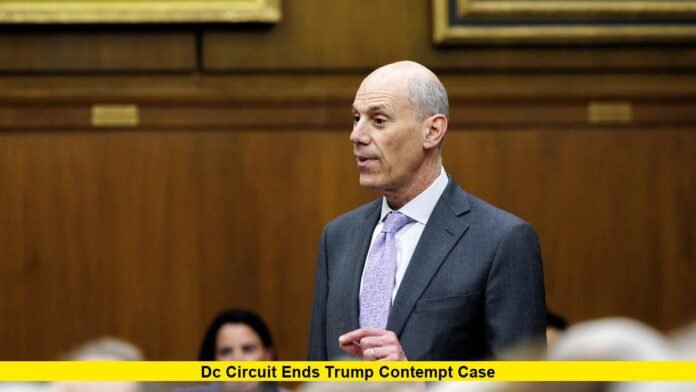

The dc circuit ends trump contempt development delivers a decisive victory for the Trump administration in its high-stakes battle over immigration enforcement. On Tuesday, a divided panel of the U.S. Court of Appeals for the D.C. Circuit ordered a federal district judge to immediately terminate a nearly year-long criminal contempt inquiry tied to deportation flights of Venezuelan migrants.
This ruling comes after months of legal wrangling that tested the boundaries between judicial oversight and executive authority in national security matters. The appeals court determined that continuing the probe would represent an overreach, clearing the way for the administration to focus on its deportation priorities without further judicial interference in this specific matter.
Readers, consider how this balance of powers directly shapes everyday American concerns about border security and public safety.
The events trace back to March 2025, when the Trump administration invoked the Alien Enemies Act to carry out rapid deportations of individuals it identified as members of the violent Tren de Aragua gang. Officials arranged flights transporting more than 130 Venezuelan migrants to El Salvador, where they were transferred to the high-security Terrorism Confinement Center, known as CECOT.
U.S. District Judge James Boasberg, serving as chief judge in Washington, D.C., had issued an emergency order directing the government to halt certain transfers and turn planes around if they were already airborne. The administration proceeded with the flights anyway, citing operational necessities and the need to protect national security. Boasberg later found probable cause that senior officials had willfully defied his directive, launching an inquiry to identify those responsible and explore criminal contempt charges.
The contempt process unfolded over nearly twelve months. Boasberg sought detailed declarations from the government about decision-making at the highest levels. He pressed for clarity on who authorized the flights despite the court order. Administration officials, including then-Homeland Security Secretary Kristi Noem, were referenced as key figures in the chain of command. The judge viewed the actions as a direct challenge to judicial authority, especially in a case involving due process claims by the migrants.
The District Court’s Push for Accountability
Boasberg emphasized that the inquiry was not about second-guessing policy but about ensuring compliance with a lawful court order. He gave the government opportunities to explain its actions through filings and hearings. When responses fell short in his view, he moved forward with proceedings aimed at determining whether criminal contempt applied. This step marked a rare escalation in federal immigration litigation, where judges seldom pursue criminal sanctions against executive officials.
The process highlighted tensions in how courts enforce orders during fast-moving deportation operations. Officials argued the flights involved complex coordination with foreign governments, including stops in Honduras before reaching El Salvador. They maintained that the scale of the operation and security risks justified swift action. Boasberg, however, insisted that the government had clear notice of his instructions and chose to proceed regardless.
Today’s D.C. Circuit Decision Shuts Down the Inquiry
In a 2-1 ruling issued Tuesday, the D.C. Circuit panel concluded that Boasberg abused his discretion by pursuing the contempt matter further. The majority opinion described the ongoing probe as an unwarranted impairment on the executive branch’s autonomy. Judges noted that the administration had already identified responsible officials and provided sufficient information about the decision-making process.
The court stressed that contempt proceedings must not encroach on core executive functions, particularly in areas involving foreign affairs and immigration enforcement. This decision effectively ends the inquiry, preventing any further hearings, testimony demands, or potential referrals for prosecution related to the March 2025 flights. The ruling builds on earlier interventions by the same appeals court, which had paused similar efforts in the past to allow full consideration of the government’s position.
Legal observers following the case recognize this as a strong affirmation of limits on judicial power when it intersects with presidential authority under statutes like the Alien Enemies Act. The Act, dating back to 1798, grants the executive significant discretion during times of declared threats from foreign adversaries or gangs. The appeals court reinforced that courts cannot use contempt as a tool to micromanage such operations without clear evidence of bad faith that overrides separation-of-powers principles.
Unique Explanation: The Collateral Bar Rule in Modern Immigration Context
One unique aspect of this case lies in how the collateral bar rule applies here. Normally, parties must obey court orders even while appealing them, with violations still punishable as contempt even if the order is later overturned. Yet the D.C. Circuit panel determined that the underlying circumstances— including the vacated nature of certain aspects of the original order and the executive’s identification of a responsible official—made further contempt proceedings unnecessary and improper. This explanation stands out because it shows how the rule, typically rigid, bends in practice when national security and rapid executive action are at stake, preventing courts from turning temporary disputes into prolonged executive harassment.
This nuanced application prevents a cycle where judges could indefinitely probe executive decisions under the guise of enforcement. It underscores that contempt serves to uphold court dignity, not to paralyze policy implementation in areas where the Constitution assigns primary authority to the president.
Broader Implications for Immigration Enforcement Today
The decision arrives at a critical time for U.S. immigration policy. The Trump administration has prioritized large-scale deportations of criminal gang members and those posing public safety risks. By halting the contempt inquiry, the ruling removes a significant legal cloud over these operations. Officials can now proceed with similar efforts confident that courts will respect the executive’s lead role in immigration and foreign relations.
For everyday Americans, this means stronger focus on border security without constant courtroom distractions. Communities concerned about gang violence, such as Tren de Aragua’s reported activities in U.S. cities, benefit from streamlined enforcement. The case also signals to lower courts that overzealous contempt probes risk reversal on appeal when they intrude on executive functions.
Critics of the administration’s approach argue that robust judicial review protects individual rights and prevents overreach. The dissenting judge in Tuesday’s ruling highlighted those concerns, emphasizing the need for accountability when orders appear violated. Yet the majority prioritized preserving the balance of powers, ensuring that immigration policy remains primarily an executive domain subject to congressional statutes rather than perpetual judicial supervision.
How This Fits Into Ongoing Legal Battles
This outcome reflects a pattern in recent years where D.C. Circuit panels have scrutinized lower court actions in high-profile Trump-era immigration cases. The 2-1 split, with Trump-appointed judges in the majority, mirrors broader debates about judicial philosophy and executive power. The ruling does not address the merits of the underlying deportations or the Alien Enemies Act itself but focuses narrowly on the propriety of the contempt process.
Future cases involving similar rapid removals will likely cite this decision as precedent for limiting contempt inquiries. It sets a high bar for judges seeking to hold administration officials accountable through criminal sanctions, requiring clear proof of willful defiance without broader separation-of-powers violations.
Analysts note that the decision protects the ability of future presidents—regardless of party—to implement urgent national security measures without fear of endless judicial entanglement. It reinforces that while courts play a vital check-and-balance role, they cannot substitute their judgment for the executive’s in real-time operations involving foreign governments and dangerous individuals.
What This Means for American Families and Communities
Families in cities affected by gang activity see this as validation of aggressive enforcement. Public safety data tied to Tren de Aragua highlights risks that justify swift action. At the same time, immigrant advocacy groups stress the importance of due process, even for those accused of gang ties. The ruling does not eliminate judicial review entirely but channels it away from criminal contempt sanctions toward other legal avenues.
Taxpayers also gain from reduced litigation costs. Prolonged contempt proceedings tie up court resources and government attorneys that could address other priorities. By ending this inquiry, the D.C. Circuit clears the docket for cases with clearer paths forward.
The decision reinforces public trust in institutions by demonstrating that the judiciary self-corrects when lower courts overstep. It shows the system working as designed, with appeals courts providing necessary guardrails.
Looking Ahead in Immigration Policy
With the contempt matter resolved, attention shifts to other legal challenges facing the administration’s deportation initiatives. The Alien Enemies Act remains a powerful tool, but its use will continue to draw lawsuits testing procedural fairness. Tuesday’s ruling provides the executive branch with breathing room to refine strategies without the immediate threat of contempt sanctions.
Americans following immigration news understand that these battles shape daily life—from school safety to job markets to community stability. The D.C. Circuit’s firm stance today ensures that policy debates occur through proper channels rather than through courtroom contempt threats.
This case also educates on the practical limits of judicial power. Contempt exists to compel compliance, not to wage policy wars. When applied too broadly against the executive in foreign affairs, it risks undermining the very constitutional framework that protects individual liberties.
In the end, the ruling promotes efficiency in governance while upholding core principles. It allows the Trump administration to deliver on promises of secure borders and public safety, free from the distraction of this particular probe.
What do you think this ruling reveals about the balance between court authority and presidential power in protecting American communities? Share your perspective in the comments and keep following developments in U.S. immigration law.