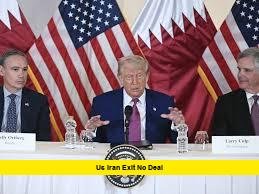

The phrase US Iran Exit No Deal is dominating global headlines as new developments reshape the conversation around U.S. foreign policy. After comments from Donald Trump suggesting that the United States could step away from tensions involving Iran without a formal agreement, attention has quickly shifted to one key question:
Why does America want to exit in the first place?
This question is now at the center of political discussions, economic concerns, and public debate worldwide.
What do you think—is this a smart strategic shift or a risky move? Keep reading and decide.
A Shift Toward “America First” Strategy
One of the strongest drivers behind the US Iran Exit No Deal approach is a renewed emphasis on prioritizing domestic interests over prolonged foreign engagement.
For Donald Trump, this reflects a consistent policy philosophy that has shaped his broader foreign agenda—reducing extended military commitments and redirecting focus toward economic growth, border security, and internal stability. The guiding belief is that American power should be used selectively, not indefinitely, especially in conflicts where clear, immediate gains have already been achieved.
At the heart of this strategy is a simple but impactful idea: once core U.S. objectives are fulfilled, staying longer does not necessarily create additional value. Instead, it can lead to rising costs, deeper entanglement, and unclear end goals. From this perspective, remaining in a conflict without a defined outcome is seen as inefficient and potentially counterproductive.
This marks a sharp departure from earlier U.S. foreign policy models, which often emphasized long-term presence to maintain global influence and prevent instability. Those approaches were built on the assumption that sustained engagement ensured leadership and control. However, the current shift questions whether continuous involvement is always worth the financial, political, and military investment.
The US Iran Exit No Deal direction reflects this evolving mindset. Rather than waiting for a formal agreement that could take months or even years to finalize, the focus is on acting decisively based on national priorities. It suggests a willingness to accept uncertainty in exchange for greater strategic flexibility.
Supporters of this approach argue that it brings clarity and discipline to U.S. foreign policy. They believe it prevents the country from becoming locked into open-ended commitments and forces a more results-driven evaluation of international involvement.
At the same time, it redefines how success is measured. Instead of long-term presence being seen as stability, success is framed as achieving objectives quickly and moving on. In this sense, exiting without a deal is positioned not as a withdrawal, but as a deliberate recalibration of priorities.
Ultimately, this strategy reflects a broader transformation in how the United States views its role in global conflicts—less as a constant enforcer of international order, and more as a selective participant guided by immediate national interest.
Reducing Military and Financial Burden
Another major factor behind the US Iran Exit No Deal approach is the growing concern over the cost of sustained military involvement. Maintaining a presence in volatile regions is not just a strategic decision—it is also a significant financial commitment that requires continuous deployment of troops, equipment, and logistical support.
For decades, the United States has taken on a leading role in securing key global hotspots, including areas tied to critical energy routes. This has involved naval patrols, defense infrastructure, and rapid-response capabilities designed to keep trade flowing and tensions contained. While these efforts have helped maintain stability, they have also come with a long-term financial and operational cost.
Under the policy direction associated with Donald Trump, there is a clear push to reassess whether such commitments remain necessary at the same scale. The argument is that extended deployments often stretch resources without delivering proportional benefits, especially when the direct impact on U.S. national security is limited.
From this perspective, moving toward an exit without a deal is seen as a way to reduce ongoing expenses and avoid being tied to an open-ended mission. It reflects a broader effort to prioritize efficiency—ensuring that military engagement is closely aligned with clearly defined goals rather than continuing out of habit or expectation.
There is also a strategic layer to this thinking. Reducing the burden allows the U.S. to reallocate resources to other priorities, whether domestic programs or emerging global challenges. Instead of maintaining a constant presence in one region, the focus shifts toward flexibility and readiness in multiple areas.
Supporters argue that this approach brings discipline to defense spending and prevents unnecessary strain on both the military and the economy. Critics, however, question whether reducing involvement could lead to instability that ultimately requires even greater intervention later.
In essence, the move reflects a calculation: that the cost of staying may outweigh the benefits, and that stepping back—at least in the short term—could be a more sustainable path forward.
Lower Dependence on Middle East Oil
Energy independence has become a key factor shaping the US Iran Exit No Deal approach. Over the past decade, the United States has significantly expanded its domestic energy production, changing how it views global oil dynamics and regional conflicts.
Today, the U.S. produces a substantial share of the oil it consumes, reducing its reliance on imports from the Middle East. This shift has altered long-standing strategic priorities that once tied U.S. foreign policy closely to protecting overseas energy supplies.
Routes like the Strait of Hormuz remain critically important for global markets, but they are no longer as vital to the U.S. economy as they once were. Many countries across Europe and Asia still depend heavily on oil passing through this narrow corridor, making them more vulnerable to disruptions.
Because of this changing landscape, policymakers in Washington are reassessing the level of involvement required in the region. If the direct economic impact on the United States is lower, the urgency to maintain a constant military presence also decreases.
This doesn’t mean the U.S. is unaffected—global oil prices still influence domestic markets—but the level of exposure is different. The country now has more flexibility to decide when and how to engage, rather than feeling obligated to remain deeply involved at all times.
Supporters of this shift argue that it reflects a modern, data-driven approach to foreign policy—one that aligns commitments with actual needs rather than historical patterns. Critics, however, caution that global energy markets remain interconnected, and reduced dependence does not eliminate broader economic consequences.
Ultimately, lower reliance on Middle Eastern oil is reshaping strategic thinking, giving the United States more room to step back and reconsider its role in regional conflicts.
Pushing Other Countries to Take Responsibility
Another key driver behind the US Iran Exit No Deal approach is the push for greater burden-sharing among nations that depend heavily on Middle Eastern energy.
Remarks from Donald Trump have underscored a broader message: countries that benefit most from oil flowing through the region should play a more active role in protecting it. For years, the United States has maintained a dominant security presence around critical trade routes like the Strait of Hormuz, ensuring stability not just for itself, but for the global economy.
This has led to growing frustration within parts of U.S. policymaking circles. The concern is that while many nations rely heavily on these routes—particularly in Europe and Asia—they contribute far less to the costs and risks involved in securing them.
From this perspective, the current approach is not just about withdrawal, but about recalibration. By signaling a potential exit without a deal, the U.S. is effectively sending a message: global benefits should come with shared responsibilities.
Supporters argue that this shift could encourage allies and partners to increase their involvement, whether through military contributions, financial support, or coordinated security efforts. It introduces a more balanced model, where no single country bears a disproportionate burden.
At the same time, this strategy carries broader implications. It challenges long-standing expectations of U.S. leadership and could reshape how international cooperation functions in high-risk regions.
Ultimately, the US Iran Exit No Deal stance reinforces a central idea—global systems work best when responsibility is distributed, not concentrated.
Avoiding Long and Uncertain Negotiations
Another important factor behind the US Iran Exit No Deal approach is the desire to avoid prolonged and uncertain diplomatic negotiations.
Traditional agreements—especially those involving complex geopolitical tensions—often take months or even years to finalize. They require multiple rounds of talks, compromises between opposing sides, and coordination among international stakeholders. In many cases, these negotiations can stall or fail altogether, leaving situations unresolved while tensions continue.
By signaling a willingness to exit without a formal deal, Donald Trump is emphasizing speed and decisiveness over extended diplomacy. The idea is to act based on current strategic goals rather than waiting for a perfect agreement that may never materialize.
This approach reflects a broader preference for direct action. Instead of being tied to lengthy processes, policymakers can move quickly, adapt to changing conditions, and avoid being locked into commitments shaped by negotiation compromises.
Supporters see this as a practical and results-driven method. They argue that in fast-moving situations, waiting for formal agreements can delay necessary decisions and increase risks. Acting sooner, even without a deal, is viewed as a way to maintain control and momentum.
However, critics warn that bypassing negotiations can create uncertainty. Without a structured agreement, there may be fewer guarantees about future stability, cooperation, or conflict resolution. Diplomatic deals often serve as frameworks that help prevent misunderstandings and provide clear expectations for all parties involved.
In this sense, the US Iran Exit No Deal strategy highlights a key trade-off: speed and flexibility versus predictability and long-term assurance.
Why This Topic Is Trending Right Now
The surge in attention around the US Iran Exit No Deal narrative is closely tied to the current phase of heightened tensions in the region, particularly involving Israel and Iran.
Moments like these tend to amplify global sensitivity. Any signal of a shift in U.S. strategy—especially one as significant as exiting without a formal agreement—immediately sends ripples through financial markets, diplomatic circles, and public discourse. Governments begin reassessing alliances, analysts revisit risk forecasts, and investors react to uncertainty.
What makes this situation especially viral is the unpredictability attached to it. A traditional exit backed by a negotiated deal usually provides a roadmap for what comes next. In contrast, the idea of leaving without that framework raises open-ended questions about stability, security, and future relations.
The involvement of critical factors like regional conflict dynamics and global energy flows only adds to the intensity. Even subtle policy signals can influence oil prices, trade expectations, and geopolitical strategies.
As a result, the topic has quickly gained traction across news platforms and social media, not just because of what is happening—but because of what might happen next.
A Divided Global Reaction
Reactions remain mixed.
Some believe the move reflects a realistic adjustment to changing global conditions. Others worry it could increase instability and create new risks.
The divide shows just how complex the issue is—and why it continues to dominate headlines.
What do you think—are these reasons enough for the U.S. to exit without a deal, or should it stay engaged longer? Share your opinion and follow the story as it unfolds.