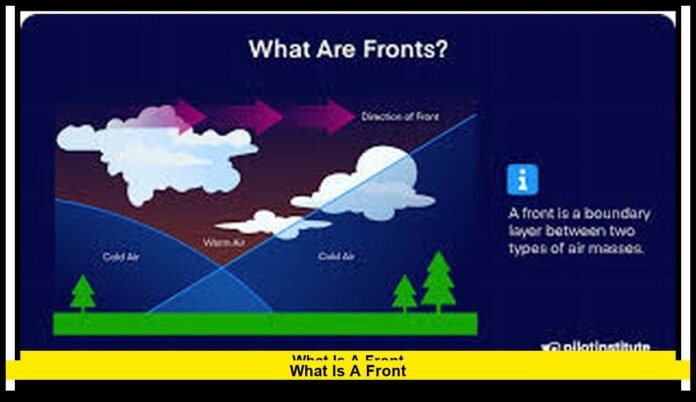

What is a front is a question many Americans search when they encounter the term in weather alerts, federal investigations, technology coverage, and political reporting. As of 2026, the word appears daily across U.S. news cycles because it describes boundaries, public-facing operations, and visible layers that represent deeper systems.
Understanding the term helps readers interpret headlines accurately. Context determines meaning, and each industry uses the word with a precise definition.
Core Definition of a Front
A front refers to a boundary, outward position, visible layer, or public representation of something larger behind it.
The definition remains consistent across fields:
- A boundary between forces or conditions
- The visible part of a system
- An organization representing another entity
- A cover used to conceal activity
- A public image presented to others
Because these meanings overlap, readers often search for clarification when the term appears in breaking news.
What Is a Front in Weather Reporting
Weather coverage provides the most widely recognized meaning.
A weather front forms when two air masses with different temperature, pressure, or humidity meet. These boundaries drive many major weather events across the United States.
Meteorologists track fronts closely because they signal rapid atmospheric change.
Primary Types of Weather Fronts
Cold Front
Cold air moves under warm air. This often triggers thunderstorms, heavy rain, gusty winds, and sharp temperature drops.
Warm Front
Warm air rises over colder air. This pattern usually produces steady precipitation, fog, and gradual warming.
Stationary Front
Neither air mass moves significantly. Clouds and rain can linger for days.
Occluded Front
A cold front overtakes a warm front. This complex system often creates widespread precipitation and unstable weather.
Weather alerts issued by the National Weather Service frequently mention approaching fronts, especially during severe storm seasons.
Why Weather Fronts Matter to Americans
Fronts influence daily life across the country.
They affect:
- Storm development
- Snowfall timing
- Flood risk
- Temperature swings
- Tornado potential
- Heat wave endings
Seasonal transitions often occur along major fronts. This explains why forecasts highlight them prominently.
During winter, strong cold fronts can trigger rapid freezes. In spring and summer, fronts help spark severe thunderstorms.
What Is a Front in Law Enforcement and Crime News
In criminal investigations, a front describes a business or organization that appears legitimate while concealing illegal activity.
This definition appears frequently in federal indictments, financial crime reporting, and major enforcement announcements.
Common Examples of Front Operations
- Retail businesses masking money laundering
- Shell companies hiding ownership structures
- Logistics companies used for illegal distribution
- Online platforms disguising fraud schemes
- Consulting firms used to route payments
Authorities often uncover these operations through financial tracking, regulatory reviews, and whistleblower disclosures.
This usage keeps the term visible in national headlines.
How Investigators Identify Front Businesses
Law enforcement examines patterns that suggest concealment.
Key indicators include:
- Unusual financial flows
- Lack of real customers
- Shared ownership across multiple companies
- Inconsistent business activity
- Payments unrelated to stated services
Financial transparency laws and reporting requirements play a major role in detecting front structures.
What Is a Front in Business and Corporate Coverage
In legitimate business reporting, a front describes the customer-facing side of an organization.
Companies separate internal infrastructure from public interaction. The visible layer functions as the front.
Examples include:
- Retail storefronts representing national brands
- Customer support channels interacting with users
- Marketing websites presenting products
- Brand divisions serving as public representatives
This meaning carries no negative implication. It reflects organizational structure.
The Role of Front-Facing Operations in Modern Companies
Large organizations rely heavily on front-facing systems.
These systems:
- Shape customer perception
- Deliver services
- Handle communication
- Collect feedback
- Represent brand identity
Corporate news often focuses on improvements to these areas because they directly affect users.
Front End vs Back End in Technology
Technology reporting uses the term constantly.
Front end refers to the user interface — everything people see and interact with. Back end refers to servers, databases, and underlying infrastructure.
This distinction is fundamental in software development.
Front End Includes
- Website design
- Mobile app interfaces
- Dashboards
- Navigation systems
- Accessibility features
Back End Includes
- Data processing
- APIs
- Storage systems
- Authentication
- Infrastructure management
Tech companies frequently announce front-end redesigns, making this meaning highly visible in U.S. technology news.
Why Front End Development Matters in 2026
Digital experience drives competition.
Companies prioritize:
- Faster interfaces
- AI-powered user experiences
- Accessibility compliance
- Mobile optimization
- Simpler navigation
Product announcements often highlight front-end changes first because users notice them immediately.
What Is a Front in Military and Defense Reporting
Military coverage uses the word to describe active operational lines.
A front indicates where opposing forces meet or where military activity concentrates.
Military Usage Includes
- Front line positions
- Regional fronts within larger conflicts
- Multi-front operations
- Defensive fronts
- Strategic fronts
Defense briefings and geopolitical analysis rely on this terminology to explain conflict dynamics.
How Military Analysts Use the Term
Analysts map fronts to understand:
- Territorial changes
- Force movement
- Supply routes
- Escalation risk
- Strategic priorities
This meaning appears frequently in international news coverage consumed by U.S. audiences.
What Is a Front in Political Reporting
Politics uses the term to describe coalitions, advocacy organizations, or public-facing entities representing broader interests.
The word appears in election coverage, policy debates, and campaign strategy reporting.
Political Usage Examples
- Advocacy alliances formed around a policy issue
- Campaign organizations acting as messaging platforms
- Coalitions representing multiple groups
- Organizations described as representing undisclosed backers
Political reporting uses this terminology when discussing influence, organization, and strategy.
Public Image and Communication Fronts
Political strategy depends heavily on public presentation.
Front-facing organizations often handle:
- Messaging
- Media outreach
- Voter engagement
- Issue campaigns
- Public events
This reinforces the broader meaning of a front as a visible layer representing something larger.
What Is a Front in Everyday Communication
In everyday conversation, Americans use the word to describe behavior or image.
Someone may present confidence while feeling uncertain. That outward persona functions as a front.
Common Everyday Uses
- Maintaining professionalism during stress
- Hiding emotions
- Presenting a curated social media image
- Acting composed in public situations
Lifestyle and psychology content often discusses this meaning.
Why the Term Trends in Search
Several factors keep the keyword highly searched.
- Severe weather alerts mention cold fronts regularly
- Financial crime coverage references front businesses
- Technology reporting highlights front-end updates
- Political coverage discusses organizational fronts
- Social media conversations focus on authenticity
Because the word spans many categories, search interest remains consistent.
Context Determines Meaning
Readers must identify context quickly.
| Area | Meaning |
|---|---|
| Weather | Boundary between air masses |
| Crime | Cover for illegal activity |
| Business | Public-facing operations |
| Technology | User interface layer |
| Military | Operational conflict line |
| Social | Outward persona |
Headlines often rely on context clues rather than definitions.
Common Misconceptions
Misunderstandings appear frequently in search behavior.
Misconception: The term always implies illegality.
Reality: Many uses are neutral.
Misconception: It only relates to weather.
Reality: Technology usage rivals weather in frequency.
Misconception: Political usage automatically suggests wrongdoing.
Reality: It often refers to coalition structure.
Clarifying these points improves media literacy.
How Different Industries Standardize the Term
Each field applies precise definitions.
- Meteorology defines atmospheric boundaries
- Law enforcement uses legal definitions tied to concealment
- Software development defines interface architecture
- Military analysis maps operational zones
- Communications professionals describe public representation
Despite differences, the central idea remains consistent: visibility versus underlying structure.
Language Evolution and Modern Media
The word has gained broader relevance due to structural complexity in modern systems.
Several trends contributed:
- Growth of digital platforms
- Increased financial transparency enforcement
- Expansion of coalition-based politics
- Global conflict coverage
- Social media focus on identity and image
As systems become layered, language describing visible layers becomes more important.
Why Understanding This Term Matters
Clarity improves how readers interpret news.
Benefits include:
- Faster understanding of severe weather coverage
- Better interpretation of federal investigations
- Stronger digital literacy
- Clearer understanding of geopolitical reporting
- Greater awareness of communication strategy
The word appears across multiple news categories daily.
Real-World Examples of Usage in Headlines
Readers encounter the term frequently.
Examples of typical headline structures include:
- Cold front bringing storms across regions
- Company accused of operating as a front
- Major app launches front-end redesign
- New coalition forms political front
- Fighting intensifies along eastern front
Each headline reflects a different meaning.
The Relationship Between Visibility and Structure
The concept behind the term centers on visibility.
A front represents what audiences see first. Behind it lies infrastructure, strategy, organization, or reality.
This applies to:
- Weather systems
- Corporations
- Software platforms
- Governments
- Human behavior
Understanding this relationship helps readers decode complex systems.
Key Takeaways
- A front represents a visible layer, boundary, or outward representation
- Weather usage remains the most familiar in U.S. reporting
- Law enforcement uses the term when describing concealment structures
- Business and technology use it to describe customer-facing layers
- Military reporting applies it to operational lines
- Everyday language uses it to describe public image
Context always determines meaning.
Language shapes how people understand headlines — when you see the word front in the news, what meaning comes to mind first? Share your thoughts and stay updated for more clear explainers.