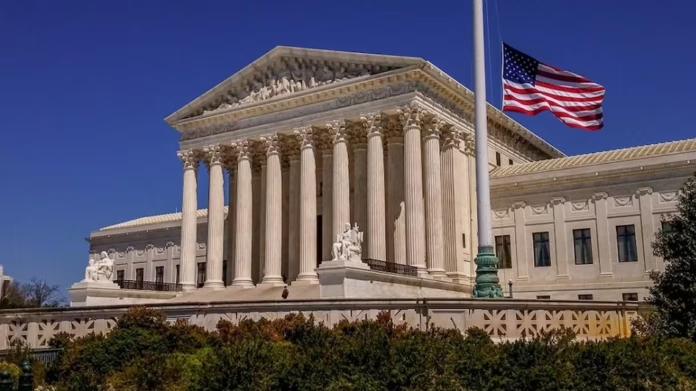

In a seismic decision handed down this morning, February 20, 2026, the Supreme Court tariff ruling in Learning Resources, Inc. v. Trump dealt a major blow to President Donald Trump’s signature economic policy, striking down most of his sweeping global tariffs and ruling that the president overstepped his authority when using a 1977 emergency law to impose them. The decision rattled Washington, sent ripples through financial markets, and ignited an urgent national debate over the future of U.S. trade, presidential power, and the cost of living for millions of American families.
The ruling is one of the most consequential the Court has issued in decades — not just for what it says about tariffs, but for what it means about the limits of presidential authority over the economy. For anyone who pays for groceries, electronics, clothing, or virtually any imported good, this decision has your name on it.
You’ve been paying for these tariffs at the checkout line. Now the highest court in the country has weighed in — here’s everything you need to know.
What the Court Actually Decided
The justices ruled that Trump exceeded his authority when he used the International Emergency Economic Powers Act — known as IEEPA — to impose tariffs on imports from virtually every U.S. trading partner. IEEPA, a law passed in 1977, allows a president to take sweeping economic action during a declared national emergency, but no president had ever used it to levy tariffs before Trump did in 2025.
The ruling does not wipe out every tariff Trump has imposed. Some duties, including those placed on specific goods under other legal authorities like Section 232 of the Trade Expansion Act of 1962 and Section 301 of the Trade Act of 1974, remain in place. But the IEEPA-based tariffs — which formed the backbone of Trump’s “Liberation Day” trade blitz in April 2025 — are now invalid.
Those invalidated tariffs include the 10% baseline levy that Trump slapped on virtually all U.S. trading partners on so-called Liberation Day, higher “reciprocal” tariffs targeting dozens of nations, and the emergency tariffs imposed on Canada, China, and Mexico that Trump justified as a response to fentanyl trafficking.
Chief Justice John Roberts had telegraphed skepticism during oral arguments in November 2025, noting that imposing taxes on Americans has always been a core power of Congress, not the executive branch. The final ruling affirmed that position in unambiguous terms.
The Numbers Behind the Decision
The financial scale of this supreme court tariff ruling is staggering. U.S. Customs and Border Protection collected approximately $133.5 billion in IEEPA-based tariff revenue between when Trump began imposing the duties in February 2025 and mid-December 2025. That figure represents roughly 60% of all tariff revenue collected during that period, according to an analysis of federal data.
Penn-Wharton Budget Model economists, using a ground-up forecasting model that tracks tariff rates across more than 11,000 product categories in 233 countries, estimated that about $175 billion in collected tariff revenue — approximately $500 million per day — is now at risk of being refunded to importers. That amount exceeds the combined annual budgets of the Department of Transportation and the Department of Justice in fiscal year 2025.
For American families, the stakes are equally personal. The average effective tariff rate had climbed to nearly 17%, the highest since the early 1930s. Economists at the Tax Policy Center estimated that if the IEEPA tariffs are struck down and not replaced, households would save an average of $1,200 in 2026, with total household tax burdens falling by an estimated $1.4 trillion over the next decade. The New York Federal Reserve Bank calculated that American households and businesses absorbed roughly 90% of the cost of the tariffs in the form of higher prices.
What Happens to the Money Already Collected?
One of the thorniest questions now facing Washington is what happens to the billions already paid. Importers who paid IEEPA tariffs may be entitled to refunds through the Court of International Trade, which has jurisdiction over such claims and a two-year statute of limitations. Thousands of companies had already been positioning themselves for this possibility, and logistics experts expect a rush of refund filings in the days and weeks ahead.
Trump himself had warned last year that a ruling against him would create a “complete mess” in terms of paying back companies. Treasury Secretary Scott Bessent said as recently as January that the Treasury could handle any refunds and remained confident the Court would side with the administration. That confidence was misplaced.
The administration has already signaled it will move quickly to replace the invalidated tariffs using other legal tools — specifically Section 232 and Section 301 — to get to what officials describe as the “same place” on trade policy. But both those authorities are slower-moving, more cumbersome processes, as Trump himself acknowledged. The president had repeatedly urged the Court to preserve the IEEPA framework precisely to avoid that complication.
The Political Fallout
Today’s decision marks a rare public rebuke of Trump by the high court. Over the past year, the justices largely sided with the administration on a string of emergency rulings covering immigration, military policy, and executive authority. The tariff case is different. It touches the Constitution’s foundational principle that taxing Americans is Congress’s job, a point that resonated across the Court’s ideological spectrum.
The ruling adds fuel to a growing fire of Republican unease about Trump’s tariff agenda. Just last week, six House Republicans crossed party lines in a 219-211 vote to pass a resolution overturning Trump’s emergency declaration justifying his 35% tariffs on Canadian goods — the first such bipartisan rebuke from the chamber. Three other Republicans had earlier joined Democrats to block a procedural rule shielding that resolution from a floor vote.
Speaker Mike Johnson had called that House vote a “fruitless exercise” because Trump could simply veto it, but that calculation now looks very different in light of today’s ruling. Democrats, led by House Minority Leader Hakeem Jeffries, had already vowed to keep forcing votes on tariff-related measures to pressure vulnerable Republicans ahead of the 2026 midterm elections.
What This Means for Global Trade
The ramifications of the ruling extend well beyond U.S. borders. Trump’s tariff regime had been central to trade negotiations and bilateral frameworks with dozens of nations throughout 2025. Countries that signed deals or made concessions under the shadow of IEEPA tariffs now face a dramatically different environment.
Global supply chains, which had been adapting to the tariff reality for nearly a year, now face fresh uncertainty. Logistics experts noted this week that the Supreme Court decision arrives during a particularly sensitive moment for supply chain planning, with Lunar New Year factory shutdowns just winding down in China and spring and summer inventory orders being placed by U.S. retailers right now.
Some freight analysts predicted a surge in import orders if companies feel newly confident about their cost structure and choose to build inventory ahead of any revised tariff framework. Others were more measured, noting that alternative tariffs — those not based on IEEPA — remain in place and will likely still shape trade volumes.
The Bigger Constitutional Picture
Beyond tariffs and trade, today’s decision draws a line in the constitutional sand around executive power. The Trump administration had argued that IEEPA’s authority to “regulate importation” during a national emergency included the power to impose tariffs. The Court rejected that reading.
Legal analysts had long compared this case to the 1952 Youngstown case, in which the Supreme Court struck down President Harry Truman’s attempt to nationalize U.S. steel mills during the Korean War. That decision became the cornerstone of modern presidential power doctrine. Today’s ruling may carry similar historical weight, establishing the principle that emergency economic powers — however broadly written — do not extend to tariff authority that the Constitution assigns to Congress.
The decision is also significant because it signals the Court’s willingness to apply the major questions doctrine, which holds that Congress must speak clearly when delegating sweeping authority to the executive branch. The word “tariff” does not appear anywhere in IEEPA, a fact that Justice Elena Kagan highlighted bluntly during oral arguments: the statute, she noted, listed many actions available to the president, just not the specific one the administration was seeking.
What Comes Next
The Trump administration has promised to move rapidly. Officials say a plan to reimpose tariffs using alternative legal authorities is ready to go, though how long that process takes in practice remains to be seen. Markets are watching closely. Financial analysts had predicted potential S&P 500 swings of 1% to 2% depending on the ruling’s specifics and any refund mandate.
Congress faces a moment of decision as well. Lawmakers could choose to explicitly authorize presidential tariff powers through legislation — effectively giving Trump or any future president the authority the Court just said IEEPA does not provide. Whether such legislation could pass a divided Congress is deeply uncertain.
For American consumers and businesses, the immediate picture is mixed. Some relief may come in the form of lower prices on goods that were heavily affected by IEEPA-specific tariffs, but the administration’s commitment to tariffs as a policy tool means the overall trade landscape will remain unsettled for months.
Bold statement pending from the White House is expected shortly, and the economic ripple effects are only beginning — share your reaction in the comments and stay close to this story as it develops.