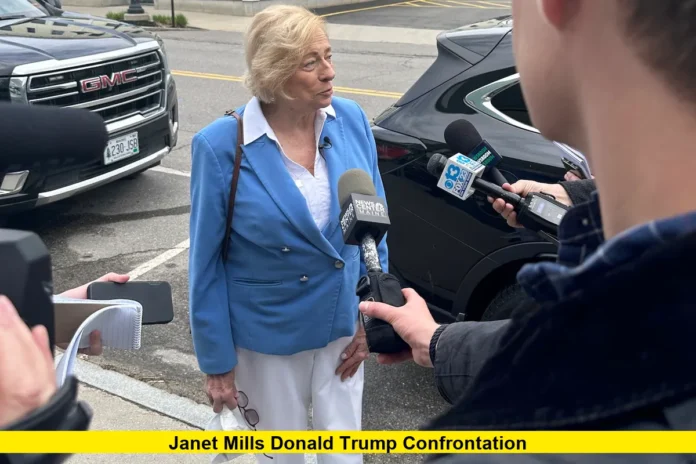

How a Maine Governor’s Four Words — “See You in Court” — Sparked a National Showdown Over States’ Rights, Transgender Athletes, and Federal Power
The White House Moment That Defined a Movement
It was a room full of the nation’s governors, and President Donald Trump was well into a campaign-style address when he stopped, scanned the crowd, and asked a pointed question: “Is Maine here? The governor of Maine?”
“Yeah,” Gov. Janet Mills answered. “I’m here.”
What followed was one of the most dramatic political confrontations in recent American memory — a brief, electric exchange that instantly became a rallying cry for Democratic governors, civil liberties advocates, and anyone watching the widening battle between state and federal authority.
Trump threatened to cut all federal funding to Maine unless the state fell in line with his executive order. Mills replied with four calm, firm words: “We’ll see you in court.”
Trump fired back: “Enjoy your life after governor, because I don’t think you’ll be an elected official afterwards.”
Those four words — See you in court — did not stay in that dining room. They traveled across the internet, social media, and cable news at lightning speed, turning a Democratic governor from a small northeastern state into a national symbol of defiance against executive overreach.
Who Is Janet Mills?
Janet Mills is not a politician who backs down. A former Maine Attorney General with decades of legal and political experience, she has built a reputation as a measured, law-first executive — one who picks her battles carefully but never retreats once cornered.
Mills was not looking for this fight. By most accounts, she had been taking a wait-and-see approach to the second Trump term, avoiding the public shows of defiance organized by some other Democratic governors. But when Trump called her out personally and publicly, backing down was simply not in her character.
Political observers who have followed her career for years were not surprised. At a 2022 gubernatorial debate, Mills put it plainly: “I’ve spent the better part of my career listening to loud men talk tough to disguise their weaknesses.” Facing the most powerful man in the country at the White House, she proved those were not empty words.
What Started the Fight: Transgender Athletes and a Viral Video
The roots of the Mills–Trump confrontation trace back to a February executive order and a social media post that went viral.
Trump signed an executive order banning transgender athletes from competing in women’s and girls’ sports and threatening to cut federal funding to schools that did not comply. When the Maine Principals Association, which governs school athletics in the state, announced it would continue to follow Maine’s state law — which includes gender identity as a protected class — rather than the executive order, a collision became inevitable.
A video of a transgender youth winning a track meet in Maine spread rapidly online, further inflaming the issue. By the time governors gathered at the White House, Trump was already publicly targeting Maine. During his remarks, he turned to Mills directly and asked whether the state planned to comply with his directive.
Mills replied that Maine would follow the law — state and federal. Trump’s response was blunt: “Well, we are the federal law. You better comply, because you’re not going to get any federal funding at all if you don’t.”
Mills later compared Trump’s claim to be the law to the behavior of French King Louis XIV — the monarch famous for declaring, “I am the state.” She argued: “You can’t create laws by thinking them, by tweeting them, by issuing press releases, or by issuing executive orders. Congress makes the laws. The executive branch executes them faithfully.”
The Federal Response: Investigations, Funding Freezes, and Threats
The Trump administration moved aggressively within minutes of the confrontation ending.
The U.S. Department of Education’s civil rights division launched a Title IX investigation into the Maine Department of Education and a local school district. The U.S. Department of Health and Human Services followed with its own Title IX probe. Both investigations were launched with extraordinary speed, with Mills calling the outcomes “all but predetermined.”
Then came the money.
Agriculture Secretary Brooke Rollins sent a letter to Mills informing her that USDA funding for certain administrative and school functions would be frozen, warning that “your defiance of federal law has cost your state” — and that this was “only the beginning.” Mills said some described the letter as a ransom note. Maine’s Attorney General Aaron Frey was equally blunt, writing that it sounded “more like a hostage taker seeking a ransom payment than a cabinet-level federal official.”
The pressure kept mounting. The Department of Justice eventually sued the state, seeking to claw back over $864 million in federal dollars after Maine refused to sign the Education Department’s compliance agreement.
Mills Fires Back — and Refuses to Apologize
As the pressure mounted, Trump demanded public contrition, posting on social media that he needed “a full throated apology from the Governor herself” before the matter could be settled.
He did not get one.
Mills responded publicly — not with an apology, but with a counter-offensive. She challenged Trump’s claim to be defending women and girls, pointing to his administration’s decisions to eliminate foreign aid, cut Medicaid, attack Social Security, and impose tariffs that would drive up prices for everyday Americans. She added that if the president truly cared about women and girls, he should speak about children dying in Sudan and other countries because his administration had cut off their food and medicine.
The governor had remained largely quiet in the weeks after the confrontation, granting no extended interviews and making few public appearances. But when she did speak, she did not waver.
Maine Takes It to Court — and Wins
Mills had promised the president she would see him in court. She kept that promise.
Maine Attorney General Aaron Frey filed a lawsuit against the USDA in federal court, arguing that the agency had not followed the legally required procedures before freezing funds — including conducting its own investigation, notifying the state, or reporting findings to Congress. He noted that despite Rollins’ assurance that food programs for children would not be touched, Maine’s Child Nutrition Program lost access to federal funding the very next day.
A federal judge sided with Maine, granting a temporary restraining order and requiring the Trump administration to immediately unfreeze the funds. The ruling marked Maine’s first significant legal victory in the dispute.
Shortly after, the two sides reached a full settlement. The USDA agreed to stop interfering with Maine’s access to federal funding over alleged Title IX violations without first following all legally required procedures. Maine dismissed its lawsuit.
At a press conference, Mills was direct: “I told him I’d see him in court. Well, we did see him in court, and we won.”
The Bigger Picture: States’ Rights vs. Presidential Power
From the very beginning, Mills insisted this fight was about something far larger than school sports.
“Do not be misled,” she said in a statement. “This is not just about who can compete on the athletic field. This is about whether a President can force compliance with his will, without regard for the rule of law that governs our nation.”
That question has yet to be fully resolved by the courts. Whether a president can unilaterally withhold congressionally appropriated funds from a state over a political dispute remains legally contested — and the answer will affect not just Maine, but every state that finds itself at odds with federal executive priorities.
Attorney General Frey made clear: “It is disturbing that President Trump would use children as pawns in advancing his political agenda.”
Maine’s Republican critics, meanwhile, argued that Mills had put hundreds of millions in federal aid at risk over a policy affecting only a tiny number of students — a framing Mills consistently rejected, calling it a fundamental question of constitutional governance.
Why This Story Still Matters
The Mills–Trump confrontation is not a closed chapter. It is a live preview of what state-federal relations may look like when executive power is pushed to its limits.
The Trump administration signaled that Maine was not its only target, with senior officials warning that California, Minnesota, and other states faced similar consequences for policies the administration considered violations of federal civil rights law.
For now, Maine’s legal victories have offered a template for resistance: move quickly, document procedural violations, and challenge unlawful executive action in court. Whether other states follow that model — and whether courts continue to push back — will help determine the shape of American governance in the years ahead.
Janet Mills walked into a White House dining room as the Democratic governor of a small New England state and walked out as a defining figure in a national debate over power, law, and who, ultimately, gets to decide what the law means.
Four words. One moment. A case that may rewrite the boundaries of federal authority for a generation.