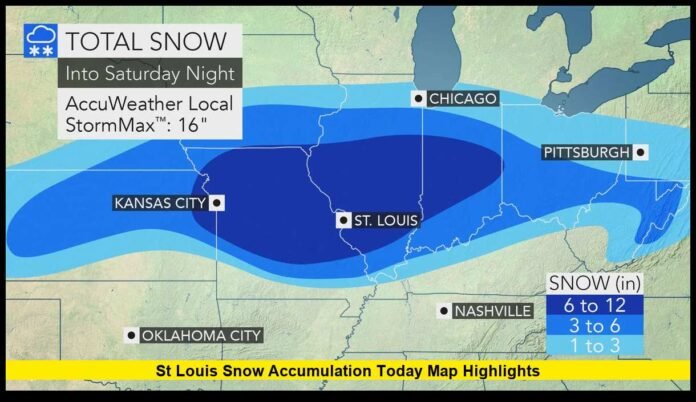

St Louis snow accumulation today map information is a key reference for residents monitoring real-time winter conditions across the metro area. As of today, the map reflects confirmed snowfall already on the ground, based on verified measurements collected throughout the day. It offers a clear picture of how snow coverage varies across the city, surrounding suburbs, and nearby counties.
Snowfall in the St. Louis region often develops unevenly. A detailed accumulation map helps residents understand where snow has settled, where melting has occurred, and which areas continue to see winter impacts. This information supports safer travel decisions and daily planning during active winter weather.
What the St Louis Snow Accumulation Today Map Represents
The St Louis snow accumulation today map represents a real-time snapshot of winter conditions across the region by showing how much snow is currently on the ground. It is designed to reflect what has already occurred rather than what may happen later. By focusing only on observed snowfall totals, the map provides a factual view of current conditions without projecting future changes.
This map helps users understand how snow coverage varies from one location to another. Snow rarely settles evenly across the St. Louis area, and the map captures those differences with clear visual detail. Each update incorporates the latest verified measurements available at that moment.
The map visually highlights several key elements that are important for daily awareness:
- Areas with measurable snow depth: These sections indicate where snow has accumulated enough to cover surfaces and potentially affect travel or outdoor activity.
- Zones with little or no accumulation: Some neighborhoods may show minimal snow due to warmer ground temperatures, faster melting, or lighter snowfall.
- Gradual changes in snow totals across short distances: The map often shows smooth transitions rather than sharp boundaries, reflecting how snowfall can vary block by block.
- Regions affected by melting or compaction: Areas where snow has begun to melt or has been packed down by traffic may display reduced accumulation compared to earlier updates.
Each update to the St Louis snow accumulation today map is based on confirmed data. As conditions evolve, totals may increase, decrease, or remain steady depending on snowfall, melting, or compaction. These adjustments ensure the map continues to represent current ground conditions as accurately as possible throughout the day.
How Snow Accumulation Is Measured
Snow accumulation shown on the map is calculated using several verified observation methods working together to reflect real conditions on the ground. No single tool can capture snowfall accurately across an entire region, especially in an area as varied as the St. Louis metro. Combining multiple data sources helps reduce gaps and improves overall reliability.
One key input comes from automated weather stations placed throughout the region. These stations continuously measure snow depth, temperature, and surface conditions. Because they operate around the clock, they provide timely updates as snowfall begins, increases, or starts to melt.
Another important source is trained observers who manually record snowfall totals at specific locations. These observers follow standardized measurement procedures to ensure consistency. Their reports are especially valuable in areas where automated sensors are limited or where localized snowfall differs from nearby locations.
Radar-based snowfall estimates also play a role. Weather radar tracks precipitation intensity and coverage, which helps identify where snow is falling and how widespread it is. These radar estimates are adjusted using ground-based measurements to better match actual accumulation, since radar alone cannot determine how much snow remains on the surface.
In addition, surface sensors help detect changes in accumulation and melting. These sensors monitor surface temperature and moisture, which helps explain why snow may accumulate in one area while melting in another. This data is especially useful during marginal temperature conditions.
Before any information appears on the map, all incoming data is carefully reviewed for accuracy and consistency. Measurements are compared across nearby locations, and adjustments are made when needed to reflect realistic patterns. This review process helps ensure the snow accumulation map remains dependable, current, and representative of actual ground conditions.
Why Snow Totals Differ Across the St. Louis Area
Snowfall rarely accumulates evenly across the St. Louis region. Even small variations in temperature or precipitation intensity can lead to noticeable differences.
Several factors influence how much snow remains on the ground:
- Pavement temperature during snowfall
- Timing of snowfall bands
- Wind direction and strength
- Urban heat retention in developed areas
These factors explain why one neighborhood may show measurable accumulation while another nearby area shows minimal coverage.
Urban Snow Accumulation Patterns
In the city of St. Louis and other dense urban areas, snow accumulation often appears lighter on maps. Roads, sidewalks, and buildings retain heat, which can limit how much snow stays on the ground.
Urban patterns often include:
- Faster melting on pavement
- Patchy coverage near major roads
- Lower totals compared to surrounding suburbs
Despite lower accumulation, slick spots can still develop, especially during colder periods.
Suburban and Outlying Area Snow Coverage
Suburban neighborhoods and less developed areas often show higher accumulation on the St Louis snow accumulation today map. Grass, soil, and open land allow snow to settle and remain longer.
These areas may experience:
- More uniform snow cover
- Slower melting during daylight
- Higher accumulation totals compared to the city
This contrast is common during winter weather events and is clearly reflected on updated maps.
Update Frequency and Timing
The St Louis snow accumulation today map is updated multiple times throughout the day as new measurements are confirmed. During active snowfall, updates may occur more frequently to reflect rapid changes.
Updates may follow:
- New snowfall reports
- Confirmation of melting or compaction
- Adjustments based on refined measurements
As snowfall ends or temperatures rise, updates may focus more on remaining snow cover rather than new accumulation.
Understanding Map Colors and Gradients
Accumulation maps use color shading to represent different snow depths. Lighter shades usually indicate minimal snow, while darker shades reflect higher totals.
Important details to note:
- Colors represent snow depth, not ice
- Boundaries between colors may shift slightly
- Small adjustments can occur with each update
Reading the color scale helps users interpret the map more accurately.
Impact on Daily Travel and Mobility
ThThe St Louis snow accumulation today map plays a critical role in daily travel and overall mobility across the region. Snow depth on roadways, sidewalks, and parking areas directly influences how safely people can move through the city and surrounding suburbs. Even small amounts of snow can reduce tire grip, lengthen braking distance, and increase the risk of slips and falls for pedestrians.
Because conditions can vary widely from one neighborhood to another, residents rely on the map to understand where snow remains on the ground and where melting has already occurred. This awareness helps drivers and pedestrians prepare for real-world conditions rather than relying on assumptions.
Residents commonly use the map to:
- Identify areas with lingering snow: Some neighborhoods, shaded streets, or less-traveled roads may retain snow longer than main routes.
- Plan safer travel routes: Drivers can choose roads that show lower accumulation, reducing exposure to slick surfaces.
- Adjust departure times: Knowing where snow remains allows commuters to leave earlier or delay travel until conditions improve.
- Anticipate slower driving conditions: Snow-covered areas often require reduced speeds and increased following distance.
Even light accumulation can create hazardous conditions when temperatures drop, especially during early morning or overnight hours. Snow that partially melts during the day may refreeze, leading to slick spots that are not always visible. By regularly checking the St Louis snow accumulation today map, residents can make informed decisions that support safer travel, reduce delays, and lower the risk of weather-related incidents.
Snow Accumulation vs. Snowfall Rate
Accumulation maps focus on what remains on the ground, not how quickly snow is falling. Snowfall rate and accumulation are related but not the same.
Accumulation may change due to:
- Melting from warmer surfaces
- Compression from vehicle traffic
- Wind drifting snow into or out of areas
This explains why accumulation totals can decrease even without new precipitation.
Role of Melting and Refreezing
Melting plays a major role in how accumulation appears on the map. Daytime temperatures, sunlight, and surface warmth can reduce snow cover quickly.
Refreezing may also occur when temperatures drop, which can create icy conditions even if accumulation totals decrease. The map reflects remaining snow but does not indicate surface slickness.
Regional View Beyond City Limits
The St Louis snow accumulation today map often includes surrounding counties in Missouri and Illinois. This broader coverage helps users understand regional patterns rather than isolated conditions.
Nearby areas may show:
- Heavier or lighter accumulation
- Slower melting trends
- Different timing of snowfall
Viewing the full regional map offers better context for travel and planning.
Why Accurate Accumulation Data Matters
Accurate snow accumulation reporting supports public safety and informed decision-making. Incorrect totals can lead to underestimating road hazards or unnecessary travel.
Reliable data helps:
- Drivers prepare for winter conditions
- Employers assess travel safety
- Residents plan daily activities
Accuracy remains essential during all winter weather events.
Limitations of Snow Accumulation Maps
Snow accumulation maps are an important tool for understanding winter conditions, but they do have practical limits. While they provide a reliable overview of how much snow is on the ground, they cannot capture every change the moment it happens. Conditions on the ground can shift faster than updates can be processed, especially during active winter weather.
Rapid snowfall can increase accumulation in a short time, while sudden warming can cause quick melting. In both cases, the map may not immediately reflect these changes. Short delays are more likely during heavy snow bursts, temperature swings near freezing, or periods of strong sunlight that accelerate melting.
Additional factors can affect how accurately maps represent conditions at any given moment:
- Snow compaction from traffic can reduce visible depth
- Wind can drift snow unevenly across neighborhoods
- Shaded areas may retain snow longer than open spaces
- Pavement can clear faster than grassy surfaces
Because snow behavior varies by surface and location, accumulation values are often averages rather than exact measurements for every street or block.
Despite these limits, snow accumulation maps remain one of the most dependable ways to track current snow coverage across a large area. They provide consistent, verified information that helps residents understand broader patterns, even if minor changes occur between updates. When used alongside local observations and caution during travel, these maps offer valuable support for winter awareness and planning.
Public Use of Snow Accumulation Maps
Snow maps have become widely used because they provide quick, visual clarity. Residents can see conditions at a glance without needing technical weather knowledge.
In St. Louis, where winter weather can change block by block, this visual approach is especially helpful.
Staying Aware Throughout the Day
Snow conditions do not remain static. Melting, refreezing, and clearing can alter conditions even after snowfall ends.
Checking the St Louis snow accumulation today map periodically allows residents to stay aware of changes throughout the day and evening.
Winter Awareness and Preparedness
Understanding current snow accumulation helps residents prepare for short trips, longer commutes, and outdoor activities. Awareness reduces risk and supports safer choices.
Snow maps complement other winter safety measures by showing what is already on the ground.
Final Perspective for St. Louis Residents
The St Louis snow accumulation today map provides a factual snapshot of current winter conditions across the region. It reflects confirmed snowfall totals and remaining snow cover, updated as conditions change.
Using this information helps residents navigate winter weather with greater confidence and awareness.
Stay alert to St Louis snow accumulation today map updates and share local observations as winter conditions continue to evolve.