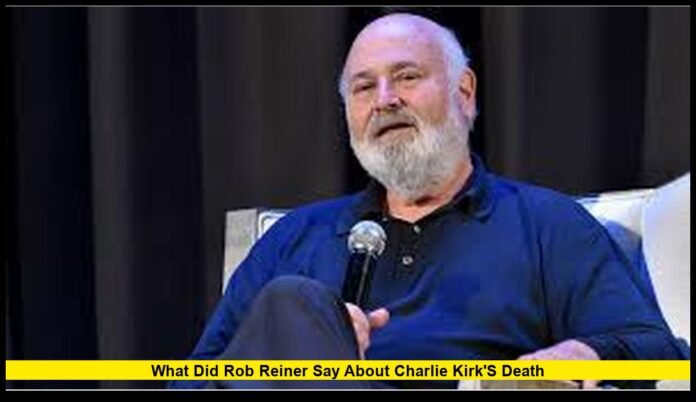

What did Rob Reiner say about Charlie Kirk’s death became a trending question across the United States after online misinformation and violent political rhetoric sparked confusion about comments made by the outspoken filmmaker. The interest did not stem from an actual death but from Rob Reiner’s public condemnation of political violence and the dangerous normalization of death-related language directed at ideological opponents. His remarks, taken out of context online, fueled widespread misunderstanding and renewed debate about responsibility in political speech.
How the Question Emerged in National Conversation
The rise of this question reflects a larger issue in American political discourse. In 2025, political language across social platforms has grown increasingly hostile. Jokes, threats, and insinuations involving harm toward public figures circulate rapidly, often without context or accountability.
Charlie Kirk, a prominent conservative activist and media personality, became a frequent subject of extreme online rhetoric. While no credible reports ever confirmed his death, misleading posts and edited clips spread confusion. This environment set the stage for Rob Reiner’s remarks to be misinterpreted.
When Reiner addressed the broader issue of political violence during televised discussions, excerpts of his words were shared without context. As a result, many people mistakenly believed he was reacting to an actual death rather than condemning violent ideology itself.
Clarifying the Central Fact
It is essential to state clearly and accurately:
- Charlie Kirk is alive.
- Rob Reiner did not announce or confirm any death involving Charlie Kirk.
- Reiner’s comments addressed the idea of political killing and violent rhetoric, not a real event.
The misunderstanding highlights how quickly false assumptions can spread when clips circulate without explanation.
Rob Reiner’s Position on Political Violence
Rob Reiner’s comments were direct and unambiguous. He spoke against violence in all forms and rejected the notion that ideological disagreement ever justifies harm.
His message centered on three fundamental beliefs:
Political opposition does not equal moral inferiority.
Violence degrades democracy rather than defending it.
Language that dehumanizes others creates real-world danger.
Reiner emphasized that even intense disagreement must remain within moral boundaries. He warned that casual references to death or harm, even when framed as jokes or political attacks, contribute to a culture that tolerates violence.
Why Charlie Kirk Was Mentioned in the Discussion
Charlie Kirk’s name surfaced because he represents a visible political identity in America’s cultural divide. As a high-profile conservative figure, he is often targeted online by opponents using inflammatory language.
Reiner did not single Kirk out for criticism. Instead, he used the climate surrounding such figures as an example of how political discourse has deteriorated. His concern was not personal. It was societal.
This distinction matters because misinterpretation transformed a warning about rhetoric into a false narrative about reaction to a death.
The Dangers of Dehumanizing Language
A major focus of Reiner’s remarks was dehumanization. He argued that when political opponents are stripped of their humanity, violence becomes easier to justify.
He pointed out several warning signs:
Celebrating the idea of someone’s harm
Using death-related language to score political points
Referring to opponents as enemies rather than citizens
According to Reiner, these behaviors weaken democratic norms and increase the risk of real-world consequences.
Why His Words Gained Traction Across Ideological Lines
Despite Rob Reiner’s known political leanings, his comments resonated beyond partisan boundaries. Many Americans who disagreed with him politically still acknowledged the validity of his warning.
The reason was simple. His message was not about winning arguments. It was about preserving human dignity.
Viewers from across the spectrum recognized that normalizing violence—whether literal or rhetorical—creates instability and fear.
Social Media and the Spread of Confusion
Short clips and screenshots played a major role in the misunderstanding. Pieces of Reiner’s remarks circulated without explanation, leading users to assume he was commenting on a real death.
This pattern is increasingly common:
Context is removed.
Assumptions replace verification.
Emotion spreads faster than facts.
The result was a surge in searches asking what Rob Reiner said about Charlie Kirk’s death, even though no such event occurred.
Responsibility of Public Figures
Reiner acknowledged that public figures carry influence. He stated that leaders, commentators, and entertainers all shape public norms through language.
He argued that:
Words can escalate or de-escalate conflict.
Silence can enable harmful narratives.
Influence demands restraint.
This perspective positioned his comments as a call for accountability rather than an attack on any individual.
Political Climate in the United States
The controversy unfolded during a period of heightened political tension. Elections, legal battles, and cultural divides intensified emotions nationwide.
In this environment, rhetoric often replaces reason. Reiner’s comments challenged that trend by urging Americans to pause and consider consequences.
He framed the issue not as left versus right, but as democracy versus decay.
Why the Question Keeps Resurfacing
People continue asking what did Rob Reiner say about Charlie Kirk’s death because the topic represents more than one moment. It reflects anxiety about where political discourse is heading.
The question persists because it touches on:
Fear of escalating violence
Mistrust of online narratives
Concerns about civic responsibility
Confusion caused by misinformation
Reiner’s remarks became symbolic of a broader warning.
Separating Fact From Fiction
In moments like this, clarity matters.
Fact: Rob Reiner condemned political violence.
Fact: Charlie Kirk is alive.
Fact: The controversy arose from misinterpretation, not reality.
Understanding these facts prevents unnecessary panic and restores focus to the real issue—how Americans talk to and about one another.
Reiner’s Broader Record on Democratic Values
Rob Reiner has a long history of speaking about democratic principles, media responsibility, and civic engagement. His comments fit within that pattern.
Rather than focusing on individual personalities, he consistently addresses systems, behavior, and consequences.
This consistency explains why his remarks carried weight even amid confusion.
Lessons From the Episode
Several lessons emerged from the public response:
Verify before reacting.
Context matters more than outrage.
Violent language has consequences.
Democracy depends on restraint.
These lessons continue to shape discussion long after the initial confusion faded.
Media Literacy and Public Trust
The incident also renewed calls for stronger media literacy. Many Americans expressed frustration over how easily misinformation spreads.
Reiner’s remarks became part of that conversation, highlighting the need for careful listening and responsible sharing.
Why This Matters Going Forward
Political tension in the United States shows no signs of disappearing. As long as emotions run high, the risk of dangerous rhetoric remains.
Reiner’s comments serve as a reminder that democracy requires more than passion. It requires discipline, empathy, and respect for life.
Final Perspective
Rob Reiner did not comment on an actual death. He commented on a dangerous idea.
His words challenged Americans to reject violence, resist dehumanization, and demand better from public discourse.
The continued interest in what he said reflects a nation grappling with how to disagree without destroying itself.