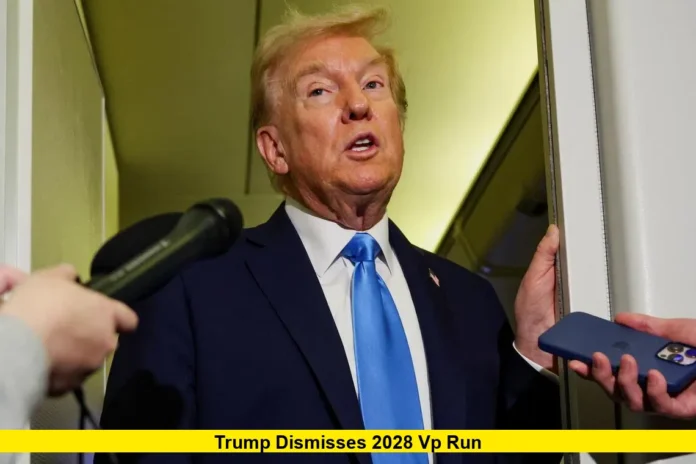

In a clear and confident statement, Trump dismisses 2028 VP run rumors, putting an end to weeks of speculation about whether the former president might return to the White House in a secondary role. Speaking to reporters on October 27, 2025, Donald Trump said he would not consider running as vice president in the 2028 election, calling the idea “too cute” and “not something I’d ever do.” His comments immediately clarified his political intentions and refocused national attention on the Republican Party’s next chapter.
Trump’s Firm Response to VP Speculation
Rumors about Trump’s possible 2028 vice-presidential bid began circulating after political strategists and commentators floated unconventional scenarios for how he could remain influential beyond the limits of his two presidential terms. Some supporters suggested a creative path that would have placed him as a vice-presidential candidate on a future Republican ticket.
However, Trump put those theories to rest. “I wouldn’t do that. I think it’s too cute,” he said when asked directly about the possibility of joining a ticket as someone else’s running mate. He went on to emphasize that his focus remains on strengthening the Republican movement rather than positioning himself for a lower role.
Constitutional Limits and Legal Context
The U.S. Constitution’s 22nd Amendment prevents any person from being elected president more than twice. Legal scholars have repeatedly confirmed that this also makes a two-term president ineligible to serve as vice president since the vice president must be eligible to assume the presidency.
Trump’s acknowledgment of these legal realities aligns with his statement rejecting the VP option. While he avoided detailed legal discussion, his remarks indicate awareness that any attempt to run as vice president would be constitutionally unworkable.
Political Strategy Behind the Announcement
By officially ruling out a 2028 vice-presidential campaign, Trump has effectively reshaped the future landscape of the Republican Party. His declaration accomplishes several key political objectives:
- Clarifies the GOP’s 2028 trajectory: Potential Republican contenders can now begin to build their platforms without speculation over Trump’s participation in a vice-presidential role.
- Reaffirms his leadership: Even while stepping away from 2028 VP speculation, Trump maintains dominance over Republican messaging and direction.
- Positions him as a kingmaker: Rather than running himself, Trump can play the role of a powerful endorser or influencer in upcoming primaries.
Trump’s Possible Role Moving Forward
Despite his dismissal of a vice-presidential bid, Trump hinted that his political story is far from over. When pressed on whether he would consider a third presidential term, he did not fully rule it out, instead responding with a characteristically ambiguous tone that kept his supporters and critics guessing.
He also mentioned several figures he sees as potential future leaders within the Republican Party, including senators and governors who align with his policy vision. His endorsement remains one of the most powerful tools in U.S. politics, and his ability to mobilize conservative voters gives him continued influence heading into 2028.
Impact on the Republican Party
Trump’s decision reverberates through every corner of the GOP. With his clear statement that he won’t run for vice president, party attention shifts to the next generation of Republican leaders. Several prominent names are now being discussed as likely front-runners for 2028, including current senators and governors who have built strong ties to Trump’s base.
This shift opens the door to what could be the first truly post-Trump Republican presidential field — though his political presence will still loom large.
Voter Reaction and Public Discussion
Among Republican voters, reactions to Trump’s announcement have been largely positive. Many of his supporters view the decision as a display of strength and principle, reinforcing his image as a leader who does not settle for second place.
Political analysts note that by removing himself from vice-presidential speculation, Trump effectively avoids potential legal battles or constitutional controversies. At the same time, he retains the power to shape party direction through endorsements, campaign appearances, and his continued dominance in conservative media.
Timeline of Key Events
| Date | Event |
|---|---|
| October 27, 2025 | Trump publicly dismisses the idea of running for vice president in 2028. |
| Early October 2025 | Speculation grows within conservative circles about Trump’s post-presidency political options. |
| Mid-2025 | GOP strategists begin informal discussions about 2028 candidates. |
| Late 2025 | Trump clarifies his position, signaling a focus on shaping the party rather than joining a future ticket. |
Constitutional Scholars Weigh In
Legal experts have consistently maintained that a two-term president cannot legally serve as vice president. The 12th Amendment specifies that no person ineligible for the presidency may hold the vice-presidency. Therefore, even if a political party attempted such a move, it would almost certainly face immediate legal challenges.
Trump’s own legal advisers have publicly reinforced this interpretation, making his decision to reject a 2028 VP run both politically and constitutionally sound.
The Broader 2028 Outlook
The 2028 election is still three years away, but Trump’s latest comments already shape the narrative. His clear rejection of a vice-presidential campaign removes one of the more controversial talking points about his political future. It also gives emerging Republican leaders a clearer path to define themselves without overshadowing speculation about Trump’s involvement on a ticket.
Still, his refusal to explicitly close the door on a potential third-term discussion ensures that Trump remains central to every conversation about the GOP’s direction.
Public Perception and Future Influence
Even out of office, Trump remains one of the most influential figures in modern American politics. His rallies, endorsements, and policy influence continue to draw massive attention. For many voters, his statement about the 2028 VP run represents not a retreat but a strategic repositioning — one that could allow him to shape the next Republican generation without occupying an official position on the ballot.
The question now shifts from “Will Trump run again?” to “Who will carry his movement forward?” That question will dominate Republican discussions for months to come.
In summary, Trump’s decision to dismiss a 2028 vice-presidential bid underscores his ongoing control over the political narrative. While closing one chapter, it opens another — one focused on legacy, party influence, and the shaping of a post-Trump Republican identity.
Stay tuned for what comes next and share your thoughts in the comments below.