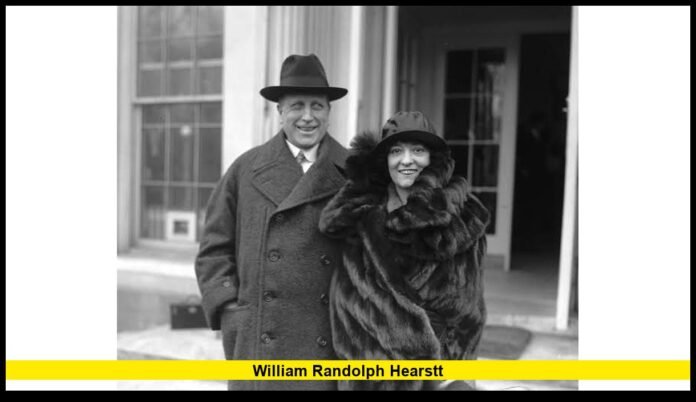

William Randolph Hearst remains one of the most influential figures in the history of American journalism. His remarkable career transformed the newspaper business from a regional industry into a powerful national force that shaped politics, public opinion, and popular culture. Through bold publishing strategies, business expansion, and a willingness to embrace innovation, Hearst created a media empire that left a lasting mark on the United States. Even decades after his death, the company he founded continues to play a major role in publishing, broadcasting, and digital media, making his legacy one of the most enduring in the communications industry.
Early Life and Family Background
Born on April 29, 1863, in San Francisco, California, William Randolph Hearst grew up in one of the wealthiest families of the American West. His father, George Hearst, was a successful mining entrepreneur who later became a U.S. senator representing California. His mother, Phoebe Apperson Hearst, was a noted philanthropist who supported education, libraries, and cultural institutions throughout her life.
Growing up in privilege gave Hearst access to opportunities that many young Americans of his era could only imagine. However, it also came with expectations that he would eventually take on responsibility for the family’s growing business interests.
Hearst attended several private schools before enrolling at Harvard University. Although he showed enthusiasm for campus activities and student publications, he was eventually dismissed before completing his degree. His experience at Harvard nevertheless fueled his passion for publishing and prepared him for the career that awaited him.
Taking Charge of the San Francisco Examiner
In 1887, George Hearst entrusted his son with management of the San Francisco Examiner. At the time, the newspaper had respectable influence but lacked the dynamic style that William envisioned.
He immediately began modernizing nearly every aspect of the publication. New editors were hired, reporters were encouraged to investigate major stories, and the newspaper adopted larger headlines, improved illustrations, and broader coverage of topics that interested ordinary readers.
Rather than limiting coverage to politics and business, the Examiner began featuring sports, entertainment, crime reporting, society news, and human-interest stories. This broader editorial approach quickly attracted new subscribers and established Hearst as an ambitious publisher willing to challenge industry conventions.
Entering the Competitive New York Market
After finding success in California, Hearst turned his attention eastward. In 1895, he purchased the struggling New York Journal, entering one of the most competitive newspaper markets in the world.
New York was already home to several established publishers, including Joseph Pulitzer, whose New York World dominated circulation. Hearst believed readers wanted faster reporting, dramatic storytelling, and visually engaging newspapers. He invested heavily in reporters, artists, editors, and printing technology to make the Journal stand out.
Competition between the two publishers became legendary. Each newspaper fought aggressively for readers by covering sensational crimes, political scandals, sporting events, and breaking news. Their rivalry pushed circulation numbers to unprecedented heights and permanently changed newspaper publishing.
The Rise of Mass-Market Journalism
One of Hearst’s greatest achievements was recognizing that newspapers could appeal to readers from every social class.
Instead of focusing exclusively on political elites, his publications spoke directly to working families, immigrants, business owners, and young readers. Newspapers became daily companions that offered a mix of information and entertainment.
His publications regularly included:
- Investigative reporting
- National political news
- Local community coverage
- Illustrated features
- Comics
- Editorial opinions
- Sports reporting
- Celebrity interviews
- Financial news
- Advice columns
This balanced approach broadened newspaper readership across the United States and influenced competitors to adopt similar strategies.
Yellow Journalism and Its Controversial Reputation
No discussion of Hearst’s career is complete without mentioning yellow journalism.
The term describes a style of reporting that emphasized dramatic headlines, emotional storytelling, and sensational coverage designed to capture public attention. Although the label has often been associated with Hearst and Pulitzer, historians continue to debate how accurately it reflects the full scope of their journalism.
Many newspapers during the late nineteenth century competed fiercely for circulation, and sensational reporting became increasingly common throughout the industry rather than being limited to a single publisher.
While critics argued that some stories sacrificed restraint for excitement, supporters believed readers benefited from newspapers that exposed corruption, challenged powerful interests, and made current events accessible to larger audiences.
Coverage of the Spanish-American War
Hearst’s newspapers played a significant role in reporting events leading up to the Spanish-American War in 1898.
His editors devoted extensive coverage to political developments in Cuba and highlighted reports describing Spanish colonial policies. Emotional stories and vivid illustrations helped build public interest in the conflict.
Although newspapers influenced public discussion, historians generally agree that the decision to enter the war resulted from numerous political, diplomatic, military, and economic factors rather than media coverage alone.
The period nevertheless cemented Hearst’s reputation as one of the nation’s most influential publishers.
Building a National Publishing Empire
Hearst refused to remain a regional newspaper owner. Throughout the early twentieth century, he purchased publications across the country, creating one of America’s largest media organizations.
His newspapers eventually operated in major cities including:
- New York
- Chicago
- Boston
- Los Angeles
- San Francisco
- Detroit
- Baltimore
- Washington, D.C.
- Seattle
- Atlanta
Each acquisition expanded his influence while allowing advertisers to reach audiences across multiple metropolitan markets.
The network became one of the first truly national newspaper groups in the United States.
Expanding Beyond Newspapers
As technology evolved, Hearst expanded far beyond traditional newspapers.
Recognizing that audiences consumed information in different ways, he invested in magazines, book publishing, syndicated features, radio broadcasting, and motion picture companies.
His magazines covered topics ranging from fashion and home living to current affairs, business, and popular culture. Syndicated comic strips and editorial features appeared in newspapers nationwide, helping establish recognizable characters and writers with loyal followings.
By diversifying early, Hearst protected his company from relying solely on newspaper sales and positioned it for long-term growth.
Political Influence
Hearst was not content with merely reporting political news. He also sought elected office himself.
He served as a member of the U.S. House of Representatives from New York during the early twentieth century. Over the years, he campaigned for mayor of New York City and governor of New York but fell short in both races.
Even without holding higher office, his newspapers gave him extraordinary political influence. Editorial endorsements, investigative reporting, and opinion pieces shaped public conversations on elections, government reform, labor issues, and foreign policy.
Politicians from across the political spectrum understood that Hearst’s newspapers had the ability to reach millions of readers each day.
Hearst Castle: A Monument to Ambition
Perhaps no symbol better represents Hearst’s success than the magnificent estate he built on California’s Central Coast.
Construction began in 1919 on a hill overlooking the Pacific Ocean near San Simeon. Working closely with pioneering architect Julia Morgan, Hearst envisioned an estate unlike anything else in the United States.
The sprawling property eventually featured:
- A grand main residence
- Multiple guest houses
- Extensive gardens
- European artwork
- Historic sculptures
- Libraries
- Tennis courts
- Private zoo
- Outdoor Neptune Pool
- Indoor Roman Pool
Hearst Castle welcomed actors, politicians, authors, business executives, and international dignitaries. Guests often stayed for days while enjoying elaborate dinners, movie screenings, horseback riding, and conversations with influential figures of the era.
Today, the estate remains one of California’s most famous historic attractions and offers visitors a glimpse into the extraordinary lifestyle of one of America’s greatest publishers.
Relationship with Marion Davies
One of the most widely discussed aspects of Hearst’s personal life was his longtime relationship with actress Marion Davies.
Davies became one of Hollywood’s leading performers during the silent film era. Hearst strongly supported her acting career, financing films and promoting her work through his media outlets.
Although their relationship attracted public attention, many friends described it as affectionate and deeply loyal. Davies frequently accompanied Hearst at social events and entertained guests at Hearst Castle for many years.
Modern film historians increasingly recognize Davies for her comedic talent rather than viewing her solely through the lens of her association with Hearst.
Financial Challenges During the Great Depression
Like many large businesses, Hearst’s empire faced serious financial difficulties during the Great Depression.
Advertising revenue declined sharply while newspaper circulation experienced increased pressure. Large construction projects, property investments, and significant borrowing added to the company’s financial strain.
Hearst responded by restructuring portions of the business and selling selected assets. Although these years proved difficult, the organization ultimately survived and regained stability.
The company’s ability to recover demonstrated the strength of its diversified operations.
Citizen Kane and Cultural Legacy
The 1941 film Citizen Kane has long been connected to Hearst’s life.
The fictional newspaper publisher Charles Foster Kane shares several characteristics with Hearst, including media ownership, political ambitions, and the construction of a massive estate.
Hearst reportedly opposed the film’s release and used his influence to discourage publicity for the production. Despite the controversy, the movie eventually became regarded as one of the greatest achievements in cinema history.
The association has introduced generations of movie lovers to Hearst’s remarkable story, even if the film itself is a fictional work rather than a biography.
Final Years
During his later years, Hearst gradually reduced his day-to-day involvement in business while continuing to oversee important editorial and corporate decisions.
He spent considerable time in California with family and close friends while remaining interested in the future of his publishing organization.
On August 14, 1951, he died in Beverly Hills at the age of 88.
His passing marked the end of an extraordinary chapter in American journalism, but the enterprise he built continued to grow under new leadership.
The Modern Hearst Corporation
Today, the company established by William Randolph Hearst has evolved into a diversified international media and information business.
Its operations now extend well beyond newspapers and include:
- Television broadcasting
- Magazine publishing
- Digital media
- Data and analytics
- Healthcare information
- Business publications
- Financial information services
- Entertainment partnerships
By adapting to changing technologies while maintaining respected publishing brands, the corporation has remained relevant in an era defined by digital transformation.
Lasting Influence on Journalism
The influence of William Randolph Hearst can still be seen throughout today’s media landscape. His emphasis on engaging storytelling, broad audience appeal, visual presentation, and business diversification helped redefine how news organizations operate. While historians continue to debate some of his editorial methods, few dispute his importance in shaping modern journalism.
His career demonstrated that newspapers could become national institutions with enormous cultural, political, and economic influence. At the same time, his successes and controversies continue to serve as valuable lessons for publishers navigating the rapidly changing world of media.
More than a century after he revolutionized newspaper publishing, Hearst’s legacy remains deeply woven into American history, reminding readers that the power of communication can shape societies, influence governments, and leave an impact that extends far beyond a single lifetime.