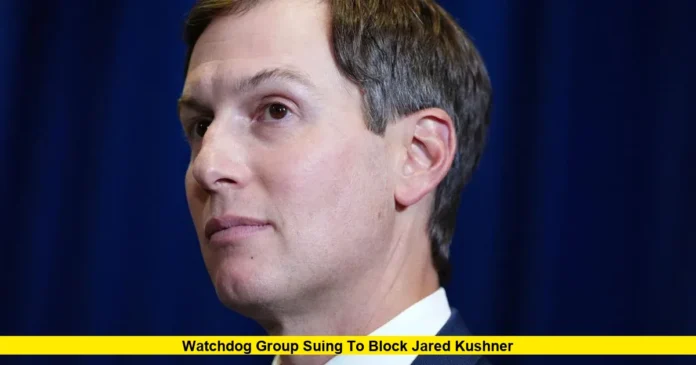

Why is a watchdog group suing to block Jared Kushner from acting as a diplomat? Citizens for Responsibility and Ethics in Washington (CREW) filed a federal lawsuit on Wednesday, October 14, 2026. The group argues that the president’s son-in-law is holding a top foreign policy role without Senate confirmation and without filing a single financial disclosure.
The case now sits in a federal court in Washington, D.C. No ruling has been reported yet.
The Core Argument in Plain Terms
So, why is a watchdog group suing to block Jared Kushner from acting as a diplomat? The answer rests on two legal ideas: the Constitution’s Appointments Clause and the Ethics in Government Act.
The Appointments Clause requires Senate approval for officers who hold continuing positions and wield significant government power. CREW says Kushner’s work for the Trump administration fits that description, even though he has no formal title or salary.
The Ethics in Government Act requires senior officials to file public financial disclosures. CREW argues that these duties apply whether or not an official gets paid. In its view, Kushner has skipped both safeguards while negotiating with foreign leaders.
Who Filed the Lawsuit and What It Says
CREW is a nonprofit that investigates government ethics and files legal actions against public officials. Its president, Donald K. Sherman, said Kushner is shaping serious national security decisions without proving his fitness or putting the public’s interests ahead of his own.
The complaint runs 45 pages and includes three counts. It names Kushner and several senior officials as defendants in their official capacities. Those officials include Secretary of State Marco Rubio, special envoy Steve Witkoff, White House Chief of Staff Susie Wiles, and Defense Secretary Pete Hegseth.
The filing says Kushner negotiates directly with foreign leaders. It also says he plays a continuing role in shaping and carrying out foreign policy during President Donald Trump’s second term.
CREW adds that the public record likely understates his activity. In its words, some meetings with foreign officials have probably gone unreported. Without disclosures, the group argues, the public cannot measure the full scope of his work.
What Kushner Has Done as a Presidential Envoy
Kushner served as a senior adviser during Trump’s first term. He later founded a private investment firm. In February 2026, Trump publicly described him as an envoy of peace, and his role has grown since then.
The record of his travel and meetings is extensive:
- He joined Witkoff for trilateral talks among the United States, Russia, and Ukraine in Abu Dhabi in January.
- He appeared alongside Witkoff in Geneva in late February.
- He traveled with Witkoff to Islamabad, Pakistan, in April.
- He met Russian President Vladimir Putin in Moscow on September 5 alongside Witkoff.
- He held a joint press conference with Ukrainian President Volodymyr Zelensky in Kyiv the next day.
Kushner has also taken part in talks tied to Iran and the broader Middle East. In late September, he spoke at a Board of Peace briefing in New York, where he appeared under the title special envoy for peace.
The White House has described his involvement as informal. CREW says the substance of his work looks like the job of an officer of the United States.
The Business Conflict Concerns
The lawsuit puts heavy weight on Kushner’s private business. He runs Affinity Partners, an investment firm that he founded after leaving the White House in 2021.
The complaint says the firm manages more than $6 billion in assets. It also says roughly 99 percent of that money comes from foreign investors. Those investors include the sovereign wealth funds of Saudi Arabia, Qatar, and the United Arab Emirates. The firm also holds major investments in Israel.
CREW argues that this overlap creates a heightened risk of conflicts. Many of these governments have a stake in the conflicts that Kushner helps negotiate. The complaint also points to the firm’s global investment strategy, which accounts for geopolitical risk. That approach, CREW says, means diplomatic outcomes could affect Kushner’s own holdings.
The group does not claim that a specific deal was improperly influenced. Its position is that financial disclosures exist so the public can check for that kind of problem. Without them, no one outside the government can.
What the Lawsuit Asks the Court to Do
CREW seeks two main forms of relief. The first is an order barring Kushner from performing diplomatic work until he is appointed and confirmed under the Appointments Clause. The group also wants the court to stop top officials from helping him exercise the powers of a federal officer.
The second request works as a fallback. If the court decides he can continue without confirmation, CREW wants him ordered to file the financial disclosure forms that senior officials must submit. That filing would cover the period in which he has served in his current role.
CREW also argues that the missing disclosures deny it access to records it has a legal right to obtain. That claim supports its standing to sue, a threshold issue that often decides cases like this one.
How the White House and Kushner’s Lawyer Responded
The White House rejected the claims. A spokesperson said Kushner’s personal business activities have nothing to do with his diplomatic engagements. The statement added that he serves as a volunteer at the president’s request and pays his own expenses.
Kushner’s attorney, Chad Mizelle, called the lawsuit without merit. He said outside ethics counsel and government ethics lawyers reviewed Kushner’s volunteer service and found that it complies with applicable requirements.
That defense leans on his unpaid status. The legal question is whether a volunteer who negotiates for the United States can still count as an officer. The court will have to decide how much weight his unpaid status carries against the amount of authority he exercises.
Why the Appointments Clause Matters in This Case
Senate confirmation serves as a public vetting process. Nominees answer questions, disclose their finances, and face a vote. Supporters of the system say it protects the public from officials who put private gain first.
Critics of CREW’s case may argue that presidents have long relied on informal envoys and personal advisers. Presidents of both parties have sent trusted friends and relatives on delicate missions. The administration’s position fits within that tradition.
CREW counters that Kushner’s role differs in scale and duration. The complaint describes continuing responsibility for several major conflicts. It also notes that key diplomatic posts remain vacant while he performs some of the duties usually assigned to them. Courts will weigh those competing views as the case moves forward.
Earlier Scrutiny of Kushner’s Role
The lawsuit follows months of political pressure. In April 2026, Rep. Jamie Raskin, the top Democrat on the House Judiciary Committee, opened an investigation into Kushner’s financial conflicts. His letter demanded documents about Affinity Partners and Kushner’s simultaneous work as a peace envoy.
Raskin warned that fundraising from Gulf governments while negotiating in the region creates national security risks. As the minority-party ranking member, Raskin cannot issue subpoenas without Republican support. That limit makes a court case a more direct route to answers.
CREW also revisits Kushner’s first-term record. The group notes that the Justice Department set aside long-standing anti-nepotism precedent so he could work in the White House. It also notes that he received a security clearance despite reported objections from career security specialists.
His first-term disclosures showed that he and Ivanka Trump earned between $172 million and $640 million in outside income during their White House service. Soon after that term ended, his firm secured billions of dollars from governments he had worked with while in office. CREW presents this history as the reason to demand transparency now.
What Happens Next
The case is at its earliest stage. The defendants will likely ask the court to dismiss it, probably on standing grounds or by arguing that Kushner’s volunteer status keeps him outside the Appointments Clause. CREW will have the chance to respond.
A judge will then decide whether the case moves forward. No hearing date or ruling had been reported as of October 17, 2026. Readers should expect a slow process, since constitutional challenges of this kind can take months.
Several outcomes remain possible. The court could dismiss the case, order disclosures, or bar Kushner from his diplomatic duties. Any decision would likely draw an appeal.
Final Thoughts
The lawsuit asks a basic question about accountability: who gets to represent the United States abroad, and under what rules? CREW says Kushner holds major authority without the vetting that Congress and the Constitution require. The White House and Kushner’s attorney say the arrangement follows the rules and that his business has no bearing on his volunteer work.
Neither side has had a court weigh in yet. For now, the facts that matter are clear: a watchdog group filed suit, the administration denied wrongdoing, and a federal judge will decide whether Kushner’s role crosses a legal line.
Share your thoughts in the comments below, and check back for the latest updates as this case develops.