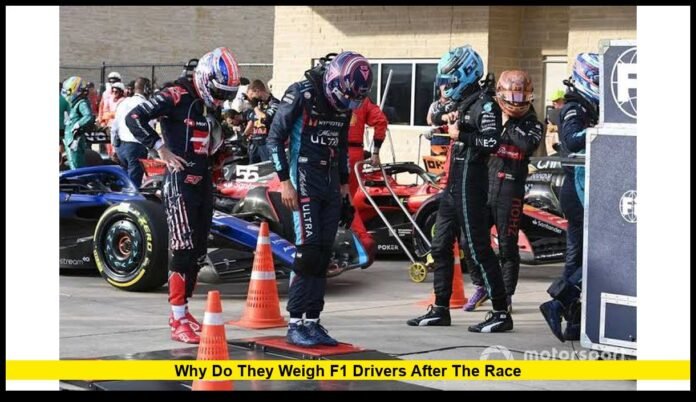

Why do they weigh f1 drivers after the race is a question many Formula 1 viewers ask when they see drivers step onto a scale almost immediately after crossing the finish line. The unusual post-race routine is not simply about recording a driver’s body weight. It is an important part of Formula 1’s technical regulations, competitive fairness and driver welfare. The FIA uses the weighing process to verify compliance with weight requirements, while teams can also use the result to understand how much fluid a driver has lost during an intense Grand Prix.
In a sport where a few kilograms can influence performance, weight is treated as a major technical factor. The car, driver, safety equipment and permitted ballast all form part of a carefully regulated system. A driver who finishes a race several kilograms lighter than at the start may also need immediate attention from the team’s performance and medical staff.
The post-race scale therefore has a much bigger role than it might appear to have on television.
Why F1 Drivers Are Weighed After a Grand Prix
The main reason is regulatory control.
Formula 1 cars must comply with minimum weight requirements, and the FIA has procedures for checking cars and drivers during a race weekend. Drivers are part of the weight calculation, meaning officials need an accurate measurement of their mass when conducting technical checks.
The FIA’s current rules establish a reference mass for every driver. For the 2026 season, the driver’s reference mass together with any permitted driver ballast cannot be below 82 kilograms during a competition.
This system prevents teams from gaining an advantage simply because they have a naturally lighter driver.
If drivers could be significantly lighter without compensation, teams might have an incentive to prioritize smaller and lighter competitors. That would turn driver body size into a more significant performance advantage. The current regulations are designed to reduce that effect.
Weight Has a Direct Impact on F1 Performance
Formula 1 engineers are obsessed with weight.
Every team wants to remove unnecessary mass from the car because a lighter machine can generally accelerate more efficiently, brake more effectively and respond more quickly to changes in direction. Weight can also influence tire performance and energy consumption.
That creates a difficult engineering challenge.
Teams want to build a car that is as light as possible, but it must remain above the FIA’s minimum requirements. Going below the legal limit can result in a major sporting penalty.
The same principle applies to the driver.
A driver is not treated as an entirely separate object from the racing car when weight is assessed. The regulations establish a reference system that ensures teams cannot exploit differences in driver body mass.
The 82-Kilogram Driver Requirement
The driver-weight rules have evolved over time.
Formula 1 introduced a minimum driver weight in 2019, originally setting the figure at 80 kilograms including the relevant racing equipment. The minimum was later increased to 82 kilograms.
The change was partly intended to reduce the pressure on drivers to maintain extremely low body weights.
For 2026, the 82-kilogram reference remains an important part of the technical regulations. If a driver does not naturally reach the required reference mass, permitted ballast can be used to bring the total to the required level.
This is important because drivers come in different shapes and sizes. Without a standardized approach, a heavier driver could be at a disadvantage compared with a lighter teammate or rival.
The ballast system helps level that aspect of the competition.
What Does the Driver Wear During the Weigh-In?
When an F1 driver steps onto the scales, the number shown is not necessarily their ordinary body weight.
The FIA’s weighing procedure accounts for the driver’s racing equipment. Depending on the specific procedure, the measurement involves the equipment associated with competing, including items such as the helmet, race suit, shoes and other required safety equipment.
That distinction is important.
A driver might weigh considerably less without their equipment, but Formula 1’s regulations are concerned with the mass relevant to competition.
The official measurement therefore provides a standardized figure that can be used for technical purposes.
Why the Timing of the Weigh-In Matters
The timing is another important part of the process.
Drivers can lose a considerable amount of fluid during a race. If they were allowed to immediately drink large quantities of water before being weighed, the resulting number could be different from their mass at the end of the competition.
For that reason, the weighing procedure takes place promptly.
The FIA can obtain a consistent measurement before the driver has had a chance to significantly change their condition through drinking, eating or removing relevant equipment.
This makes the post-race number useful for both regulatory checks and driver recovery analysis.
How Much Weight Can an F1 Driver Lose During a Race?
The amount varies from driver to driver and from circuit to circuit.
In a relatively cool race, fluid loss may be manageable. In a hot or humid Grand Prix, however, drivers can lose several kilograms through sweating.
The cockpit can become extremely hot, and drivers are wearing protective clothing while operating a physically demanding racing machine. Their heart rate can remain elevated for long periods, while repeated braking and cornering forces place significant demands on the body.
A loss of two to four kilograms during a race is possible in difficult conditions, although the exact amount depends on the driver, weather, circuit and race circumstances.
Most of that loss is fluid rather than body fat.
That distinction is important because dehydration can affect concentration, reaction time and physical recovery.
The Health Reason Behind the Scale
There is also a medical benefit to weighing drivers.
Teams can compare the driver’s post-race measurement with pre-race data to estimate how much fluid has been lost.
That information can help the driver’s physiotherapist and performance team determine an appropriate recovery plan.
After a demanding race, a driver may need fluids, electrolytes, carbohydrates and other nutritional support. Knowing approximately how much mass was lost gives the team a useful starting point.
This becomes particularly important after races held in extreme heat.
A driver who has lost a substantial amount of fluid may require more aggressive rehydration and monitoring before returning to normal activities.
What Happens If a Driver Is Below the Required Weight?
Being below the relevant reference mass does not automatically mean a driver has broken the rules in the way fans sometimes assume.
The regulations provide a system involving driver ballast. Teams can use approved ballast to ensure the driver-related weight requirement is satisfied.
The important point is that teams cannot simply place weight anywhere they want.
Driver ballast is controlled by the technical regulations, including where and how it can be installed. The rules are designed to prevent teams from turning the weight requirement into another opportunity for an aerodynamic or handling advantage.
The objective is straightforward: the driver must satisfy the required reference mass without giving the team unlimited freedom to position additional weight wherever it might improve the car.
Can a Team Be Disqualified for Being Underweight?
Yes.
Weight violations can have serious consequences in Formula 1.
The FIA can weigh cars after qualifying, sprint sessions and races. If a car is found to be below the applicable minimum weight, the matter can be referred to the stewards and may result in disqualification.
There have been real examples of drivers losing results because their cars failed post-race weight checks.
This demonstrates why teams take the scales so seriously.
Engineers have to consider fuel usage, tire wear, component losses and other factors when calculating how much weight the car will have at the end of a race.
A car that is legal at the start is not necessarily guaranteed to remain comfortably above the limit after completing a Grand Prix.
Why Teams Leave a Weight Safety Margin
In theory, teams would prefer to operate as close to the minimum as possible.
Extra weight can cost performance, so carrying a large safety margin is not necessarily desirable.
However, running exactly at the limit is risky.
A team has to account for possible weight changes during the race. Parts can wear, small pieces of the car can become damaged or detached, and fluid levels change as the car completes the distance.
Engineers therefore have to balance two competing objectives: minimize mass while ensuring the car remains legal.
This is one reason post-race technical inspections are so important.
The Importance of Weight in the 2026 F1 Era
The 2026 regulations brought a major change to Formula 1’s approach to car design.
The new generation was developed around the concept of lighter and more agile cars. The FIA set weight reduction as one of the major goals of the regulations, alongside changes to aerodynamics and power-unit technology.
That makes weight an especially interesting subject for the current generation of Formula 1 cars.
Teams are constantly looking for opportunities to reduce mass without compromising reliability, structural integrity or regulatory compliance.
As development continues, the difference between a car that is close to the minimum and one carrying significant extra weight can become an important performance consideration.
Why Drivers Are Weighed After Qualifying Too
The procedure is not limited to the end of a Grand Prix.
FIA weighing procedures also apply during qualifying and sprint qualifying.
Drivers can be instructed to proceed directly to the FIA garage, where officials can establish the relevant measurements. Cars can also be selected for weighing.
This gives the FIA several opportunities during a race weekend to verify that competitors are complying with the regulations.
It also explains why viewers occasionally see drivers heading toward the scales after qualifying rather than going straight back to their garages.
The process is routine, but it is a serious part of Formula 1’s technical oversight.
What Is the Small Paper Slip Drivers Receive?
Fans may have noticed another unusual detail during the weighing process: drivers are sometimes handed a small printed slip after stepping off the scale.
The slip records the measurement from the weighing process.
While it may look like an insignificant piece of paper, the information can be useful to the team, particularly when considering the driver’s physical recovery.
The driver’s performance staff can use the recorded figure alongside other information from the weekend to understand the driver’s hydration status and recovery requirements.
It can also provide a record of the official measurement if there is a question about the number recorded.
Why Drivers Cannot Simply Ignore the Scale
The weighing process is part of the FIA’s official sporting procedures.
Drivers are required to cooperate when instructed to report for weighing. Failing to follow the procedure can result in the matter being referred to the stewards.
This is necessary because technical regulations are only effective if every competitor is subject to the same checks.
A team cannot argue that its car should be exempt from weighing simply because it believes the vehicle is compliant.
The FIA needs an objective measurement.
Does Driver Weight Affect Race Strategy?
Driver weight is not normally something teams can dramatically change during a race weekend, but it is certainly considered when engineers build and prepare the car.
Drivers train carefully to maintain a weight that is healthy and compatible with the regulations.
At the same time, they cannot simply focus on becoming as light as possible. They need enough muscle and physical strength to withstand the extreme forces produced by modern F1 cars.
That balance is especially important under the current rules, which place greater emphasis on driver well-being than earlier eras of Formula 1.
Why Do They Weigh F1 Drivers After the Race?
So, why do they weigh F1 drivers after the race when the driver has already completed the competition?
The answer comes down to two major factors: regulatory compliance and driver health.
The FIA needs an official measurement to help enforce the sport’s weight regulations. The driver’s reference mass is part of the technical framework governing the car and permitted ballast.
At the same time, the post-race measurement tells the team something about the driver’s physical condition. A substantial drop in weight can indicate significant fluid loss, especially after a hot and demanding race.
The scale is therefore not merely checking whether a driver is “heavy enough.” It is part of a much larger system designed to protect competitive fairness while helping teams manage one of the most physically demanding jobs in motorsport.
A Small Step With a Big Role in Formula 1
The few seconds a driver spends standing on a scale may look insignificant compared with the spectacle of a Grand Prix.
In reality, that moment connects several important areas of Formula 1.
It helps officials enforce technical rules, prevents weight from becoming an unfair source of performance, supports the regulations surrounding driver ballast and provides teams with useful information about post-race fluid loss.
For drivers, it is one of the first steps after an exhausting battle on the track. For engineers and FIA officials, however, the number displayed on the scale can be extremely important.
Formula 1 is built around precision, and that precision extends well beyond lap times. From the dimensions of an aerodynamic component to the mass of the car and driver, almost every measurable detail is governed by rules.
The next time an F1 driver climbs onto the scales after taking the checkered flag, it is worth remembering that the procedure is not just another television ritual. It is one of the sport’s simplest-looking but most important technical checks.