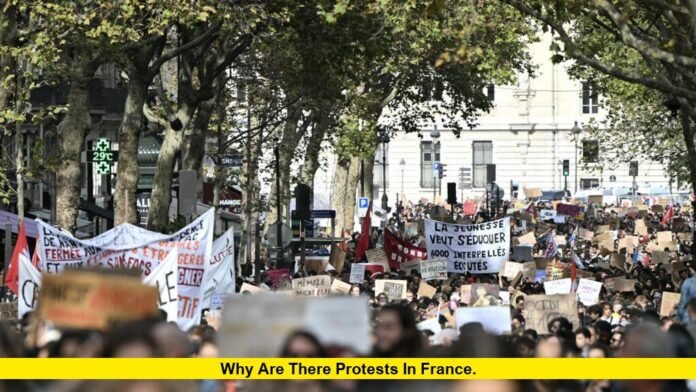

Why are there protests in France? The demonstrations have intensified because of rising living costs, frustration over underfunded schools, concerns about public services, and growing dissatisfaction with government policies. On October 17, 2026, protests spread across the country, bringing together students, workers, trade union members, and supporters of the Yellow Vest movement. While many demonstrators participated in peaceful marches, some gatherings descended into clashes, fires, property damage, and confrontations with police.
The unrest reflects several problems that have developed simultaneously. High school students are demanding better educational conditions, households are struggling with expensive essentials and fuel, and critics are questioning the government’s response to economic hardship and social inequality. Concerns about policing and proposed legislation have also added to tensions.
For Americans following developments in Europe, the situation is more complicated than a single protest against the government. Different groups have brought their own demands to the streets, but their grievances increasingly overlap around purchasing power, public investment, equal opportunities, and accountability.
The latest update: The October 17 demonstrations brought together several strands of discontent. The immediate issues included the cost of living and deteriorating public services, while the student movement continued to highlight teacher shortages, overcrowded classrooms, and unequal educational opportunities.
Why Are People Protesting in France? The Main Reasons
The demonstrations have grown from specific complaints into a wider expression of frustration. Several connected issues explain why so many people have joined the movement.
- Rising living costs: Households face pressure from expensive essentials, including food, energy, transportation, and fuel.
- Education problems: Students are demanding more teachers, better-maintained schools, and fairer access to educational opportunities.
- Public service concerns: Protesters want stronger public investment and oppose what they see as declining service quality.
- Wages and pensions: Labor unions are calling for better pay, stronger purchasing power, and the protection of retirement benefits.
- Policing and accountability: Some demonstrators object to police tactics and fear that proposed legal changes could weaken accountability.
- Political dissatisfaction: The protests reflect wider frustration with government priorities, economic decisions, and persistent inequality.
These demands are related, but they are not identical. A student seeking a permanent teacher has different immediate concerns from a retiree struggling with expenses. Their participation in the same demonstrations shows how individual grievances can combine into a broader national movement.
1. Rising Living Costs and Fuel Prices
The cost of living is one of the central reasons behind the latest protests in France. Many demonstrators believe that everyday expenses have become increasingly difficult to manage while their incomes fail to provide sufficient financial security.
Fuel prices have become a particularly visible source of anger. Higher transportation costs affect commuters, delivery workers, farmers, and people who depend on cars to reach their jobs or essential services. When fuel becomes more expensive, businesses can also face higher operating costs, which may put additional pressure on household budgets.
Food, electricity, heating, and housing expenses contribute to the same frustration. Even when individual prices move differently, families can feel squeezed when several essential costs compete for the same income.
The Yellow Vest movement, known in France as the gilets jaunes, provides an important historical comparison. It emerged in 2018, initially around fuel taxation and purchasing power, before developing into a wider protest against perceived economic unfairness and political detachment.
The movement’s familiar high-visibility yellow vests have reappeared in the latest demonstrations. Their presence signals that complaints about affordability and unequal economic burdens remain politically powerful.
However, the current protests are not simply a repeat of the 2018 movement. They now include a prominent student campaign, organized labor, and demands concerning public services. The common thread is the belief that government policy should do more to address the financial pressures experienced by ordinary people.
2. Student Protests Over Teacher Shortages and School Conditions
Education has become another major driver of the unrest. The current student movement began in the Paris suburbs in September 2026 before spreading to schools and other locations across France.
Students have raised concerns about teacher shortages, frequent teacher absences, overcrowded classrooms, and deteriorating school buildings. Some say they spend important periods of their education without the instruction they need.
These problems are particularly contentious because students see education as a route to future employment and economic independence. When schools lack staff or suitable facilities, young people worry that their opportunities will depend more heavily on where they live and what their families can afford.
The complaints extend beyond classroom conditions. Students have also criticized the pressure associated with France’s education system and the role of Parcoursup, the platform used to manage applications to many higher education programs.
For some students, these concerns represent a broader fear about their futures. They want a system that offers meaningful opportunities regardless of their socioeconomic background.
The movement initially developed through school blockades, walkouts, and demonstrations. Social media helped spread images and messages, encouraging students elsewhere to join the campaign.
Teachers, parents, university students, and other supporters subsequently became involved. Their participation helped turn a localized education dispute into a nationwide debate about inequality and public spending.
The government has faced pressure to respond to the shortage of substitute teachers and other staffing problems. Yet students have continued to demand practical improvements rather than assurances alone.
3. Concerns About Public Services and Government Spending
Another important answer to the question of why are there protests in France is growing dissatisfaction with public services.
France has traditionally maintained an extensive social protection system, including public education, health care, and retirement benefits. Many protesters fear that financial constraints and government spending decisions are undermining the quality or accessibility of those services.
The debate has become especially intense because the government faces pressure to control public debt. Efforts to restrain spending can create difficult choices over staffing, investment, benefits, and the funding available to local authorities.
For protesters, these decisions are not abstract budget calculations. They can translate into missing teachers, aging school buildings, reduced local capacity, or concerns about whether public institutions will meet community needs.
Labor unions have used the demonstrations to demand higher wages and pensions, lower prices, and the protection of essential services. Their involvement connects household financial concerns with a wider argument over the role of the state.
Government officials, meanwhile, must balance demands for additional spending against France’s fiscal pressures. That makes a quick resolution difficult because protesters and policymakers disagree not only about the problems but also about how much money should be committed to addressing them.
The education protests illustrate this conflict clearly. Students want visible improvements in their schools, while the government must determine how to finance staffing and infrastructure commitments.
4. Anger Over Inequality and Unequal Opportunities
Economic inequality has helped connect the different groups taking part in the demonstrations.
Students in disadvantaged communities have highlighted differences in school conditions and educational resources. Workers have emphasized the gap between wages and household expenses. Retirees and other demonstrators have called for policies that protect their purchasing power.
These concerns reflect a wider question: whether people across France have a fair chance to benefit from the country’s economic and public institutions.
For younger protesters, unequal access to quality education can influence future employment and earnings. For working households, the rising cost of essentials can make financial stability harder to achieve. For people relying on public services, reduced access or deteriorating quality can deepen existing disadvantages.
The protests also reveal frustration with how national resources are distributed. Demonstrators want policymakers to explain which priorities receive funding and how those decisions affect different communities.
This does not mean that every protester shares the same political ideology. The movement brings together people with different backgrounds and sometimes conflicting solutions. Their participation reflects overlapping concerns rather than a single unified political program.
Nevertheless, inequality has become a recurring theme because it links immediate problems to a larger question about social mobility, public responsibility, and economic fairness.
5. Controversy Over Police Powers and Accountability
Policing has become another source of tension in France. In September 2026, thousands of people demonstrated against proposed legislation that would provide additional legal protection to armed police officers and gendarmes who use their firearms while on duty.
The proposal would establish a presumption of lawful self-defense in certain circumstances. Supporters argue that officers need legal protection when confronting dangerous situations, including organized crime.
Critics fear that the change could make it harder to investigate shootings and hold officers accountable for unlawful uses of force. They also worry about the potential consequences for communities that already distrust the police.
The controversy has revived broader concerns about police conduct, particularly in disadvantaged urban neighborhoods. Past incidents, including the 2023 killing of teenager Nahel Merzouk during a traffic stop, have fueled public debate about police accountability and the treatment of young people.
These issues overlap with the current student protests. Demonstrators have criticized the police response to school blockades and questioned the use of force against young protesters.
The debate involves two distinct questions: how authorities should maintain public order and how they should protect the right to peaceful protest. Many people support action against violence while also demanding investigations into alleged police misconduct.
The proposed police legislation remains a separate issue from the immediate economic and educational grievances. However, it contributes to the wider atmosphere of mistrust surrounding the demonstrations.
6. Why the Government Is Facing Growing Pressure
President Emmanuel Macron and Prime Minister Sébastien Lecornu face a difficult political situation as the demonstrations expand.
The government must address public concerns about living standards and school conditions while responding to violence and property destruction. Officials have condemned attacks on police and public buildings, and Macron has pledged that those responsible will face prosecution.
The government has also faced criticism over its handling of student demonstrations. Protesters and their supporters argue that authorities should respond to legitimate complaints with meaningful improvements rather than relying primarily on police deployments.
France’s financial position complicates the response. The government faces pressure to manage public debt, which limits its room to promise additional spending without considering how to fund it.
The political calendar adds another dimension. France is approaching its 2027 presidential election, making public dissatisfaction an important issue for political parties across the spectrum.
Left-wing politicians have expressed support for student demands, while right-wing figures have emphasized public order and condemned violence. Political leaders have also faced accusations of trying to benefit from the unrest.
Nevertheless, the demonstrations cannot be reduced to a campaign organized by one political party. The student movement began with concerns about everyday school conditions and expanded as other groups recognized similar frustrations in their own lives.
What Happened During the October 17 Protests?
The latest nationwide mobilization brought together students, teachers, labor unions, workers, farmers, retirees, and people associated with the Yellow Vest movement.
Demonstrations took place in Paris and numerous other French cities. Many people marched peacefully, but some gatherings experienced serious violence.
Authorities reported approximately 550,000 participants nationwide, while the CGT labor union estimated attendance at around 800,000. The figures differ because the government and organizers used separate estimates.
The scale of the unrest was accompanied by significant damage and arrests.
Key developments included:
- More than 1,200 arrests: Prime Minister Sébastien Lecornu reported this total following the October 17 demonstrations.
- Damage to public buildings: Fires severely damaged Limoges city hall, while protesters entered Marseille’s municipal building and vandalized property.
- Clashes in Paris: Police used tear gas as some demonstrators threw objects, set fires, and looted businesses.
- Injured police officers: Officials reported that more than 150 police officers had been injured.
- Continued scrutiny of policing: Authorities faced questions about injuries to demonstrators and the use of crowd-control weapons.
These incidents demonstrate the seriousness of the situation, but they do not mean every demonstrator participated in violence. Peaceful protesters made up a substantial part of the nationwide mobilization.
Officials have blamed violent groups and criminals for attacks on public institutions and businesses. Protesters have also criticized police conduct, creating competing demands for accountability.
The immediate challenge for authorities is to protect public safety without escalating tensions further.
How the Current Protests Compare With France’s Yellow Vest Movement
The Yellow Vest movement began in 2018 and became one of France’s most recognizable examples of mass public opposition to government economic policy.
Initially driven by anger over fuel taxes and purchasing power, it expanded into a broader protest against perceived inequality and the distance between political leaders and ordinary citizens.
The October 2026 demonstrations share several characteristics with that earlier movement.
| Issue | Yellow Vest movement | Current protests |
|---|---|---|
| Living costs | Fuel taxes and purchasing power | Fuel prices, household expenses, and affordability |
| Social concerns | Inequality and economic fairness | Inequality, public services, and educational opportunity |
| Participants | Workers, motorists, and other citizens | Students, workers, unions, retirees, and Yellow Vest supporters |
| Protest methods | Street demonstrations and road blockades | Marches, school blockades, and nationwide demonstrations |
| Main demand | Greater economic fairness | Better living standards and stronger public services |
The key difference is the prominent role of students in the current movement. Their complaints about teacher shortages and school conditions helped bring other groups into the streets.
The protests also feature renewed debate about public spending and police powers. That combination gives the current unrest a broader focus than a dispute over fuel prices alone.
What Could Happen Next in France?
The future of the protests will depend partly on whether the government can produce credible responses to the demonstrators’ demands.
Students are looking for improvements in staffing, classroom conditions, and educational equality. Labor unions want stronger purchasing power, better wages, and protection for public services. Other demonstrators want action on fuel prices and household expenses.
Authorities must also investigate alleged misconduct, respond to damage, and maintain public order. These responsibilities could become harder to balance if further demonstrations lead to serious injuries or additional property destruction.
A lasting resolution may require more than one announcement or policy adjustment. The different groups have distinct priorities, and the underlying concerns involve education, household finances, inequality, and trust in public institutions.
As France approaches the 2027 presidential election, the protests could also influence debates about the country’s economic and social priorities. Political parties will face pressure to explain how they would address these problems and pay for proposed solutions.
However, the demonstrations’ long-term political impact remains uncertain. Their future will depend on public participation, government decisions, and whether protesters believe their demands are receiving meaningful attention.
Why Are There Protests in France? The Bottom Line
The protests in France reflect a convergence of economic pressure, educational frustration, concerns about public services, and distrust surrounding policing and government decisions. The October 17 demonstrations brought these issues together on a national scale, with peaceful marches taking place alongside serious episodes of violence.
The central question is whether the government can address the grievances driving public anger while protecting democratic rights and public safety. The outcome will matter not only to students and workers but also to France’s wider debate over economic fairness and the future of its public institutions.
What do you think is driving the protests in France, and what steps should the government take to address the concerns? Share your thoughts and stay tuned for the latest verified updates.