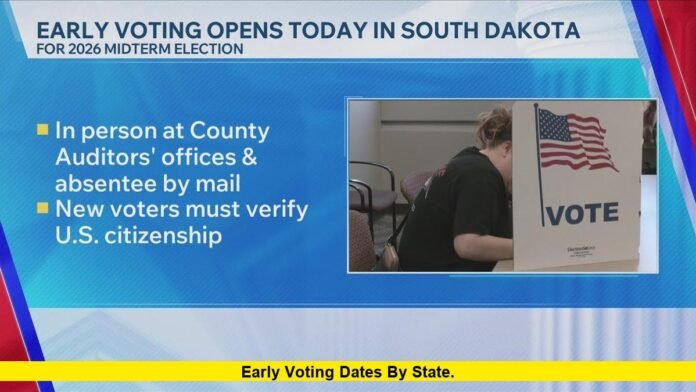

The early voting dates by state for the 2026 midterm elections vary across the United States, with in-person voting already underway in several states as Election Day approaches on Tuesday, November 3, 2026. California and Maine began early voting in early October, while Georgia, Idaho, and Iowa opened their voting periods in mid-October. Many other states will begin offering early in-person voting during the second half of October.
Early voting gives eligible Americans an opportunity to cast their ballots before Election Day. However, the opening dates, closing dates, polling locations, operating hours, and voting procedures differ by state. Some states also allow counties to establish local schedules within statewide requirements.
As of the latest available election-calendar updates, voters should check their state’s official election information before visiting a polling place. A statewide opening date does not necessarily mean every local voting center will operate on that day or follow identical hours.
The 2026 general election takes place on November 3, and the early voting window depends on the voter’s state and local election jurisdiction. Understanding these dates can help voters plan ahead and avoid missing their opportunity to participate.
Early Voting Dates by State for the November 3, 2026, Election
The following schedule summarizes the published start dates for early in-person voting in the 2026 general election. Some states offer statewide periods, while others leave certain dates or locations to local election officials.
| State | Early voting start date |
|---|---|
| Alabama | No statewide no-excuse early voting |
| Alaska | October 19 |
| Arizona | October 7 |
| Arkansas | October 19 |
| California | October 5 |
| Colorado | October 19 |
| Connecticut | October 19 |
| Delaware | October 22 |
| Florida | October 24 |
| Georgia | October 13 |
| Hawaii | October 20 |
| Idaho | October 13 |
| Illinois | September 24 |
| Indiana | October 6 |
| Iowa | October 14 |
| Kansas | October 14 |
| Kentucky | October 29 |
| Louisiana | October 20 |
| Maine | October 4 |
| Maryland | October 22 |
| Massachusetts | October 17 |
| Michigan | October 24 |
| Minnesota | September 18 |
| Mississippi | Excuse-required in-person absentee voting |
| Missouri | October 20 |
| Montana | October 5 |
| Nebraska | October 5 |
| Nevada | October 17 |
| New Hampshire | No statewide no-excuse early voting |
| New Jersey | October 24 |
| New Mexico | October 6 |
| New York | October 24 |
| North Carolina | October 15 |
| North Dakota | October 19, where offered by counties |
| Ohio | October 6 |
| Oklahoma | October 28 |
| Oregon | Primarily vote-by-mail; local in-person options vary |
| Pennsylvania | Dates vary by county |
| Rhode Island | October 14 |
| South Carolina | October 19 |
| South Dakota | September 18, through absentee voting |
| Tennessee | October 14 |
| Texas | October 19 |
| Utah | October 20 |
| Vermont | September 19 |
| Virginia | September 18 |
| Washington | October 16 |
| West Virginia | October 21 |
| Wisconsin | October 20 |
| Wyoming | October 6 |
Dates reflect the latest available published 2026 election calendars reviewed for this article. Local schedules, eligibility rules, and the distinction between early voting and in-person absentee voting may affect availability. Confirm your county’s schedule before voting.
Which States Have the Earliest Early Voting Dates?
Several states opened their voting periods in September, giving eligible voters an extended opportunity to cast ballots before November 3.
Minnesota, South Dakota, and Virginia began voting on September 18. Vermont followed on September 19, while Illinois opened early voting on September 24. These dates place their voting periods among the earliest in the country.
California, Maine, Nebraska, and Montana opened voting in early October. Other states scheduled their starts for the middle or end of the month.
The length of a voting period matters because it determines how much time voters have to visit an authorized location. However, an early statewide start does not guarantee that every county provides the same number of voting days or identical opening hours.
States Where Early Voting Is Already Underway
As of October 18, early voting has started in numerous states. These include Arizona, California, Georgia, Idaho, Illinois, Indiana, Iowa, Kansas, Maine, Massachusetts, Minnesota, Nebraska, Nevada, New Mexico, North Carolina, Ohio, Rhode Island, South Dakota, Tennessee, Vermont, Virginia, and Washington.
The precise availability of voting centers depends on state law and local administration. Some jurisdictions operate centralized voting centers, while others use county election offices or designated polling locations.
Voters should check whether their preferred location is open on the day they plan to vote. They should also confirm its address and hours rather than assuming that Election Day polling arrangements apply to early voting.
When Does Early Voting End in 2026?
Early voting does not end on one national deadline. Many states close their regular early voting periods shortly before Election Day, while others permit voting through November 2 or provide additional options on November 3.
Published schedules show several important closing dates:
- October 27: Louisiana’s regular early voting period ends.
- October 29: Kentucky, Maine, Maryland, and Tennessee have published early voting closing dates around this point, although their individual schedules differ.
- October 30: Arizona, Georgia, Idaho, Massachusetts, Nevada, Texas, and several other states have published closing dates.
- October 31: Many states, including North Carolina and South Carolina, conclude their regular early voting periods.
- November 1: Connecticut, Delaware, Michigan, New Jersey, New York, and other jurisdictions have published Sunday closing dates.
- November 2: Numerous states permit voting on the final day before Election Day, subject to their rules and local schedules.
These dates are not interchangeable. A voter should use the specific calendar for their state and county to confirm the final opportunity for in-person voting before November 3.
How Early Voting Works Across the United States
Early voting allows eligible voters to submit their ballots before the scheduled election date. In most states, voters can use this option without providing a reason for voting early.
The terminology differs across the country. Election officials may describe the process as early voting, advance voting, in-person absentee voting, or no-excuse absentee voting. These terms can refer to similar options, but their legal requirements and availability vary.
The National Conference of State Legislatures reported in August 2026 that 47 states and the District of Columbia offer early in-person voting to all voters. Alabama, Mississippi, and New Hampshire generally require an eligible reason for voting early in person.
That distinction is important. A state without universal early in-person voting may still provide absentee voting for eligible voters. Voters should check the applicable eligibility rules rather than assuming that no early voting option exists.
What Voters Should Check Before Visiting an Early Voting Location
Knowing the opening date is only one part of planning an early vote. A few additional checks can help prevent unnecessary trips and last-minute problems.
- Confirm your registration: Check your registration status and make sure your information is current.
- Find an authorized location: Some states let voters visit any approved early voting center within a county, while others impose different location rules.
- Review operating hours: Voting centers may have different weekday, weekend, and evening schedules.
- Understand identification requirements: Some states require specific forms of identification, so check the rules before leaving home.
- Allow enough time: Popular locations may experience longer lines during busy periods, particularly as Election Day approaches.
- Check for local changes: Election officials provide the most relevant information about temporary closures, relocated sites, and schedule changes.
These steps are especially useful for voters planning to vote during the final week of October, when many states begin or continue their busiest early voting periods.
Why Early Voting Dates Differ by State
The United States does not operate a single nationwide early voting calendar. State legislatures establish election rules, and state and local officials administer voting under those requirements.
Consequently, one state may begin voting several weeks before Election Day, while another may offer only a shorter period. Some states establish a statewide schedule, while others allow local jurisdictions to determine certain details.
Local administration also affects the locations available to voters. County election offices, satellite offices, and dedicated voting centers may have different schedules. States that offer early voting on weekends may also differ in which weekend days are available.
Changes in election law can affect these arrangements from one election cycle to the next. That is why voters should rely on the current 2026 calendar rather than reusing dates from the 2024 presidential election or an earlier state election.
FAQs
When is Election Day in 2026?
The 2026 general election takes place on Tuesday, November 3. Early voting dates vary by state and, in some cases, by county.
Can I vote early in every state?
Most states allow eligible voters to vote early in person without an excuse. Alabama, Mississippi, and New Hampshire have restrictions on universal early in-person voting, although qualifying voters may have absentee options.
Which state starts early voting first?
Some states began their voting periods on September 18, 2026, including Minnesota, South Dakota, and Virginia. The precise method available differs among these states.
Can I vote early on a weekend?
Weekend voting depends on state law and local election schedules. Some states provide Saturday or Sunday voting, while others offer limited weekend hours or leave certain scheduling decisions to local officials.
Can I vote at any polling place during early voting?
Not necessarily. Some states allow voters to visit approved early voting centers throughout their county, while others have location restrictions. Check the rules for your jurisdiction before visiting a site.
What happens if I miss the early voting deadline?
Eligible voters can generally still vote on Election Day, November 3, at the appropriate polling location. However, voters must follow their state’s registration, identification, and polling-place requirements. Do not assume that a missed early voting deadline means you cannot vote on Election Day.
Where can I confirm my state’s early voting schedule?
Your state election office and local county election office are the best places to confirm current dates, operating hours, voting locations, and eligibility rules. Local officials can also clarify whether a particular location offers early in-person voting or another form of absentee voting.
Final Thoughts
The 2026 early voting schedule gives eligible voters across much of the United States an opportunity to cast their ballots before November 3. Because each state follows its own calendar, checking the opening and closing dates is essential for making a reliable voting plan.
Have you checked your state’s early voting dates for 2026? Share your state in the comments and stay informed as Election Day approaches.