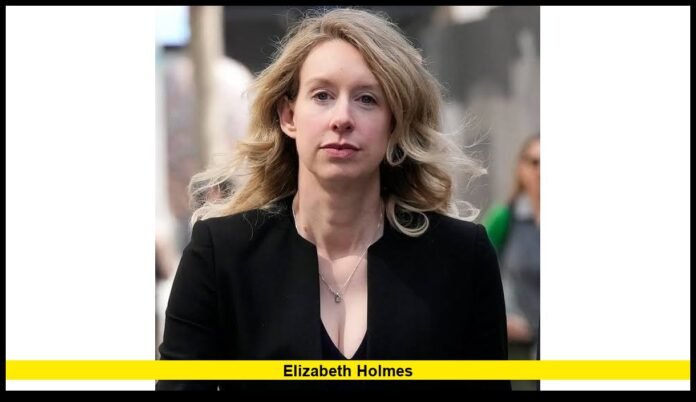

Who is Elizabeth Holmes? She is the founder and former CEO of Theranos, the failed Silicon Valley blood-testing company, and she is currently serving a federal prison sentence after a jury convicted her of defrauding investors. As of the latest confirmed updates, Holmes remains incarcerated in Texas, her original 135-month sentence was reduced to 123 months in March 2026, and her 2025 request for presidential commutation was still reported as pending in the latest publicly confirmed update.
Holmes became one of the most recognizable figures in Silicon Valley after presenting Theranos as a company capable of changing medical testing. The startup claimed its technology could perform numerous blood tests using only a small amount of blood. Investors, business leaders and major corporate partners backed the company as its valuation climbed into the billions.
That success eventually collapsed. Investigations revealed major problems with Theranos’s technology and business claims. Federal prosecutors later accused Holmes of misleading investors about the company’s capabilities, financial condition and business relationships.
Her criminal trial ended with a conviction on four investor-related counts in January 2022. The court later sentenced her to 11 years and three months in federal prison.
In 2025, the U.S. Court of Appeals for the Ninth Circuit upheld her convictions, sentence and restitution order. A subsequent request for further review by the appeals court also failed.
A separate development in March 2026 reduced Holmes’s prison sentence by 12 months under an amended federal sentencing guideline. That decision changed the length of her sentence but did not overturn her conviction.
Who Is Elizabeth Holmes?
Elizabeth Anne Holmes is an American entrepreneur best known as the founder of Theranos, a biotechnology company she established in 2003.
Holmes was born on February 3, 1984, in Washington, D.C. She attended Stanford University but left college before completing her degree. At 19, she founded Theranos, initially pursuing a vision of making medical testing faster, cheaper and less invasive.
The company’s central pitch focused on collecting a small blood sample from a patient’s finger rather than relying primarily on conventional blood draws.
Holmes promoted the idea that a single small sample could support a broad range of diagnostic tests. The promise attracted substantial attention from investors and influential figures.
Over time, Theranos raised hundreds of millions of dollars. At its peak, the privately held company was valued at about $9 billion.
Holmes became the public face of the business. Her distinctive appearance, carefully controlled public image and ambitious claims helped make her one of the most prominent young entrepreneurs in the technology industry.
The company’s eventual collapse transformed that image.
How Elizabeth Holmes Built Theranos
Holmes founded Theranos when she was still a teenager. Her early vision centered on changing the traditional laboratory-testing model.
The company developed proprietary devices intended to analyze blood samples. Theranos promoted the technology as a way to conduct a large number of tests with very small quantities of blood.
The concept appealed to investors because it promised convenience and potentially lower costs for patients.
Theranos also developed relationships with major companies and attracted prominent investors. Walgreens became one of the company’s most visible commercial partners, while wealthy individuals and investment groups provided significant financial backing.
Holmes’s leadership helped Theranos secure extraordinary attention for a company operating in a technically demanding medical field.
However, the technology did not perform as Holmes and Theranos publicly represented.
Investigations eventually revealed that the company frequently relied on conventional third-party laboratory equipment rather than its proprietary systems for testing.
That discovery became central to the eventual criminal case against Holmes.
Why Did Theranos Become So Famous?
Theranos combined several powerful ideas: Silicon Valley entrepreneurship, medical innovation and the promise of making healthcare more accessible.
Holmes presented the company as a potential alternative to traditional laboratory testing. Instead of patients providing larger blood samples through standard collection methods, Theranos said its technology could work with much smaller quantities.
The company’s pitch appealed to investors who saw the potential for a large healthcare market.
Holmes also attracted influential supporters. Theranos assembled a board that included prominent political and business figures, adding credibility to the company in the eyes of many observers.
The company’s valuation eventually reached approximately $9 billion.
For Holmes, the success brought extraordinary public attention. She became a prominent figure in the technology and business worlds.
That reputation began to unravel after investigative reporting raised questions about whether Theranos’s technology worked as advertised.
What Happened to Theranos?
Theranos faced growing scrutiny after reports challenged its claims about blood-testing technology.
The company had told investors and business partners that its proprietary systems could conduct numerous tests from tiny blood samples. Internal and external evidence later showed that the company’s technology could not reliably perform the wide range of tests it had promoted.
The problems became increasingly difficult for Theranos to contain.
The company lost business relationships, faced regulatory action and came under investigation.
In 2018, federal prosecutors charged Holmes and Ramesh “Sunny” Balwani, her former romantic partner and senior Theranos executive, with fraud-related offenses.
The Securities and Exchange Commission also accused Holmes and Balwani of engaging in a massive fraud involving investors.
Theranos ultimately shut down.
The company’s collapse became one of the most prominent examples of the risks that can emerge when ambitious startup claims move faster than independent verification.
What Was Elizabeth Holmes Convicted Of?
A federal jury convicted Holmes in January 2022 on four counts connected to defrauding Theranos investors.
Those convictions consisted of:
- One count of conspiracy to commit wire fraud against investors
- Three counts of wire fraud involving investors
The distinction between investors and patients is important.
The jury did not convict Holmes on the patient-related fraud charges brought against her. She was acquitted on those counts, while the jury also failed to reach unanimous decisions on several other charges.
Therefore, it is inaccurate to describe Holmes as having been convicted of every allegation prosecutors made against her.
Her convictions specifically concerned fraud against investors.
The prosecution argued that Holmes knowingly misrepresented Theranos’s technology and business prospects while seeking investment.
Holmes defended herself during the trial and testified about her belief in the company’s technology. She maintained that she did not intentionally defraud investors.
The jury ultimately rejected that defense on the four counts for which it found her guilty.
When Was Elizabeth Holmes Sentenced?
U.S. District Judge Edward Davila sentenced Holmes on November 18, 2022.
The court imposed a sentence of 135 months, equivalent to 11 years and three months, in federal prison.
She also received three years of supervised release after her imprisonment.
Holmes was additionally ordered to pay restitution jointly with Balwani. The final restitution amount was approximately $452 million.
The restitution order covered investor losses associated with the fraud.
Holmes did not immediately enter prison after sentencing because she pursued legal efforts to remain free while challenging her conviction.
Those efforts ultimately failed.
When Did Elizabeth Holmes Go to Prison?
Holmes reported to Federal Prison Camp Bryan in Bryan, Texas, on May 30, 2023.
The facility is a minimum-security federal prison camp for women.
Her incarceration marked a dramatic change from her earlier public image as a celebrated technology entrepreneur.
Holmes has remained incarcerated while pursuing post-conviction legal options and serving her sentence.
Her prison term has since changed because of both federal time-credit calculations and a later court-ordered sentence reduction.
Did Elizabeth Holmes Win Her Appeal?
No.
The Ninth Circuit Court of Appeals upheld Holmes’s conviction and sentence on February 24, 2025.
The appellate court rejected her arguments that errors during her trial justified overturning the convictions.
The court also upheld the restitution order.
Holmes later asked the Ninth Circuit to reconsider the decision. In May 2025, the appeals court denied her request for rehearing.
The later appellate ruling therefore left the original convictions intact.
A December 2025 Ninth Circuit opinion also addressed issues raised in the case and continued to affirm the judgment.
The important point is that Holmes did not succeed in overturning her criminal conviction through the federal appeals process.
Why Was Elizabeth Holmes’s Prison Sentence Reduced?
A major update came in March 2026.
Judge Edward Davila reduced Holmes’s sentence from 135 months to 123 months, cutting one year from the original prison term.
The reduction involved a change to the federal sentencing guidelines that created a potential reduction for certain first-time, nonviolent offenders who meet specific requirements.
Prosecutors opposed Holmes’s request.
They argued that the financial harm connected to the Theranos fraud should prevent her from receiving the reduction.
Judge Davila disagreed with the government’s position regarding the guideline’s financial-hardship requirement.
The court concluded that the relevant standard had not been established in a way that excluded Holmes from the reduction.
The decision reduced the sentence to 10 years and three months.
Importantly, the ruling did not declare Holmes innocent. It did not overturn her convictions. It changed the length of the prison sentence under the applicable sentencing rules.
That distinction matters when discussing her current legal status.
Where Is Elizabeth Holmes Now?
Elizabeth Holmes remains incarcerated at Federal Prison Camp Bryan in Texas based on the latest confirmed public information.
Her original sentence was 135 months. The March 2026 court ruling reduced that sentence to 123 months.
Her actual projected release date can change because federal prison release calculations can incorporate earned credits and other adjustments.
Public reports have previously listed different projected dates as the Bureau of Prisons recalculated her time. For that reason, a projected release date should not be treated as an immutable end date.
The most reliable description of her current status is that Holmes remains in federal custody while serving her reduced sentence.
Has Elizabeth Holmes Asked President Donald Trump for Clemency?
Yes.
Holmes submitted a request for commutation to the U.S. Department of Justice’s Office of the Pardon Attorney.
The request was filed in 2025, and ABC News reported in January 2026 that its status was listed as pending.
A commutation request is different from an appeal.
An appeal asks a court to review a conviction or sentence for legal errors. A presidential commutation, by contrast, is an executive action that can reduce a sentence.
The reported clemency request therefore does not mean that Holmes’s conviction has been overturned.
As of the latest publicly confirmed information available for this article, there has been no verified announcement that President Donald Trump granted Holmes a commutation.
Her criminal conviction remains in place.
What Happened to Elizabeth Holmes’s Restitution?
The courts ordered Holmes and Balwani to pay approximately $452 million in restitution.
The amount represents financial losses connected to the investor fraud case.
The Ninth Circuit upheld the restitution order in 2025.
The appeals court rejected arguments challenging the calculation of the amount.
Restitution is separate from the prison sentence. The March 2026 reduction in Holmes’s prison term did not erase the restitution judgment.
Therefore, the sentence reduction should not be interpreted as a cancellation of the financial judgment against her.
What Is Elizabeth Holmes Doing in Prison?
Public reporting has provided some details about Holmes’s life at Federal Prison Camp Bryan.
In a widely reported prison interview, Holmes discussed her daily routine, her separation from her children and her work inside the facility.
She has also described participating in activities intended to help other incarcerated women prepare for release.
Her statements about prison life represent her personal account and should not be confused with independent findings about the facility.
Holmes has continued to maintain that she did not intentionally commit fraud.
That position has remained consistent even though the federal jury convicted her and the Ninth Circuit later upheld those convictions.
Elizabeth Holmes’s Family Life
Holmes has two children with her husband, Billy Evans.
Her family circumstances became an important part of public discussion after she entered federal prison.
Holmes has spoken about the difficulty of being separated from her children during her incarceration.
Her husband has continued to support her while she serves her sentence.
The family has remained connected through prison visitation and other permitted forms of communication.
These personal circumstances, however, have not changed the legal status of her case.
Why Is Elizabeth Holmes Still a Major Public Figure?
Holmes remains widely known because her story combines technology, medicine, venture capital and criminal law.
Her rise demonstrated how quickly an ambitious healthcare startup could attract enormous investment and public attention.
Her downfall raised equally important questions about corporate oversight, investor due diligence and the responsibility of executives who make claims about complex medical technology.
The case also attracted unusual public attention because of Holmes’s age when she founded Theranos and the enormous valuation the company achieved.
Her conviction turned the story from a Silicon Valley success narrative into a major federal fraud case.
Today, the most significant developments concern her incarceration, appeals, restitution, sentence reduction and clemency request.
Elizabeth Holmes Timeline
| Year | Major development |
|---|---|
| 1984 | Elizabeth Holmes is born in Washington, D.C. |
| 2003 | Holmes founds Theranos after leaving Stanford. |
| 2010s | Theranos attracts major investors and business partners. |
| 2015 | Serious questions emerge about Theranos’s testing technology. |
| 2018 | Holmes faces federal fraud charges, and Theranos begins its final collapse. |
| 2022 | A federal jury convicts Holmes on four investor-related fraud counts. |
| November 2022 | Holmes receives a 135-month federal prison sentence. |
| May 2023 | Holmes begins serving her sentence at Federal Prison Camp Bryan in Texas. |
| February 2025 | The Ninth Circuit upholds her convictions, sentence and restitution order. |
| May 2025 | The Ninth Circuit denies her request for rehearing. |
| 2025 | Holmes submits a presidential commutation request. |
| January 2026 | Her clemency request is publicly reported as pending. |
| March 2026 | A federal judge reduces her sentence from 135 months to 123 months. |
| September 2026 | Holmes remains incarcerated, with her conviction still intact. |
Elizabeth Holmes’s Current Legal Status
The simplest way to understand Holmes’s current position is to separate four issues: conviction, appeal, imprisonment and clemency.
Conviction: Her federal jury conviction remains in place.
Appeal: The Ninth Circuit upheld her conviction and sentence, and the court later rejected her request for rehearing.
Prison sentence: Her original 135-month sentence was reduced to 123 months in March 2026.
Clemency: Her request for presidential commutation was reported as pending in the latest confirmed public update.
This means Holmes remains a convicted federal fraud defendant serving her sentence.
The March 2026 reduction did not change the verdict.
What Does Elizabeth Holmes’s Case Mean Today?
Holmes’s case continues to stand as a major example of the consequences that can follow when claims made to investors conflict with the underlying reality of a company’s technology.
Theranos attracted extraordinary financial support before regulators, journalists and investigators exposed fundamental problems.
The criminal case ultimately focused on investor deception rather than simply whether Theranos failed as a business.
That distinction became central to the trial.
A failed startup does not automatically constitute criminal fraud. In Holmes’s case, however, the jury concluded that the evidence established fraud beyond a reasonable doubt on the four counts for which she was convicted.
The appeals process then left those convictions intact.
Her later sentence reduction changed the punishment but not the underlying finding of guilt.
So, Who Is Elizabeth Holmes Today?
So, who is Elizabeth Holmes today? She is a former Theranos founder and CEO who rose to prominence as a young Silicon Valley entrepreneur before being convicted of federal investor fraud. She is currently serving a prison sentence in Texas, while her conviction remains intact after unsuccessful appeals.
Her original 11-year-and-three-month sentence was reduced by one year in March 2026, bringing the court-imposed term to 123 months.
She has also sought presidential commutation, but the latest publicly confirmed information does not show that her clemency request has been granted.
Holmes’s story has moved far beyond the rise and collapse of Theranos. Her current status is defined by the federal conviction, continuing incarceration, restitution obligations, unsuccessful appeals and the unresolved clemency request.
What do you think about Elizabeth Holmes’s current legal status and the latest developments in her case? Share your thoughts in the comments and stay updated as new verified information emerges.