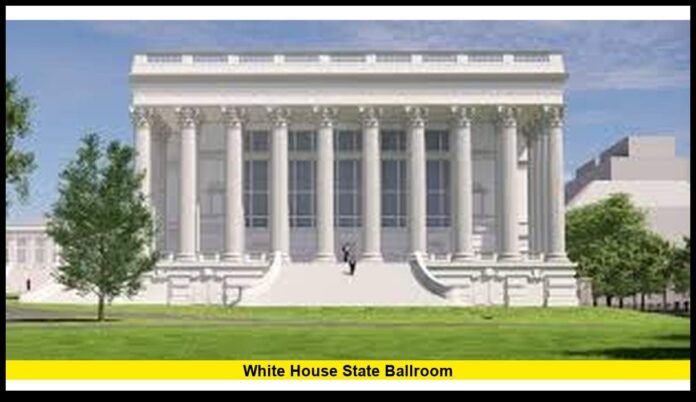

The white house state ballroom proposal is once again at the center of political debate in Washington, as Republican lawmakers explore the possibility of committing substantial federal funding to build a large ceremonial hall tied to a concept promoted during the presidency of Donald Trump.
The idea, which had previously surfaced as a privately funded offer, is now being discussed in terms of public investment. Lawmakers are weighing costs, national priorities, and long-term benefits as conversations continue. While no final approval has been granted, the issue has quickly become one of the most talked-about infrastructure discussions connected to the White House in recent years.
A Longstanding Idea Returns to the Spotlight
Plans for a larger ballroom at the White House are not new. For years, administrations have faced logistical limits when hosting large-scale events such as state dinners, diplomatic receptions, and official ceremonies.
The current White House layout includes:
- The East Room, the largest interior space available
- The State Dining Room, which accommodates smaller gatherings
- Temporary outdoor structures used for large events
These arrangements often require complex setups. Outdoor tents, for example, must be constructed, secured, and climate-controlled for each major event.
The proposed ballroom aims to solve these challenges by offering a permanent, purpose-built venue designed to handle large gatherings without temporary installations.
Core Features of the Proposed Ballroom
The white house state ballroom concept focuses on functionality, scale, and efficiency. Lawmakers and planners discussing the proposal have outlined several potential features:
- Seating capacity for several hundred guests
- A fully enclosed, climate-controlled environment
- Integrated security infrastructure
- Space for formal dining, speeches, and cultural presentations
The goal is to create a venue that meets modern diplomatic needs while maintaining the historic identity of the White House complex.
From Private Offer to Public Debate
During his time in office, Donald Trump proposed funding a ballroom at the White House using private money. His suggestion was framed as a way to enhance the building without using taxpayer funds.
That plan did not move forward.
Today, the conversation has shifted. Instead of private financing, discussions now involve federal spending. This shift has intensified scrutiny and sparked a broader debate over whether taxpayer dollars should support such a project.
Why the Proposal Is Gaining Momentum
Republican lawmakers supporting the project argue that the United States needs a more suitable space for hosting global leaders.
Their reasoning includes:
- Modern Diplomatic Needs: Large gatherings are common in international relations, and current facilities can limit guest capacity.
- Cost Efficiency Over Time: Repeated use of temporary structures adds up over the years.
- National Image: A dedicated ballroom could strengthen the presentation of U.S. diplomacy on the global stage.
Supporters also emphasize that other nations host events in large, purpose-built halls, making the absence of such a space at the White House more noticeable.
The Cost Factor Driving Debate
The financial scope of the project remains one of the most closely watched aspects.
Preliminary discussions suggest:
- Construction costs could reach hundreds of millions of dollars
- Additional expenses would come from security upgrades
- Preservation requirements may increase design and engineering costs
When combined, total projections discussed in policy circles approach the billion-dollar range.
This level of spending has drawn strong reactions from both sides of the political spectrum.
Arguments Supporting the Investment
Supporters believe the ballroom would provide lasting value.
They point to several potential benefits:
- Reduced Event Setup Costs: Eliminating repeated construction of temporary venues
- Improved Security: Permanent infrastructure allows better planning and control
- Enhanced Functionality: A dedicated space simplifies logistics for large events
Many argue that federal buildings evolve over time, and the White House should be no exception.
Criticism Focused on Spending Priorities
Opponents raise concerns about the scale and purpose of the project.
Their arguments include:
- Federal funds should prioritize essential services such as infrastructure, healthcare, and national security
- The White House already functions effectively for its current needs
- A ballroom may be seen as symbolic rather than necessary
Some critics also question whether the timing aligns with broader economic challenges facing the country.
Preservation and Design Challenges
Any addition to the White House must meet strict preservation standards.
Architects and planners would need to ensure:
- The new structure complements the existing design
- Historic elements remain untouched
- Construction does not disrupt the building’s legacy
Balancing modernization with preservation presents a significant challenge.
Experts emphasize that even small changes to the White House require careful review, making a large-scale addition especially complex.
Security Considerations
Security remains a central factor in evaluating the proposal.
A permanent ballroom could:
- Provide controlled entry points for guests
- Reduce reliance on outdoor setups that require additional security measures
- Allow for more efficient coordination among agencies
At the same time, constructing a new facility within a highly secure area introduces its own risks and logistical hurdles.
Public Opinion Across the United States
Americans remain divided on the issue.
Supporters Say:
- The White House should reflect modern global standards
- A permanent venue would improve efficiency and presentation
- The investment would serve future administrations
Opponents Say:
- The cost is too high for a ceremonial facility
- Government spending should focus on urgent needs
- The proposal may carry political symbolism rather than practical necessity
Public discussion continues across digital platforms, with strong views on both sides.
Political Impact and Broader Messaging
The debate surrounding the white house state ballroom has broader political implications.
For Republicans, backing the proposal may:
- Appeal to voters who support infrastructure improvements
- Reinforce alignment with Trump-era initiatives
- Highlight a focus on national presentation and modernization
For Democrats, opposing the project may:
- Emphasize fiscal responsibility
- Appeal to voters concerned about government spending
- Frame the issue as a question of priorities
As political campaigns evolve, the ballroom discussion could play a role in shaping voter perceptions.
Operational Changes if Approved
If the project moves forward, it would significantly change how events are hosted at the White House.
Expected Improvements:
- Large state dinners held indoors
- Greater guest capacity for international events
- Simplified logistics for planning and execution
These changes could reduce complexity and improve efficiency for future administrations.
Comparison With Other Federal Projects
Supporters often compare the proposal to other government upgrades.
Federal buildings regularly undergo modernization to meet changing needs.
Examples include:
- Renovations to legislative buildings
- Updates to military and administrative facilities
- Infrastructure improvements across federal agencies
Proponents argue that the White House should also evolve to meet modern demands.
Critics counter that ceremonial spaces differ from operational infrastructure.
Read Also – DOJ Lawsuit White House
Economic Considerations
Large construction projects typically generate economic activity.
Potential benefits include:
- Job creation in construction and engineering
- Increased demand for materials and services
- Long-term maintenance roles
However, opponents argue that economic benefits alone should not justify the scale of spending.
Current Status of the Proposal
As of now, the proposal remains under discussion.
Key confirmed points include:
- No final funding has been approved
- Lawmakers continue to debate the issue
- Planning concepts exist but are not finalized
- No construction timeline has been announced
The project remains in an early stage, with many steps required before any work could begin.
What Comes Next
Several steps must take place before the project can move forward:
- Congressional approval of funding
- Detailed architectural planning
- Preservation and security reviews
- Final budgeting and scheduling
Each phase will involve scrutiny and potential adjustments.
Why This Debate Matters
The white house state ballroom discussion reflects larger national questions about how the United States invests in its most visible institutions.
It raises issues such as:
- Balancing tradition with modernization
- Determining priorities for federal spending
- Defining the role of symbolism in government spaces
The outcome will shape not only the White House but also future conversations about national infrastructure.
Conclusion
The white house state ballroom proposal has evolved into a major political and public debate, combining questions of cost, function, and national identity. Lawmakers continue to weigh the benefits of modernization against concerns over spending and priorities. With no final decision yet, the issue remains open and continues to draw attention across the country.
Do you believe a new ballroom would improve the White House, or should the focus remain elsewhere? Share your perspective and stay informed as the story develops.