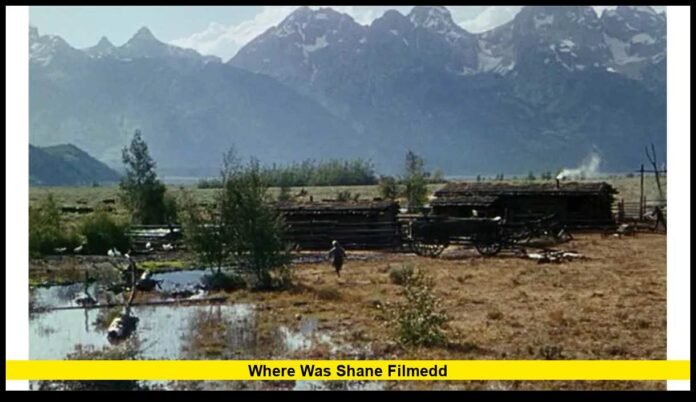

The question where was Shane filmed continues to interest classic movie fans who want to discover the real landscapes behind one of Hollywood’s most celebrated Westerns. Released in 1953, Shane starred Alan Ladd as a mysterious gunfighter who becomes involved in a conflict between hardworking homesteaders and a powerful cattle rancher. The production used the spectacular scenery of Jackson Hole and the Teton Mountains in Wyoming, along with additional locations in Southern California, to create its unforgettable frontier setting.
Directed by George Stevens, the film is remembered for its compelling characters, dramatic confrontations, and striking outdoor cinematography. Its natural surroundings play an essential role in the storytelling, making the movie particularly appealing to travelers interested in historic filming locations. Although some of the original structures were temporary movie sets, several landscapes and historic sites connected with the production can still be explored today.
Where Was the Movie Shane Filmed?
The principal filming region for Shane was Jackson Hole in northwestern Wyoming. This broad valley, surrounded by rugged mountains and open ranchland, provided an authentic Western environment that would have been difficult to reproduce entirely on a studio set.
The production also used locations associated with present-day Grand Teton National Park, including historic homestead surroundings. Additional filming locations in Southern California helped complete the movie’s visual world.
The combination of real landscapes and constructed sets was important to the finished film. Mountains, meadows, rivers, and isolated ranches established the physical setting, while purpose-built buildings supplied the details needed for the fictional town and its community.
The principal locations associated with the production include:
- Jackson Hole, Wyoming
- Grand Teton National Park, Wyoming
- The historic Luther Taylor Cabins
- Menor’s Ferry and the Snake River area
- Antelope Flats in the Jackson Hole region
- Big Bear Lake, California
- Iverson Ranch in Chatsworth, California
These locations illustrate how filmmakers used several environments to create a unified setting for the story.
Jackson Hole, Wyoming, Provided the Film’s Western Atmosphere
Jackson Hole is central to the movie’s identity. Located in northwestern Wyoming, the valley is known for its wide-open spaces, ranching traditions, mountain views, and distinctive relationship with the surrounding wilderness.
For a story about homesteaders trying to establish secure lives on the frontier, the region offered an especially convincing backdrop. The open terrain made horseback riding and ranching scenes feel natural, while the surrounding mountains created a powerful visual contrast with the characters’ everyday struggles.
The landscape also helped communicate the isolation experienced by the settlers. Homes and farms appear separated by considerable distances, emphasizing how difficult life could be when communities depended on one another for protection and support.
Rather than treating the scenery as decoration, director George Stevens used the environment to reinforce the film’s themes. The land represents opportunity, independence, and the possibility of building a new life. At the same time, its vastness suggests vulnerability when powerful interests threaten a small farming community.
Jackson Hole remains a popular destination for visitors interested in Western history, mountain scenery, and outdoor recreation. Travelers can experience the same general landscape that helped make the movie visually distinctive, although modern development and changing conditions mean that the region does not look exactly as it did in 1951.
Grand Teton National Park and the Mountains Behind Shane
Grand Teton National Park is another important part of the film’s geographical story. The park’s dramatic mountain range rises above the valley, creating one of the most recognizable natural settings in the American West.
The Teton peaks are visually striking because they rise sharply from the surrounding terrain. Their rugged profiles give the landscape a sense of scale and permanence, making them particularly effective for a movie built around frontier life and personal conflict.
The mountains also distinguish Shane from Westerns filmed primarily in deserts or arid regions. Instead of relying on dusty plains and rocky mesas, the film benefits from green valleys, mountain meadows, and expansive views of the surrounding wilderness.
This scenery supports the story’s emotional contrasts. The Starrett family’s home represents stability and the promise of a peaceful future, while the mountains and open range create a sense of freedom beyond the immediate conflict.
Visitors exploring Grand Teton National Park today can enjoy mountain viewpoints, historic areas, wildlife habitats, and scenic drives. However, not every location associated with the movie is a developed tourist attraction, and access to individual historic structures may be limited.
Anyone planning a film-location visit should check current park conditions, road closures, and site-access guidance before traveling.
The Luther Taylor Cabins and Their Connection to the Movie
Among the historic places associated with Shane, the Luther Taylor Cabins hold particular interest for movie enthusiasts.
The cabins formed part of an existing homestead in the Jackson Hole region. Unlike a purpose-built Hollywood structure, the property reflected the area’s real settlement history and provided a genuine rural setting for a scene in the film.
The history of the homestead stretches back to the early twentieth century. John Erwin established a homestead on the property around 1910, and Luther Taylor acquired it in 1923. The property included a cabin and additional buildings associated with rural life.
By the time Shane was filmed, the homestead already had a history of its own. Its appearance helped the production create a convincing sense of place without constructing every building from scratch.
The cabins are now associated with Grand Teton National Park’s historic landscape. Their connection with the movie offers a glimpse into how Hollywood productions sometimes incorporated real buildings into fictional stories.
However, visitors should not assume that the cabins function as a conventional attraction with unrestricted access. Historic structures can be fragile, and preservation requirements may limit how close visitors can get to them.
The most responsible approach is to appreciate the site’s historical significance while following current access rules and protecting the surrounding environment.
Menor’s Ferry and the Historical Importance of the Snake River
Menor’s Ferry is another location associated with the Jackson Hole region and the production’s geographical history.
Situated along the Snake River, the historic crossing represents an important part of the area’s development. Before modern transportation networks became widespread, river crossings helped connect settlements, farms, and communities.
The location also provides useful context for understanding the environment depicted in Shane. Western stories often portray remote settlements, but their survival depended on practical matters such as transportation, access to supplies, and connections with neighboring communities.
A river could serve as a valuable resource while also creating an obstacle for travelers and ranchers. Crossings therefore played a significant role in the movement of people, livestock, and goods.
For visitors interested in the historical background of the film, Menor’s Ferry offers more than a connection to Hollywood. It illustrates the challenges faced by people who established communities in the American West.
Exploring the surrounding area can also provide a better understanding of the natural features that influenced settlement patterns throughout Jackson Hole.
Antelope Flats and the Disappearing Movie Town
The Western town seen in Shane was not an entirely existing community. Production required constructed buildings to create the fictional settlement where much of the story unfolds.
Antelope Flats is associated with the area where the production established a temporary town set. Buildings such as a saloon and general store helped create the appearance of a working frontier community.
These structures were designed for filmmaking rather than permanent use. As a result, the original movie town no longer stands.
This is a common feature of classic Western production. A film may combine genuine ranches and historic buildings with temporary structures designed to meet the needs of a particular story. Once filming finishes, those sets may be dismantled or left to disappear over time.
The absence of the original town does not make the location unimportant. The surrounding landscape remains part of the region’s history, and understanding the difference between natural filming locations and constructed sets helps explain how the movie was made.
Visitors should approach the area with realistic expectations. The landscape can still be appreciated, but travelers should not expect to find the complete Western town preserved as it appeared on screen.
Big Bear Lake, California, and Additional Filming Locations
Wyoming supplied the production’s most recognizable mountain setting, but Southern California is also associated with Shane.
Big Bear Lake, located in the San Bernardino Mountains, is known for its forests, mountain scenery, and recreational opportunities. Its natural environment has made the area attractive to film productions seeking landscapes different from the urban surroundings of Los Angeles.
The region’s combination of trees, hills, and open spaces can create convincing settings for outdoor stories. Its association with Shane reflects the broader practice of combining filming locations to achieve the desired appearance.
The use of California locations also illustrates the practical considerations behind Hollywood filmmaking. Production crews needed suitable terrain, workable schedules, and access to the resources required to film outdoor scenes.
Big Bear Lake has changed considerably over the decades, and present-day visitors should not assume that every landscape or viewpoint remains identical to its appearance in the early 1950s.
Nevertheless, the area’s connection with classic filmmaking makes it interesting to travelers who enjoy exploring the real-world locations associated with older movies.
Iverson Ranch in Chatsworth, California
Iverson Ranch in Chatsworth, part of Los Angeles, is another location connected with the film’s production history.
The property became famous as a filming destination for Westerns and other movies. Its rugged terrain, rock formations, and open spaces offered filmmakers practical alternatives to building every outdoor setting in a studio.
Movie ranches were particularly valuable for Western productions because they could accommodate horses, performers, camera equipment, and action sequences. Their landscapes could also be presented as remote frontier locations, depending on camera angles and the surrounding scenery.
Iverson Ranch represents the relationship between Southern California and the development of the Hollywood Western. Many productions relied on accessible outdoor locations to create stories set in places far removed from the studios where the films were financed and produced.
Although the ranch is historically associated with movie production, current access depends on property arrangements. Travelers should verify whether a particular site is open to the public before planning a visit.
When Was Shane Filmed and Released?
Shane was filmed in 1951 and released in 1953. The production took place over several months, with photography beginning in July and continuing into October.
The movie was directed by George Stevens and distributed by Paramount Pictures. Its running time is approximately 118 minutes.
Alan Ladd played Shane, the mysterious gunfighter at the center of the story. Jean Arthur portrayed Marian Starrett, Van Heflin played her husband Joe Starrett, Brandon de Wilde portrayed their son Joey, and Jack Palance played the threatening gunfighter Jack Wilson.
The film’s production combined outdoor photography with constructed settings to create a believable Western community. This approach allowed the filmmakers to use Wyoming’s dramatic scenery while maintaining control over scenes that required carefully arranged buildings and interiors.
Its release in 1953 helped establish Shane as an enduring example of the classic Hollywood Western.
Why the Filming Locations Matter to the Story
The real locations are important because they help explain why Shane has remained visually memorable.
The open valley communicates the homesteaders’ desire for independence. The isolated ranches reflect the challenges of establishing a home far from major communities. The mountains provide a sense of grandeur, while the town set gives the conflict a clear social center.
Together, these environments create a world that feels larger than the individual characters. The settlers’ struggle is personal, but it also reflects broader questions about land, power, community, and justice.
The landscape reinforces the difference between the peaceful life the Starrett family wants and the violence that threatens to destroy it. Shane’s presence introduces another contrast: he is a skilled gunfighter whose past makes him dangerous, yet he becomes a potential protector for people who cannot defend themselves against stronger opponents.
This connection between setting and character is one reason the movie remains a significant work of Western cinema.
Can You Visit Shane’s Filming Locations Today?
Several landscapes associated with the production can still be explored, particularly around Jackson Hole and Grand Teton National Park. Other locations have changed, and some historic structures are not freely accessible.
Jackson Hole offers scenic drives, ranching history, and views of the Teton Range. Grand Teton National Park provides opportunities to explore mountain landscapes and historic areas. Menor’s Ferry adds historical context, while the broader Antelope Flats region offers open scenery connected with the movie’s temporary town set.
For visitors traveling to Southern California, Big Bear Lake provides mountain scenery, while Iverson Ranch has a long association with Hollywood Westerns. Access to specific filming sites may be restricted, so advance planning is important.
Late spring through early fall is generally a convenient period for exploring many of the Wyoming locations. Summer is especially popular, while autumn offers changing colors and cooler conditions. Winter travel requires more preparation because weather, road closures, and reduced services can affect access.
Travelers should check current conditions, follow posted rules, and avoid entering private property without permission.
Frequently Asked Questions
Where was the original Shane movie filmed?
The movie was filmed primarily in Jackson Hole and the surrounding Grand Teton region of Wyoming, with additional locations associated with Southern California.
Was Shane filmed in Grand Teton National Park?
Yes. The production used the region’s scenery, and the historic Luther Taylor Cabins are associated with a scene in the film.
Does the Shane cabin still exist?
Historic remnants of the Luther Taylor homestead remain. The site is associated with the movie, although access to individual structures may be restricted.
Was the town in Shane a real town?
The Western town shown in the movie was a constructed film set associated with the Antelope Flats area. The original buildings, including the saloon and general store, are no longer standing.
Was Shane filmed in California?
Yes. Southern California locations, including sites associated with Big Bear Lake and Iverson Ranch, are connected with the production.
When was Shane released?
The film was released in 1953 after being filmed in 1951.
Who directed Shane?
George Stevens directed the movie, with Alan Ladd starring as Shane.
Conclusion
The real locations behind Shane reveal how carefully selected landscapes helped shape one of Hollywood’s most recognizable Westerns. Jackson Hole and Grand Teton National Park provided the sweeping Wyoming scenery, while historic homesteads and constructed town sets brought the fictional frontier community to life. Additional Southern California locations demonstrate how the production combined different environments to achieve its distinctive visual style.
Although some original sets have disappeared, the region’s mountains, valleys, and historic sites continue to offer a connection to the movie’s legacy. For classic Western enthusiasts, exploring these places is an opportunity to appreciate both the film and the landscapes that helped make it memorable.
Have you explored any classic Western filming locations, or is Wyoming on your travel wish list? Share your thoughts in the comments and stay tuned for more stories about the places behind Hollywood’s most memorable movies.