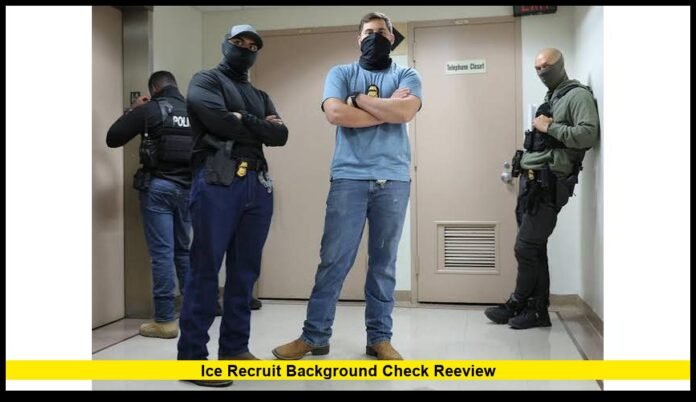

The ice recruit background check review is attracting attention as U.S. Immigration and Customs Enforcement (ICE) continues to face questions about recruitment standards, employee screening, and the process used to evaluate candidates for federal positions. For people interested in joining the agency, understanding how background investigations work has become especially important. The screening process is intended to establish whether applicants have the integrity, professional judgment, reliability, and personal conduct necessary to serve in a federal law enforcement or administrative role.
ICE recruitment involves more than submitting an application and completing an interview. Depending on the vacancy, candidates may need to undergo fingerprinting, criminal history reviews, financial checks, employment verification, reference interviews, medical assessments, and additional security-related evaluations. Some applicants may also face extended investigations before receiving final approval.
Public attention has also increased because of questions about how background screening operates during large recruitment campaigns. While the agency has established personnel-vetting requirements, the effectiveness of those procedures depends on how consistently information is collected, investigated, and evaluated.
For prospective applicants, the distinction between receiving a tentative job offer and completing the entire vetting process is particularly important. A candidate may progress through several recruitment stages without having received a final suitability determination.
Key Points Summary
– ICE conducts background investigations to evaluate the suitability and trustworthiness of prospective federal employees.
– Screening may cover criminal records, employment history, education, financial circumstances, references, and personal conduct.
– Field investigations may take approximately 45–60 days under published guidance, although the complete hiring process can take considerably longer.
– Increased recruitment activity has brought additional attention to the consistency and thoroughness of personnel screening.
– A tentative job offer does not necessarily mean that every background investigation or security requirement has been completed.
– Applicants can reduce avoidable delays by submitting accurate information and responding promptly to requests from investigators.
Why ICE Recruit Background Checks Are Receiving Attention
Background investigations are a fundamental part of federal employment, particularly for positions involving law enforcement authority, sensitive government information, or access to restricted facilities.
ICE operates within the Department of Homeland Security (DHS) and performs responsibilities connected to immigration enforcement, investigations, detention operations, and other federal activities. Employees working in these areas may exercise significant authority and interact with individuals in sensitive circumstances.
Consequently, recruitment screening is intended to establish whether candidates meet the standards associated with their positions.
The discussion surrounding ICE hiring has become more prominent as the agency’s recruitment efforts have attracted public scrutiny. Questions about hiring speed, preliminary screening, and the treatment of potential misconduct concerns have highlighted the importance of maintaining reliable safeguards even when an organization is attempting to fill positions quickly.
It is important to distinguish between concerns about recruitment procedures and evidence concerning an individual employee. An allegation, an arrest, a disciplinary record, and a confirmed finding of misconduct are not interchangeable. Each requires appropriate evaluation.
For applicants, these developments reinforce the importance of understanding the investigation process rather than relying on assumptions about how quickly a candidate can receive final approval.
Understanding the ICE Background Investigation Process
An ICE background investigation examines information relevant to a person’s eligibility and suitability for federal employment. The exact requirements depend on the position, its responsibilities, and the level of access required.
The investigation may involve multiple information sources rather than a single database search. Investigators can compare application information against official records, contact references, request documentation, and conduct interviews when necessary.
The purpose is to identify relevant concerns and establish whether the applicant satisfies the applicable federal personnel-security requirements.
1. Criminal History and Court Record Checks
Criminal history screening is among the most recognizable elements of a federal background investigation.
Depending on the position and investigation requirements, ICE may review fingerprint-based records, relevant criminal history information, and available court documentation. Investigators may examine whether an applicant has disclosed required information about previous legal incidents.
The review is not necessarily limited to recent convictions. Questions may arise about arrests, charges, unresolved cases, or other circumstances when the applicable forms and screening standards require disclosure.
However, an arrest does not establish guilt, and an allegation should not automatically be treated as a proven violation.
Investigators must consider the available information and its relevance to the position. The circumstances, seriousness, frequency, and subsequent conduct may all matter when assessing an applicant.
2. Employment History and Professional Conduct
Previous employment can provide useful information about a candidate’s professional background and reliability.
Investigators may verify employment dates, job titles, responsibilities, and other details supplied during recruitment. They may also contact former supervisors or employers when relevant to the investigation.
Issues that could require clarification include unexplained employment gaps, conflicting job dates, inaccurate descriptions of responsibilities, and discrepancies involving previous disciplinary matters.
An applicant who has changed jobs frequently is not automatically unsuitable. However, investigators may request additional details when employment records do not match the information submitted.
Candidates should prepare a complete employment history and ensure that their application accurately represents their professional experience.
3. Financial History and Credit Review
Financial information may form part of a federal background investigation, particularly when evaluating potential vulnerabilities or concerns relevant to a sensitive position.
Depending on the applicable requirements, investigators may review credit-related information, outstanding financial obligations, bankruptcies, unpaid debts, and other relevant circumstances.
The objective is not simply to determine whether someone has substantial financial resources. Financial difficulties can occur for many reasons, including unemployment, unexpected expenses, family responsibilities, and medical costs.
Investigators may consider whether the applicant has demonstrated responsible efforts to address financial obligations and whether any circumstances raise concerns relevant to the position.
A poor credit score alone should not be interpreted as an automatic ICE hiring disqualification.
4. Education and Qualification Verification
ICE applicants must provide accurate information about their educational background and professional qualifications.
Depending on the position, investigators or hiring officials may verify degrees, educational institutions, certifications, licenses, and other claimed credentials.
Candidates applying for specialized roles may need to demonstrate that they possess the qualifications specified in the vacancy announcement.
Incorrect education dates, unsupported credentials, and misleading claims about professional experience can create complications.
Applicants should review their résumés and supporting documents before submission to ensure that the information is consistent.
5. Personal References and Background Interviews
Personal and professional references can help investigators understand an applicant’s character and history.
Depending on the investigation, relevant individuals may be contacted to discuss the applicant’s reliability, judgment, conduct, and interactions with others.
Some investigations may also involve interviews with the applicant. These conversations provide an opportunity to clarify information, explain discrepancies, and address questions raised during the screening process.
Candidates should answer questions honestly and avoid guessing when they cannot remember an exact date or detail. Explaining uncertainty is preferable to providing information that could later prove inaccurate.
ICE Background Check Timeline: From Application to Final Decision
The hiring process generally moves through several stages. Understanding these stages can help applicants determine what to expect after submitting their initial paperwork.
Stage One: Initial Application Review
Recruiters assess an application to determine whether the candidate meets the position’s basic eligibility and qualification requirements. Depending on the vacancy, this can include reviewing education, work experience, professional qualifications, and other required information.
Applicants should read the vacancy announcement carefully because different ICE positions may have different eligibility requirements.
Stage Two: Fingerprinting and Security Forms
Candidates selected for further consideration may receive instructions to complete security questionnaires and submit fingerprints.
ICE’s published vetting guidance describes an initial review of security forms, criminal history results, and credit information. Officials may also determine whether an existing federal background investigation can be reused for the new position.
Incomplete paperwork or missing information can delay the process.
Stage Three: Preliminary Suitability Review
A preliminary assessment may be used to determine whether an applicant can begin working while the full investigation continues.
ICE’s published guidance explains that a risk-based preliminary determination may permit an applicant to enter on duty before the complete investigation is finished. This is not the same as final approval.
The distinction has become particularly significant amid scrutiny of ICE’s recent recruitment campaign. Reports published during 2026 described concerns about some new employees starting work before all background checks were completed.
Stage Four: Full Background Investigation
A contracted investigative service provider may coordinate the full investigation. This stage can involve a personal interview, employment verification, reference checks, and further examination of relevant records.
ICE’s published guidance estimates that field investigations typically take around 45–60 days, although the actual duration varies.
Stage Five: Final Adjudication
Once the investigation is complete, authorized officials evaluate the information and determine whether the applicant meets the applicable suitability or fitness standards.
For positions involving national security-sensitive duties or classified information, additional eligibility determinations may apply.
If investigators identify new concerns, the applicant may be contacted to provide an explanation or supporting documents before a decision is made.
Stage Six: Continuing Personnel Vetting
Background screening does not necessarily end when an employee starts working.
ICE describes continuing vetting and evaluation as part of its personnel-security framework. Depending on the applicable requirements, officials may review new information to determine whether employees continue to satisfy relevant standards.
This continuing process is intended to identify issues that emerge after hiring rather than relying exclusively on information available during the initial investigation.
Latest Update: New Questions About ICE Recruitment Standards
The latest developments as of November 10, 2026, have placed renewed attention on the difference between ICE’s established vetting procedures and their implementation during its recent hiring expansion.
A report published November 10 described a review of approximately 300 people appearing in a compromised Department of Homeland Security database. The review identified at least 19 recent ICE hires with previous misconduct allegations, criminal charges, or employment-related warning signs. The reported cases included individuals associated with use-of-force incidents, lawsuits that ended in settlements, and prior dismissals or resignations under threat of dismissal.
These findings raise questions about whether certain candidates received sufficient scrutiny before being hired or assigned responsibilities. However, the records examined represented only a small portion of the agency’s workforce, and the findings do not establish that every person identified was disqualified under federal hiring rules.
The development follows earlier reporting in 2026 about concerns raised by an ICE official responsible for overseeing background checks. The official alleged that the agency’s accelerated hiring drive had weakened preliminary screening procedures and allowed some applicants to move forward without basic checks being completed.
ICE and DHS have defended their vetting practices, pointing to established screening procedures and the use of temporary employment arrangements while full investigations remain underway.
The issue is therefore not simply whether background checks exist. It is whether required preliminary reviews are consistently completed, potential red flags are properly evaluated, and final suitability decisions are made using the available evidence.
For prospective employees, the ice recruit background check review remains relevant because these developments demonstrate why a tentative offer, an initial clearance to begin work, and a final favorable determination should be understood as separate stages.
What Can Disqualify an ICE Applicant?
There is no single list of circumstances that automatically determines the outcome of every ICE background investigation. Decisions depend on the position, applicable federal requirements, and the facts established during screening.
Nevertheless, certain issues can create substantial concerns.
- Dishonesty on application forms: Deliberately falsifying employment details, qualifications, or required disclosures can undermine an applicant’s credibility.
- Relevant criminal conduct: Serious offenses or patterns of conduct may affect suitability, depending on the circumstances and the position.
- Misconduct in previous employment: Documented dishonesty, abuse of authority, or other serious workplace issues may require careful evaluation.
- Unresolved discrepancies: Conflicting information about employment, residence, finances, or legal history can prompt additional investigation.
- Failure to cooperate: Ignoring requests for required documentation or refusing to complete necessary screening steps can jeopardize an application.
- Security-related concerns: Information that raises questions about an applicant’s trustworthiness or eligibility for sensitive duties may affect the final decision.
An issue that warrants investigation is not automatically proof that an applicant is unsuitable. Officials must evaluate the relevant circumstances under the applicable standards.
How Applicants Can Avoid Common Background Check Problems
Preparation can help candidates reduce preventable errors and respond more effectively when questions arise.
Organize Your Records Before Applying
Prepare a reliable timeline of your employment, education, addresses, and other information requested in the application. Having records available can make it easier to answer questions accurately.
Disclose Required Information Completely
Read every question carefully and follow the instructions for disclosure. Do not assume that a resolved incident or older event can be omitted when a form specifically requests it.
Correct Errors Promptly
If you discover an incorrect date, missing employer, or other mistake after submission, contact the appropriate hiring or personnel-security representative to ask how to correct it.
Prepare for Follow-Up Questions
Investigators may request clarification about previous employment, financial circumstances, or personal history. Respond factually and provide supporting documentation when available.
Monitor Official Communications
Check your email and application account regularly. Respond within stated deadlines and keep copies of submitted documents.
Protect Your Personal Information
Provide sensitive information only through authorized government systems or verified investigative channels. If you are uncertain about an investigator’s identity, use ICE’s published procedures to confirm their credentials before sharing personal records.
What Happens If an Applicant Receives an Unfavorable Decision?
An unfavorable suitability determination can prevent a candidate from obtaining or retaining a position, depending on the circumstances and applicable employment rules.
Applicants should carefully review any official notice explaining the decision. The notice may identify the relevant concerns, explain whether additional information is required, or describe available review procedures.
Where an opportunity to respond is provided, candidates should address the stated issues directly and submit relevant evidence within the required timeframe.
Applicants should not assume that every decision has the same appeal process. Available rights and procedures can depend on the type of position, the stage of employment, and the determination involved.
Frequently Asked Questions
How long does an ICE recruit background check take?
ICE guidance indicates that field investigations typically take approximately 45–60 days. The complete hiring and vetting process can take longer because it includes other recruitment stages and final adjudication.
Can ICE hire someone before the full background investigation is complete?
ICE’s published guidance allows for a risk-based preliminary determination that may permit an applicant to begin work while the full investigation continues. This does not mean the final suitability decision has been made.
Does an arrest automatically disqualify an ICE recruit?
Not necessarily. An arrest is not proof of guilt, and its relevance depends on the circumstances, the available evidence, and the requirements of the position.
Does a poor credit score mean an applicant will fail?
No. Financial information may be considered, but a low credit score alone does not automatically establish that an applicant is unsuitable for federal employment.
Can an ICE background investigation be reopened after hiring?
ICE’s personnel-vetting framework includes continuing evaluation. New information may lead to additional screening or a review of whether an employee continues to meet applicable requirements.
Can an applicant check the status of an ICE background investigation?
Applicants should monitor official communications and contact the designated hiring or personnel-security representative when appropriate. They should avoid relying on unofficial claims about their application status.
Why are ICE background checks under increased scrutiny?
Recent reports have raised questions about whether preliminary screening and full investigations were consistently completed during the agency’s hiring expansion. The findings have prompted renewed attention to how potential misconduct and other warning signs are evaluated.
Conclusion
ICE background investigations remain an important safeguard for federal employment, particularly for positions involving law enforcement authority, sensitive information, and public trust. The process can include criminal history checks, financial reviews, employment verification, interviews, and a final assessment of the applicant’s suitability.
Recent scrutiny of ICE recruitment has highlighted the importance of applying these safeguards consistently, especially when hiring increases rapidly. At the same time, allegations and isolated findings must be evaluated carefully rather than treated as proof that every applicant or employee has failed to meet the required standards.
For candidates, the best approach is to submit accurate information, disclose required details, respond promptly to investigators, and understand that a tentative offer may precede final approval. Staying informed about official hiring procedures can help applicants navigate the process with greater confidence.
Have you experienced an ICE hiring delay or background screening issue? Share your thoughts in the comments and stay tuned for the latest updates on federal recruitment and personnel vetting.