
A Real-Time Look at Humanity’s Most Advanced Orbiting Laboratory
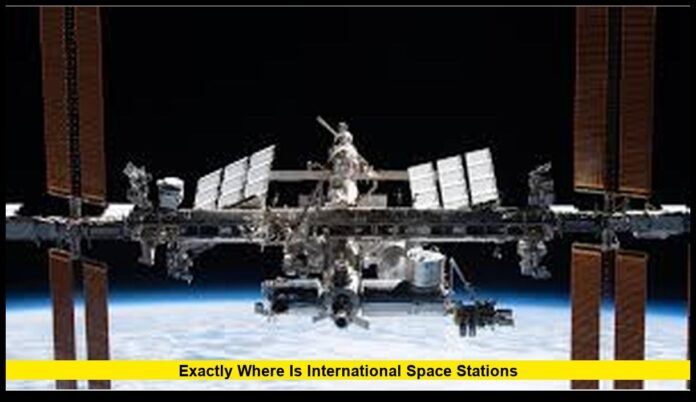
If you’re asking where is international space station, the answer is simple—but constantly changing. The International Space Station (ISS) is always moving, circling Earth at incredible speed while orbiting roughly 400 kilometers above the surface. It never stays fixed over one location, which means its position is different every minute of the day.
At any given moment, the ISS could be flying over oceans, deserts, or major cities. Within just 90 minutes, it completes a full orbit of Earth, making it one of the fastest-moving human-made objects ever built. This continuous motion is what allows it to remain in space while supporting astronauts and scientific research around the clock.
Understanding where the ISS is right now requires thinking beyond maps and borders. It’s not tied to a country or continent—it belongs to the entire planet.
The ISS Is Always Moving—Here’s Why That Matters
Unlike satellites that hover over a single region, the ISS follows a low Earth orbit that carries it across vast portions of the globe. It travels at approximately 17,000 miles per hour, fast enough to circle Earth about 15 to 16 times each day.
Because Earth rotates beneath it, the station’s path shifts with each orbit. One pass might take it over the United States, while the next brings it across Europe or Asia. This shifting pattern ensures that the ISS eventually flies over most populated areas on Earth.
For people on the ground, this means you have multiple chances to see it—even if you miss it one night.
How High Is the International Space Station?
The ISS operates in low Earth orbit, typically maintaining an altitude between 400 and 420 kilometers above the planet. That may sound far, but in cosmic terms, it’s relatively close.
To put it into perspective:
- Commercial airplanes fly at about 10 kilometers
- The edge of space begins around 100 kilometers
- The ISS orbits roughly four times higher than that boundary
This altitude allows astronauts to conduct experiments in microgravity while still being close enough for regular supply missions and crew rotations.
However, the station’s altitude is not perfectly stable. It gradually decreases due to atmospheric drag, even at that height. To counter this, mission teams perform periodic boosts using spacecraft engines to keep the ISS in its ideal orbit.
Speed: The Key to Staying in Orbit
The ISS doesn’t float—it’s constantly falling toward Earth while moving forward at immense speed. This balance between gravity and motion is what keeps it in orbit.
At roughly 27,500 kilometers per hour, the station moves fast enough to keep missing Earth as it falls toward it. This creates the effect of orbiting rather than crashing.
For astronauts onboard, this results in a continuous state of freefall, which is why they experience weightlessness.
One of the most fascinating side effects of this speed is how often the crew sees the sun. Because the ISS circles Earth so quickly, astronauts witness around 16 sunrises and sunsets every day.
Why the ISS Can Be Seen From Earth
Despite its distance, the ISS is visible to the naked eye under the right conditions. It appears as a bright, fast-moving point of light, often brighter than most stars.
There are a few reasons for its visibility:
- Its large size reflects sunlight effectively
- Its solar panels act like mirrors, increasing brightness
- It travels steadily, without blinking like an airplane
The best time to see it is shortly after sunset or before sunrise, when the sky is dark but the ISS is still illuminated by the sun.
If you’ve ever spotted a silent, fast-moving light crossing the sky, there’s a good chance you were looking at the ISS.
How to Track the ISS From Your Location
Tracking the ISS has become easier than ever thanks to modern technology. Real-time tracking tools allow you to see exactly where it is and when it will pass overhead.
These systems provide:
- Live position updates
- Predicted pass times for your area
- Visibility duration and brightness
- Direction of travel across the sky
If you’re in the United States, you can often spot the ISS several times a week, depending on weather and orbital timing.
Knowing when and where to look turns a random sighting into a planned experience.
Life Aboard the International Space Station
The ISS is not just a spacecraft—it’s a fully functioning laboratory and living environment. Astronauts from different countries live and work together for months at a time.
A typical crew includes six to seven members, each with specialized roles. Their daily routines are carefully scheduled and include:
- Conducting scientific experiments
- Maintaining station systems
- Exercising to counteract muscle and bone loss
- Communicating with mission control and the public
Living in space presents unique challenges. Even simple tasks like eating, sleeping, and moving require adjustments due to microgravity.
Despite these challenges, astronauts adapt quickly and often describe the experience as life-changing.
What Kind of Research Happens on the ISS?
The ISS serves as a platform for research that cannot be conducted on Earth. The microgravity environment allows scientists to study processes in ways that would otherwise be impossible.
Key research areas include:
- Human health and the effects of long-term space travel
- Fluid dynamics and combustion
- Plant growth in space
- Materials science and manufacturing
These studies have practical benefits on Earth, including advancements in medicine, engineering, and environmental science.
The ISS also plays a crucial role in preparing for future missions to the Moon and Mars.
Recent Activity and Ongoing Operations
The station remains highly active, with regular missions delivering supplies, equipment, and new crew members. Spacecraft from multiple countries dock and undock throughout the year, ensuring continuous support.
Crew rotations typically occur every few months, allowing fresh teams to take over operations while others return to Earth.
Maintenance is also a constant priority. Astronauts perform spacewalks to upgrade systems, repair components, and install new technology.
These ongoing efforts ensure that the ISS remains operational and productive as it continues its mission in orbit.
How Long Will the ISS Stay in Space?
The ISS has been continuously occupied since the year 2000, making it one of the longest-running human space missions in history.
Current plans aim to keep it operational until around 2030. After that, it will be safely guided back into Earth’s atmosphere, where it will break apart and fall into a remote ocean region.
This planned retirement marks the end of an era, but it also opens the door for the next generation of space stations.
Private companies are already developing commercial platforms that could replace many of the ISS’s functions.
Why the ISS Still Captures Global Attention
Even decades after its launch, the ISS continues to inspire people around the world.
It represents:
- International cooperation on an unprecedented scale
- Continuous human presence beyond Earth
- A stepping stone toward deeper space exploration
For many, it’s also a reminder that space is not as distant as it seems. The ISS is close enough to see, track, and even photograph from your own backyard.
Where Is International Space Station and Why It Matters More Than Ever
So, where is it right now?
The ISS is racing across the sky, orbiting Earth at extraordinary speed, constantly shifting its position as it circles the planet. It may be thousands of miles away at this moment, but it will pass over new regions within minutes.
Understanding where is international space station is not just about location—it’s about movement, technology, and the human drive to explore beyond our world.
Every orbit tells a story of innovation, cooperation, and discovery.
Take a moment tonight to look up at the sky—you might catch a glimpse of the ISS as it silently glides overhead, a bright symbol of human achievement in motion.
Have you ever seen the ISS pass overhead? Share your experience or check back for more updates on space and science.