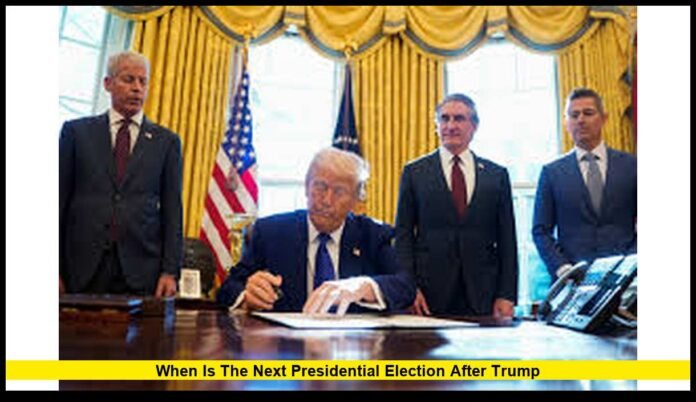

The next United States presidential election after President Donald Trump is scheduled for Tuesday, November 7, 2028. The election will mark the first presidential race following Trump’s second and constitutionally final term in office. Political attention is already shifting toward potential new candidates from both the Republican and Democratic parties as the country prepares for another major leadership transition. Key national issues such as the economy, immigration, foreign policy, and social debates are expected to shape the campaign. Many Americans are closely watching how both parties will position themselves for the next era of U.S. politics.
Why the 2028 Presidential Election Is So Important
The next United States presidential election is officially scheduled for Tuesday, November 7, 2028, and political attention is already beginning to shift toward the post-Trump era. As of today, President Donald Trump is serving his second term in office, which is considered the maximum allowed under the U.S. Constitution. Because of the two-term limit established by the 22nd Amendment, Trump will not be eligible to run for president again in 2028.
The upcoming election is expected to become one of the most closely watched political events in recent American history. Leaders from both the Republican and Democratic parties are already being discussed as possible future candidates, even though the primary election season is still years away.
Key reasons the 2028 election is receiving early attention include:
- It will determine the country’s leadership after Trump’s presidency
- Both major political parties may introduce a new generation of national leaders
- Major issues like inflation, border security, healthcare, and foreign policy are expected to dominate debates
- Voters remain deeply divided on economic and cultural priorities
- Campaign fundraising and early political endorsements are already beginning behind the scenes
Political analysts believe the 2028 race could reshape the future direction of the Republican Party as well as the Democratic Party’s national strategy. Several governors, senators, and former cabinet officials are already being mentioned in early political discussions and media coverage.
Americans are also watching how current policies on immigration, taxes, global conflicts, and the economy evolve over the next few years before deciding who should lead the country next. While the official campaigns have not yet fully started, the groundwork for the next White House race is already quietly taking shape across the nation.
The Official Date of the Next Election
Federal law sets presidential elections every four years on the Tuesday after the first Monday in November.
That means Americans will vote for the next president on:
Tuesday, November 7, 2028
The winner of the election will officially take office during the presidential inauguration on January 20, 2029.
The election will include several major races at the same time:
| Election Type | What Voters Choose |
|---|---|
| Presidential Election | President and Vice President |
| Congressional Elections | Members of Congress |
| Senate Elections | U.S. Senators in select states |
| State Elections | Governors and local officials |
Millions of Americans are expected to participate through early voting, absentee ballots, mail voting, and Election Day polling locations.
Can Donald Trump Run Again in 2028?
One of the biggest political questions Americans continue asking is whether President Donald Trump can legally run for another White House term in 2028. Under the current U.S. Constitution, the answer is no.
The restriction comes from the 22nd Amendment, which states that no person can be elected president more than twice. Trump won presidential elections in both 2016 and 2024, meaning he has already reached the constitutional limit allowed for any U.S. president.
Although his presidencies were separated by four years, the Constitution still counts them as two successful presidential elections. Because of this, Trump would not be eligible to appear as a presidential candidate in the 2028 general election.
Simple Breakdown of the Constitutional Rule
| Constitutional Rule | Result |
|---|---|
| Maximum presidential elections allowed | Two |
| Nonconsecutive terms permitted | Yes |
| Third presidential election permitted | No |
| Applies to Donald Trump | Yes |
The rule is considered one of the clearest constitutional limits in American government. It was added to the Constitution after President Franklin D. Roosevelt served four terms in office during the 1930s and 1940s. Lawmakers later introduced the amendment to prevent future presidents from remaining in power for extended periods.
As of today, there is no approved constitutional change that would allow Trump to legally seek another elected presidential term in 2028. While political debate and online speculation continue, constitutional experts across the political spectrum generally agree that the two-term limit remains firmly in place.
Why Some Americans Still Talk About a Third Trump Term
Even though the U.S. Constitution currently prevents President Donald Trump from serving a third term, discussions about “Trump 2028” continue across social media, political rallies, podcasts, and online communities. The topic remains popular among some supporters who believe Trump should continue leading the country beyond his second presidency.
In recent months, “Trump 2028” hats, shirts, and campaign-style merchandise have appeared online and at conservative political events. Some supporters view the slogan as a political statement, while others discuss possible legal or constitutional theories that could theoretically create a path for another term.
Common ideas discussed include:
- A constitutional amendment changing presidential term limits
- Legal reinterpretations of the 22nd Amendment
- Speculation about alternate political roles or influence after leaving office
- Continued leadership within the Republican Party beyond the presidency
However, constitutional experts widely agree that the legal barriers are extremely high.
To officially change the Constitution, the United States would require:
- Approval from two-thirds of both chambers of Congress
- Ratification by three-fourths of U.S. states
This process is intentionally difficult and has historically taken years, sometimes decades, to complete. Because of these requirements, major constitutional amendments rarely succeed unless there is overwhelming bipartisan support nationwide.
As of today, there is no active constitutional amendment moving through Congress that would allow Trump to seek another presidential term. Legal scholars from across the political spectrum generally agree that the current Constitution limits presidents to two elected terms.
While public debate about a possible third term continues online and in political discussions, the 2028 presidential election is currently expected to move forward with a new group of candidates from both major political parties competing for the White House.
What Happens Before the 2028 Election
Although Election Day is still years away, the presidential campaign process begins long before Americans cast ballots.
The road to the White House typically unfolds over nearly two years.
Early Candidate Activity
Potential candidates usually begin preparing well in advance by:
- Hiring campaign staff
- Raising money
- Visiting early voting states
- Building political networks
- Testing public support
Candidates often announce exploratory committees before formally entering the race.
Primary Elections and Caucuses
The presidential primaries help determine each party’s nominee.
States like Iowa and New Hampshire traditionally receive major national attention because they vote early in the process.
Candidates who perform well in early states often gain momentum, media coverage, and fundraising support.
National Party Conventions
Both parties hold national conventions during the summer before the general election.
At these events, delegates officially nominate presidential and vice presidential candidates.
The conventions also help parties introduce campaign themes and policy priorities to voters nationwide.
The General Election Campaign
Once the nominees are selected, the final phase of the campaign begins.
Candidates travel across the country holding rallies, participating in debates, running television advertisements, and targeting swing-state voters.
The final months before Election Day often dominate American news coverage.
Who Could Run in 2028?
Although the official candidate list for the 2028 United States presidential election has not yet been finalized, several well-known political figures are already attracting national attention as possible contenders for the White House.
Within the Republican Party, many political analysts are closely watching leaders connected to President Donald Trump, his administration, and the broader conservative movement. Some Republicans are expected to campaign on continuing Trump-era policies, while others may attempt to present a new direction for the party after his presidency ends.
Frequently discussed Republican names include:
- Vice President JD Vance
- Senator Marco Rubio
- Prominent Republican governors
- Conservative senators with national profiles
- Former Trump administration officials
On the Democratic side, party leaders are also expected to build a competitive field of candidates. Democrats are likely to focus on economic policy, healthcare, climate issues, reproductive rights, and national unity as they prepare for the next election cycle.
Potential Democratic contenders could include:
- Democratic governors from large states
- U.S. senators with national recognition
- Current or former cabinet officials
- Younger rising political figures
- Candidates supported by progressive and moderate wings of the party
At this stage, most possible candidates have not officially launched presidential campaigns. However, early political activity is already increasing behind the scenes through fundraising, public appearances, policy speeches, television interviews, and national travel.
Political experts expect the list of potential candidates to grow significantly over the next two years as both parties begin preparing for the 2028 primary season.
The Growing Importance of Swing States
Recent presidential elections have shown how a small number of battleground states can decide the entire election outcome.
States expected to receive heavy campaign attention in 2028 include:
- Pennsylvania
- Michigan
- Wisconsin
- Arizona
- Georgia
- Nevada
- North Carolina
These states often feature narrow vote margins between Republicans and Democrats.
Campaigns spend billions of dollars on advertising, voter outreach, polling, and organizing efforts in battleground regions.
Because the Electoral College determines the winner, swing states often carry more strategic importance than heavily Democratic or Republican states.
Understanding the Electoral College
The Electoral College remains one of the most important parts of the U.S. presidential system.
Rather than winning solely through the national popular vote, candidates must secure at least 270 electoral votes.
Each state receives electoral votes based on congressional representation.
Large states like California, Texas, Florida, and New York carry significant influence because of their population size.
Most states award all electoral votes to the statewide winner.
That system increases the importance of competitive battleground states during presidential campaigns.
Major Issues Likely to Shape the 2028 Election
Although campaign platforms are still developing, several major issues are expected to dominate political debates leading into 2028.
The Economy
Economic concerns continue influencing voters nationwide.
Topics likely to remain central include:
- Inflation
- Interest rates
- Job growth
- Energy prices
- Taxes
- Federal spending
Presidential candidates will likely focus heavily on middle-class economic concerns.
Immigration and Border Security
Immigration policy remains one of the country’s most discussed political issues.
Debates over border enforcement, asylum policy, deportation procedures, and legal immigration pathways are expected to continue through the next election cycle.
Healthcare
Healthcare costs remain a top issue for millions of Americans.
Candidates may debate:
- Prescription drug prices
- Insurance affordability
- Medicare programs
- Access to medical care
Foreign Policy
Global conflicts and international alliances could also influence the 2028 race.
Presidential candidates often campaign heavily on national security and America’s role overseas.
Supreme Court Influence
The Supreme Court continues shaping national policy on major social and legal issues.
Judicial appointments remain highly important for many voters in both parties.
How Americans Will Vote
Voting methods continue evolving across the country.
Depending on state law, Americans may vote through:
- Early in-person voting
- Mail-in voting
- Absentee ballots
- Traditional Election Day voting
- Secure ballot drop boxes
Election officials have spent recent years improving election administration systems and voting security procedures.
States continue updating voting rules and election laws ahead of future national elections.
The Role of Social Media in the 2028 Race
Social media now plays a major role in presidential campaigns.
Candidates use online platforms to:
- Reach younger voters
- Raise campaign money
- Share speeches and videos
- Respond quickly to political events
- Organize supporters
Digital campaigns now influence voter behavior almost as much as traditional television advertising.
Platforms including video apps, podcasts, livestreams, and short-form content increasingly shape political messaging.
Artificial intelligence and misinformation concerns are also expected to remain major election topics.
How Young Voters Could Influence the Election
Young Americans continue becoming a larger force in presidential elections.
College students, first-time voters, and younger working adults increasingly participate in national elections.
Issues that may motivate younger voters include:
- Student debt
- Housing affordability
- Climate policy
- Job opportunities
- Healthcare access
- Technology regulation
Both political parties are expected to spend heavily on outreach aimed at younger demographics.
What Happens After Americans Vote
The presidential election process continues even after Election Day concludes.
Several constitutional steps follow the public vote.
Vote Counting and Certification
States certify election results after counting ballots and resolving legal challenges.
Electoral College Voting
Electors formally cast their votes for president in December 2028.
Congressional Certification
Congress counts electoral votes in early January 2029.
Presidential Inauguration
The new president officially takes office on January 20, 2029.
This process has remained part of American democracy for generations.
The History Behind Presidential Term Limits
Presidential term limits became official after the ratification of the 22nd Amendment in 1951.
Before that amendment, presidents could theoretically serve unlimited terms.
President Franklin D. Roosevelt won four elections before the constitutional limit was adopted.
Since then, presidents have been restricted to two elected terms.
The amendment remains fully active today.
Why the World Watches U.S. Presidential Elections
American presidential elections influence global politics, financial markets, and international diplomacy.
World leaders monitor U.S. elections closely because American policy decisions affect:
- Military alliances
- International trade
- Energy markets
- Global security
- Climate agreements
- Technology regulation
The 2028 election will likely receive worldwide attention throughout the campaign season.
How Political Campaigning Has Changed
Modern presidential campaigns look very different from campaigns decades ago.
Candidates now rely heavily on:
- Digital advertising
- Online fundraising
- Data analytics
- Mobile communication
- Streaming interviews
- Viral video clips
Campaign teams also use advanced voter outreach systems to target specific demographic groups.
Political messaging moves faster than ever before, especially during breaking news events.
The Long Road to 2028
Although the next presidential election after Trump remains years away, political positioning has already begun.
Potential candidates continue building national profiles while political parties prepare for another highly competitive race.
Fundraising networks, campaign organizations, and voter outreach operations are expected to grow rapidly during the next two years.
By 2027 and 2028, Americans will likely see nonstop political coverage as candidates compete for momentum heading into the primaries.
What the 2028 Election Represents for America
The 2028 election represents more than just another White House contest.
It will help determine:
- The future direction of the Republican Party
- The Democratic Party’s national strategy
- Economic priorities for the next administration
- Immigration enforcement policies
- America’s international role
- Federal judicial influence for years ahead
Voters will ultimately decide which vision for the country moves forward after Trump’s final term concludes.
Final Thoughts on the Next Presidential Election After Trump
The answer to when is the next presidential election after Trump remains clear and official: Americans will vote on November 7, 2028.
That election will begin a new presidential chapter because the Constitution bars Donald Trump from seeking another elected term. As political campaigns slowly take shape, millions of Americans are already preparing for another historic election season filled with intense debate, national attention, and high voter interest.
The road to 2028 is only beginning, and the next few years will shape one of the most important presidential races in modern American history.