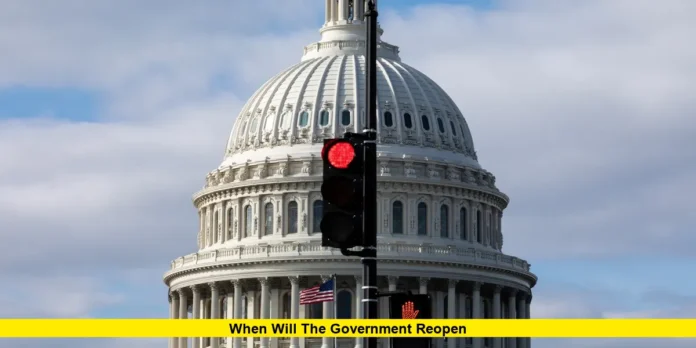

The question when will the government reopen has become one of the most pressing in the United States this month. With the federal government now more than a week into a funding lapse, hundreds of thousands of workers, families, and businesses are feeling the effects. As of today, there is still no final agreement in Washington to end the shutdown — but negotiations are intensifying.
Current Status of the Federal Shutdown
The federal government officially shut down at 12:01 a.m. EDT on October 1, 2025, after Congress failed to pass funding for the 2026 fiscal year. This triggered the closure of many government operations:
- Approximately 900,000 federal workers have been furloughed without pay.
- Around 700,000 “essential” employees, including military personnel and air traffic controllers, are working without pay until funding is restored.
- Numerous federal agencies have suspended non-essential services. Many national parks and museums are closed or operating with limited staff.
- Social safety programs like WIC are running on reserve funds and are expected to face disruptions if the shutdown continues much longer. SNAP benefits are also under strain.
This is the first government shutdown in the United States since 2019, and it’s unfolding in a politically tense environment heading into a presidential election year.
Why the Government Closed
The current shutdown is rooted in a deadlock over healthcare policy. At the center of the fight is whether to include Affordable Care Act subsidy extensions and Medicaid-related provisions in the funding package:
- Democrats, who control the Senate and the White House, want to pass a funding bill that includes these healthcare measures as nonnegotiable.
- House Republicans want to pass bills that fund the government without these additions. They argue that these policies should be debated separately, not tied to a broader spending bill.
This disagreement has blocked the usual passage of appropriations bills or a continuing resolution. The Senate has repeatedly rejected House-passed measures that omit the healthcare provisions, while House leadership has resisted bringing up Senate versions for a vote.
Why Negotiations Are Stuck
There are several reasons why a quick deal has proven difficult:
- Partisan Polarization – Both parties are framing the dispute as a test of political strength ahead of the 2026 budget cycle. Neither side wants to appear to back down.
- Leadership Pressure – The Speaker of the House is under pressure from the party’s conservative wing to hold firm on policy concessions, while the Senate Majority Leader is facing pressure from moderates and the White House to keep healthcare provisions intact.
- Timing and Leverage – Each chamber is using the shutdown as leverage to secure its preferred outcome. So far, neither side has shown signs of making the first major concession.
- Piecemeal Proposals – Some lawmakers are pushing for a strategy to reopen the government in stages, starting with bills to fund the military and essential services. However, leadership in both chambers remains divided on this approach.
How Long Could the Shutdown Last?
To understand when the government will reopen, it’s helpful to look at history. Past shutdowns offer some perspective:
- The shortest shutdowns have lasted just a few days, often ending after weekend negotiations.
- The longest shutdown in modern history lasted 35 days, from late December 2018 to late January 2019.
- Most shutdowns resolve within two to three weeks, often after public pressure mounts and economic disruptions become more severe.
Analysts watching the situation closely believe this shutdown could last multiple weeks, especially if neither side shows movement before key federal pay dates. The first major pressure point is expected in mid-October, when military and federal employee paychecks are scheduled. If the shutdown persists beyond that, political costs will rise sharply.
Steps Required to Reopen the Government
The process to reopen the government is straightforward but politically challenging:
- Congress must pass either a continuing resolution (short-term funding) or a series of appropriations bills for the new fiscal year.
- Both chambers — House and Senate — must agree on identical language, which can then be sent to the President.
- The President must sign the measure into law.
- Once funding is restored, agencies begin recalling employees and resuming services. Some functions resume immediately, while others may take days to fully restart.
Without agreement on the healthcare provisions, neither chamber has been willing to pass the other’s version, keeping the process stalled.
Potential Timelines
Here is a simplified view of the likely reopening scenarios being discussed:
| Scenario | Timeline Estimate | Description |
|---|---|---|
| Short-Term Deal | Within 1 week | A continuing resolution funds the government temporarily while debates continue on healthcare and budget policy. |
| Piecemeal Reopening | 2–3 weeks | Congress passes individual bills for defense, homeland security, or veterans’ services first, gradually restoring operations. |
| Full Budget Agreement | 3+ weeks | A comprehensive deal covers all agencies and includes a resolution on healthcare policy. |
| Prolonged Standoff | More than 1 month | Neither side compromises, leading to extended closures similar to the 2018–2019 shutdown. |
The most immediate pressure point is October 15, when missed federal paychecks could fuel stronger calls for action.
Economic and Public Impact
The shutdown is already affecting daily life for many Americans:
- Delays in federal loan processing and small business services.
- Slowed operations at IRS offices, delaying some refunds and audits.
- Reduced operations in national parks and cultural sites.
- Heightened uncertainty for government contractors and employees working without pay.
If the shutdown stretches into late October, economists expect broader economic impacts, including slower GDP growth for the quarter and potential credit market jitters.
So, When Will the Government Reopen?
The answer depends on when Congress can break its political stalemate. Negotiations are ongoing behind closed doors, with both parties facing mounting pressure from federal workers, the business community, and voters.
Some lawmakers are signaling openness to a temporary funding measure to end the shutdown quickly, while others insist on a full-year solution. The most likely outcomes are either a short-term continuing resolution passed within the next week or a piecemeal reopening over the next two to three weeks.
Until an agreement is reached, federal agencies, workers, and millions of Americans who rely on government services remain in limbo.
The situation is changing quickly. Share your thoughts below on how this shutdown is affecting you, and stay tuned for further updates.