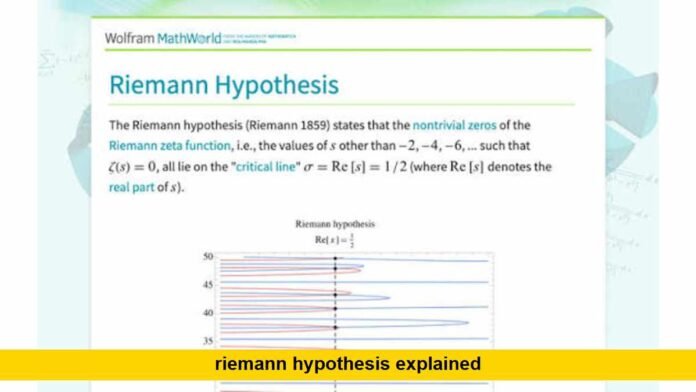

The riemann hypothesis explained topic continues to attract attention from mathematicians, researchers, science enthusiasts, and technology experts because it addresses one of the deepest unanswered questions in number theory. More than 160 years after the conjecture was introduced, researchers still have not established whether its central prediction is true, despite extensive calculations and major advances in mathematical analysis.
The problem focuses on the mathematical structure behind prime numbers, which are essential building blocks of arithmetic. Its significance extends beyond a theoretical curiosity, as the conjecture is connected to numerous mathematical results involving the distribution of primes, complex functions, and numerical estimates.
As research methods evolve and artificial intelligence begins assisting mathematical investigations, renewed interest has emerged in whether a breakthrough could finally resolve the long-standing puzzle.
The Mathematics Behind the Prime Number Question
Prime numbers are often described as the atoms of mathematics because every whole number can be built from them through multiplication. Despite their fundamental role, primes do not follow a simple sequence of gaps or predictable intervals.
The Riemann zeta function offers mathematicians a way to investigate this behavior. Written as \(\zeta(s)\), the function is initially defined through an infinite series and can be extended into the complex-number system.
Researchers study the points where the function equals zero. Certain zeros are known as trivial zeros, while the nontrivial zeros occupy a region called the critical strip.
The conjecture says those nontrivial zeros all share a real coordinate of one-half. This seemingly narrow mathematical statement has consequences for estimates describing how primes are distributed.
Why the Conjecture Has Remained Open
The challenge is not proving that some zeros follow the predicted pattern. Mathematicians have already demonstrated that infinitely many zeros lie on the critical line and have established results showing that a significant proportion do.
The difficult part is proving that no nontrivial zero ever appears away from the line, regardless of how high the zeros extend.
Computers have examined vast ranges of zeros, providing strong evidence supporting the conjecture. But finite computational checks cannot establish a claim involving infinitely many mathematical objects.
The problem therefore requires a general proof capable of covering every nontrivial zero.
A Major AI-Assisted Proof Claim Emerges in November 2026
A potentially historic development has emerged on November 20, 2026, after mathematician Levent Alpöge announced a claimed solution to the Riemann hypothesis developed with assistance from Anthropic’s AI model Claude.
The announcement has generated immediate attention because the claim reportedly goes beyond the original problem and addresses the Generalized Riemann Hypothesis, a broader conjecture involving related mathematical functions.
The proposed work reportedly includes a large collection of formal proof files written using Lean, a proof-assistant system designed to check mathematical logic. Formalization can be valuable because it allows a computer to verify whether individual logical steps follow according to the system’s rules.
However, the announcement should not yet be interpreted as confirmation that the Riemann hypothesis has been solved.
Independent mathematical verification remains the essential next step. Researchers must establish that the formal proof is complete, that the theorem being verified is precisely the claimed mathematical statement, and that the proof does not rely on assumptions that effectively presuppose the conclusion.
The development is significant as a research claim, but the distinction between an announced proof and an accepted mathematical breakthrough remains important.
What Makes Formal Proof Verification Important?
Traditional mathematical proofs are written in language that other mathematicians review, scrutinize, and challenge. Even highly respected researchers can make mistakes, overlook assumptions, or leave gaps in arguments.
Proof assistants such as Lean take a different approach. They translate mathematical reasoning into a formal structure that a computer can check.
If a proof is successfully formalized, the system can verify the logical chain rather than relying solely on a reader’s interpretation.
Nevertheless, formal verification does not eliminate every research question. Independent mathematicians still need to examine the theorem statement, the underlying definitions, the assumptions, and the relationship between the formal result and the problem researchers believe has been solved.
For a problem as consequential as the Riemann hypothesis, careful examination would be expected regardless of the technology used to produce the proof.
The $1 Million Prize and What Comes Next
The Riemann hypothesis is one of the seven Millennium Prize Problems. A qualifying solution carries a $1 million award under the Clay Mathematics Institute’s rules.
A newly announced proof does not immediately trigger the prize. The institute’s process requires a proposed solution to meet publication, review, and acceptance requirements. The mathematical community must have sufficient time to assess the result.
If the November 20 claim withstands independent scrutiny, it could become one of the most consequential mathematical developments in modern history. It would also raise major questions about how artificial intelligence can contribute to advanced scientific discovery.
Until verification is complete, the responsible description is that a proof has been claimed, but the Riemann hypothesis has not yet been officially confirmed as solved.
What the Riemann Hypothesis Explained Means for the Future of Mathematics
The riemann hypothesis explained in practical terms is a prediction that prime numbers are governed by a mathematical structure more precise than their seemingly irregular appearance suggests.
A confirmed proof would strengthen important mathematical estimates and resolve a question that has influenced generations of research. It could also demonstrate how computational tools, formal verification, and artificial intelligence can support work on problems previously considered extraordinarily difficult.
For now, the November 2026 proof announcement has created a new chapter in the story of the conjecture. The claim is attracting attention, but the mathematical community must determine whether the proposed argument is correct before the problem’s status can change.
The coming period of independent review may prove just as important as the announcement itself. If the proof survives detailed examination, the consequences would extend well beyond number theory and could mark a turning point in AI-assisted mathematics.