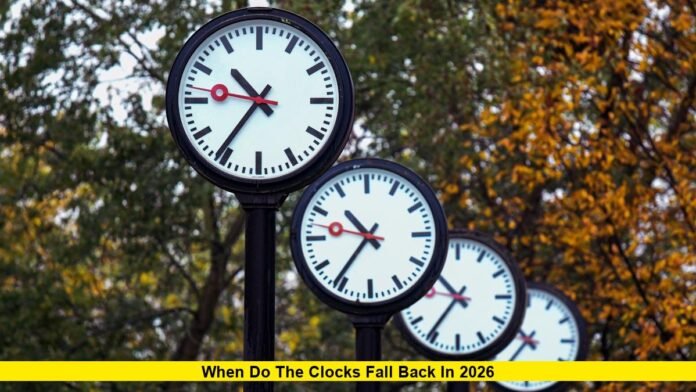

The answer to when do the clocks fall back in 2026 is Sunday, November 1, 2026. In most of the United States, Daylight Saving Time will end at 2 a.m. local daylight time, when clocks move back one hour to 1 a.m. standard time. The change gives people an extra hour on the clock overnight, but it also means earlier sunsets and darker evenings as the country moves deeper into fall.
The November time change is part of the United States’ established Daylight Saving Time schedule. Most Americans have followed the same seasonal pattern for years: clocks move forward in March and return to standard time in November. Although the debate over ending the twice-yearly clock change continues, the scheduled fall transition for 2026 remains November 1.
Planning your weekend around the time change? Check your phone, alarm clock, travel reservations, and Sunday morning appointments before October ends so the transition does not catch you off guard.
When Do the Clocks Fall Back in 2026? The Exact Date and Time
Clocks will fall back on Sunday, November 1, 2026, in most U.S. states that observe Daylight Saving Time.
The official transition occurs at 2 a.m. local daylight time. At that moment, the clock returns to 1 a.m. standard time. Instead of moving directly from 1:59 a.m. to 2 a.m., the clock repeats the hour between 1 a.m. and 2 a.m.
Here are the essential details for the 2026 fall time change:
- Date: Sunday, November 1, 2026
- Official transition: 2 a.m. becomes 1 a.m.
- Clock direction: Backward by one hour
- Time period after the change: Standard Time
- Effect on the overnight schedule: One additional clock hour
- Effect on daylight: Earlier sunrises and earlier sunsets compared with the previous day
The date follows the federal schedule established for Daylight Saving Time. Under the current rules, the seasonal period ends on the first Sunday in November.
For Americans who observe the change, the practical instruction is straightforward: turn clocks back one hour. Most people do not need to make the adjustment at exactly 2 a.m. They can change manual clocks before going to bed on Saturday, October 31, and wake up on Sunday using the correct standard time.
The transition is particularly important for anyone with an early Sunday appointment, a flight, a work shift, or a scheduled event. Because the 1 a.m. hour happens twice, digital systems and schedules may handle the transition differently depending on their settings.
Why Do Clocks Fall Back in November?
The United States changes its clocks to move between Daylight Saving Time and Standard Time. During Daylight Saving Time, clocks are advanced by one hour relative to standard time. When the seasonal period ends, clocks return to standard time.
The fall transition restores the clock to the standard time associated with each time zone. It also changes how daylight is distributed across the day according to the clock.
During the summer months, Daylight Saving Time shifts more daylight into the evening hours. This can be useful for people who want more daylight after work or school. Once standard time returns in November, sunrise and sunset occur earlier on the clock.
The change does not create additional daylight or eliminate daylight. The amount of sunlight available on a particular day depends on the season, the location, and the Earth’s position relative to the Sun. The clock adjustment changes the relationship between daylight and the times people see on their watches.
For example, someone who finishes work at 5 p.m. may have had some daylight remaining before the time change. After clocks fall back, the same clock time may occur after sunset. The person’s work schedule has not changed, but the daylight available after work has.
This distinction helps explain why the November transition can feel significant even though the clock changes by only one hour.
What Happens at 2 A.M. on November 1, 2026?
The fall transition follows a specific sequence.
On Saturday night, clocks continue to display Daylight Saving Time. When local daylight time reaches 2 a.m. on Sunday, November 1, the official change takes place. The clock returns to 1 a.m. standard time.
This means that the period between 1 a.m. and 2 a.m. occurs twice according to the local clock. The first occurrence belongs to Daylight Saving Time, while the second belongs to Standard Time.
For most people at home, the difference is simple. A clock that automatically adjusts will display the correct standard time after the transition. A manual clock that does not update itself will need to be changed.
The repeated hour can matter more for computer systems, time records, transportation schedules, and overnight employees. A digital timestamp that shows 1:30 a.m. may not identify a unique moment unless the system also records the time zone or the applicable offset from Coordinated Universal Time.
This is why businesses that operate overnight often account for the time change when scheduling employees, processing transactions, or recording events.
For everyday users, there is no need to stay awake to watch the clock change. Adjusting manual clocks before bed is generally sufficient, while automatic devices should be checked afterward if accuracy matters.
Do We Gain an Hour or Lose an Hour When Clocks Fall Back?
Americans gain one hour on the clock when Daylight Saving Time ends in November.
The change is the opposite of the spring transition. In March, clocks move forward from 2 a.m. to 3 a.m., removing an hour from the local clock schedule. In November, clocks move backward from 2 a.m. to 1 a.m., repeating an hour.
The extra hour does not mean everyone will automatically sleep for an additional 60 minutes. People who wake up according to their usual routines may still get up at the same clock time. Others may use the change to sleep longer, enjoy a slower morning, or adjust their schedules.
Consider a person who normally goes to bed at 11 p.m. Saturday and sets an alarm for 7 a.m. Sunday. If the person follows the same clock schedule after the transition, the clock will show an additional hour of elapsed time between bedtime and the alarm compared with a night of equal clock-time duration under the usual schedule.
However, individual sleep patterns vary. Some people may wake earlier than expected because their internal body clocks have not immediately adjusted to the new schedule.
The time change can therefore offer an extra clock hour without guaranteeing an extra hour of restorative sleep. Maintaining a consistent bedtime and wake-up routine can help make the transition easier.
Which U.S. States Change Their Clocks in 2026?
Most U.S. states observe Daylight Saving Time and will turn their clocks back on November 1, 2026.
However, the rule does not apply uniformly throughout the country. Hawaii and most of Arizona do not observe Daylight Saving Time. As a result, they do not make the November clock adjustment.
The Navajo Nation, which extends across parts of Arizona, Utah, and New Mexico, observes Daylight Saving Time. This creates an important distinction within Arizona: most of the state stays on standard time throughout the year, while the Navajo Nation follows the seasonal clock schedule.
Several U.S. territories also do not observe Daylight Saving Time. These include Puerto Rico, Guam, American Samoa, the U.S. Virgin Islands, and the Northern Mariana Islands.
For residents of places that do not observe the seasonal change, November 1 is not a day to turn clocks back. Their local clocks remain on the same time standard, although the time difference between those locations and places that do observe Daylight Saving Time can change.
Travelers should pay particular attention to this distinction. A person flying from Phoenix to Denver, for example, may experience a change in the time difference between the cities when Denver switches to standard time and most of Arizona does not. The local time displayed at each destination remains governed by that location’s own time-zone rules.
People who live near state borders should also check the local rules rather than assuming that every location within a particular region makes the same change.
How the November Time Change Affects Sunrise and Sunset
One of the most noticeable effects of falling back is the shift in daylight hours according to the clock.
After the transition, sunrise and sunset occur approximately one hour earlier on the clock than they would under the previous daylight-time schedule, all else being equal. The actual difference in sunrise and sunset from one calendar day to the next also reflects the seasonal movement of daylight.
For many people, this means brighter mornings and darker evenings. Someone who drives to work shortly after sunrise may find the morning commute brighter for a period after the change. However, a person who leaves work late in the afternoon may find that darkness arrives sooner.
The effect varies by latitude, location, weather, and the time of year. Northern parts of the United States experience particularly short daylight periods as winter approaches, while southern locations generally retain longer days.
The November clock change does not stop the seasonal reduction in daylight. Days continue to shorten toward the winter solstice in December. The time change simply alters the clock readings associated with sunrise and sunset.
A Practical Example of the Daylight Shift
Imagine a worker who leaves home at 7 a.m. and returns at 5:30 p.m.
Before the November change, the worker may travel to work while the sky is still dim and return home with some daylight remaining. After clocks fall back, the morning trip may be brighter, but the evening commute may take place in darkness.
The worker has not changed the departure time, the length of the commute, or the workday. The difference comes from the clock adjustment and the continuing seasonal change in daylight.
This example illustrates why the time change can affect daily routines differently. People who value morning light may appreciate the adjustment, while those who spend much of the day indoors may notice the loss of evening daylight more strongly.
Will Phones and Computers Change Automatically?
Most modern smartphones, computers, tablets, and internet-connected devices can adjust automatically when their time-zone settings are configured correctly.
For many users, no manual action will be necessary on November 1. The device will follow the local time-zone rules and display standard time after the transition.
Nevertheless, automatic adjustment is not universal. A device with automatic date and time disabled may retain an incorrect clock setting. Some older appliances, vehicle clocks, watches, and standalone electronic devices also require manual adjustment.
Before the time change, check the following:
- Smartphones and tablets
- Laptop and desktop computers
- Wall clocks and traditional alarm clocks
- Watches that do not synchronize automatically
- Vehicle dashboard clocks
- Kitchen appliances and other household electronics
- Smart-home systems and connected alarms
Pay particular attention to alarms and reminders. A phone that uses automatic time-zone settings should normally update itself, but a manually configured device may not.
For important appointments, check the displayed time after waking up on November 1. This is especially useful if you rely on multiple devices that may not all update in the same way.
Businesses and people managing technical systems should also ensure that software uses current time-zone rules. Correct time-zone configuration is important for calendar invitations, transaction logs, scheduled processes, and records created during the repeated hour.
How Falling Back Affects Travel, Work, and Appointments
The November time change can affect travel plans, work schedules, and appointments, particularly when activities take place overnight.
Airlines, airports, rail services, hotels, and other travel providers operate according to local time-zone rules and their published schedules. Travelers should rely on the departure or arrival time shown in their current reservation and check for any schedule updates before leaving home.
A flight departing early on Sunday, November 1, may involve a different local clock calculation than a flight scheduled for the previous evening. The time change does not automatically mean that every flight will depart an hour later or earlier. The actual schedule depends on the carrier, route, and published departure time.
The same principle applies to hotel check-in times, rental car reservations, and ground transportation. A reservation for 8 a.m. remains a reservation for 8 a.m. local time unless the provider changes it.
For people working overnight shifts, the repeated hour can have a more direct effect. An employee scheduled from midnight to 8 a.m. may work through two occurrences of the 1 a.m. hour. Depending on workplace policies and applicable employment rules, the change can affect timekeeping and the calculation of hours worked.
Employers should communicate how overnight schedules will be recorded. Employees should review their schedules and follow their workplace’s instructions rather than assuming the shift will be shortened or extended in a particular way.
Appointments also deserve attention. A medical appointment, examination, or early-morning meeting should be checked against the calendar entry and the local time at the appointment location. This is especially important for people coordinating across multiple time zones.
What Should You Do Before the Clocks Fall Back?
The simplest way to prepare for November 1 is to review the devices and commitments that depend on accurate time.
You do not need to make major changes to your routine. A short checklist can help prevent confusion during the weekend.
1. Adjust manual clocks before bed.
Set traditional clocks and watches back one hour on Saturday night, October 31. This allows you to wake up with the correct time on Sunday morning.
2. Check automatic time settings.
Make sure your smartphone and computer use the correct time zone and have automatic time updates enabled. This reduces the chance of a missed alarm or incorrect calendar display.
3. Review Sunday appointments.
Check early appointments, work shifts, travel arrangements, and family commitments. If another person or business is involved, use the latest schedule provided by that organization.
4. Prepare for darker evenings.
Consider how the earlier sunset affects your commute, exercise routine, and outdoor activities. If you walk or cycle after work, allow time to adjust to the change in visibility.
5. Check household safety devices.
Use the seasonal clock change as a reminder to review smoke alarms and carbon monoxide alarms. Follow the manufacturer’s instructions for testing devices and replacing batteries where appropriate. Not every alarm requires a battery replacement, so avoid replacing components unnecessarily.
6. Keep your sleep schedule consistent.
The extra hour can make the transition feel easier, but irregular bedtimes may still leave you tired. Maintaining a regular sleep routine can help your body adapt.
7. Check clocks in vehicles and appliances.
Some devices do not synchronize with internet time. Confirm that the clocks you rely on most display the correct local time after the change.
These steps are useful because the most common problems associated with a time change are practical rather than complicated. A clock that is wrong by one hour can cause someone to arrive too early or too late, even when the person has made no other scheduling mistake.
Does Daylight Saving Time End on the Same Date Every Year?
No. The exact calendar date changes from year to year, although the United States generally follows a consistent rule.
Under the current federal schedule, Daylight Saving Time ends on the first Sunday in November. That means the date can fall anywhere from November 1 through November 7.
The date in 2026 is November 1 because that day is the first Sunday of the month.
The same rule explains why the transition occurred on November 2 in 2025 and is scheduled for November 7 in 2027. The calendar date changes, but the underlying rule remains the same unless the law changes.
The spring transition follows a corresponding rule: Daylight Saving Time begins on the second Sunday in March. In 2026, that date was March 8.
This calendar pattern is useful for planning ahead. People do not need to memorize the date for every future year if they remember the rule, but checking the annual calendar is still sensible before making travel arrangements or scheduling important events.
The time change is also not necessarily identical in every country. Different nations and regions use different seasonal clock policies, and some do not observe Daylight Saving Time at all. International travelers should therefore check local time rules rather than applying the U.S. schedule worldwide.
Will the United States Stop Changing the Clocks?
The possibility of ending seasonal clock changes remains a recurring subject of public debate in the United States.
Some people favor permanent Daylight Saving Time because they want more daylight during the evening. Others prefer permanent standard time, arguing that it better aligns the clock with morning daylight and the body’s natural sleep-wake cycle.
These are different proposals. Permanent Daylight Saving Time would keep clocks on the daylight-time schedule throughout the year. Permanent standard time would eliminate the spring-forward and fall-back transitions by keeping the standard-time schedule year-round.
Under the existing federal framework, states generally cannot independently adopt permanent Daylight Saving Time without a change in federal law. States may choose to exempt themselves from observing Daylight Saving Time and remain on standard time, subject to the applicable legal requirements.
The distinction matters because eliminating the clock change does not automatically determine which time standard a state would use. A decision to stop changing clocks requires clarity about whether the jurisdiction would remain on standard time or adopt daylight time permanently under a legally authorized system.
As of the latest available information for this article, the scheduled fall transition remains November 1, 2026. The continuing public debate should not be confused with an enacted nationwide change to the existing calendar.
For households and businesses, the practical approach is to plan around the established date unless an applicable legal change is adopted. Predictions about future legislation or political support should not be treated as a replacement for the schedule currently in effect.
Why the Fall Time Change Can Feel Different From the Spring Change
Although both seasonal transitions move clocks by one hour, people may experience them differently.
In spring, clocks jump forward. The transition removes an hour from the local clock schedule and can temporarily disrupt sleep for people who have difficulty adjusting. In fall, clocks move backward, creating a repeated hour and offering more flexibility for some people to rest.
However, the fall change also arrives when daylight is decreasing and temperatures are often becoming cooler in much of the country. The earlier sunset can affect outdoor exercise, commuting, recreation, and family schedules.
The effect on sleep is not identical for everyone. A person who naturally wakes early may welcome brighter mornings, while someone who prefers evening activities may find the earlier darkness inconvenient. People working rotating shifts may face additional scheduling challenges because their working hours can intersect with the repeated hour.
A useful way to understand the transition is to separate three factors: the clock itself, the body’s internal timing, and the seasonal availability of daylight.
The clock changes instantly according to the official rule. The body’s sleep-wake rhythm may take longer to adapt. Meanwhile, the season continues to influence sunrise and sunset regardless of the clock adjustment.
Keeping these factors separate helps explain why the extra hour does not necessarily make the transition effortless. It also shows why a small amount of planning can make the weekend easier.
What Time Will It Be After the Clocks Fall Back?
The official transition takes place at 2 a.m. local daylight time on November 1, 2026. The clock then displays 1 a.m. standard time.
The exact time-zone abbreviation depends on where you live. For example, Eastern Daylight Time becomes Eastern Standard Time, Central Daylight Time becomes Central Standard Time, Mountain Daylight Time becomes Mountain Standard Time, and Pacific Daylight Time becomes Pacific Standard Time.
The same general rule applies across the U.S. time zones that observe Daylight Saving Time, although locations outside the continental United States may use other time-zone names.
The transition can affect time differences between locations. When one location changes its clocks and another does not, the number of hours separating them may change.
For example, a person scheduling a video call with someone in Hawaii should check the time difference after the November transition. Hawaii does not observe Daylight Saving Time, while most mainland U.S. locations do. As a result, the difference between their local clock readings may be different after November 1.
Calendar applications that recognize time zones generally account for these changes automatically. Problems are more likely when people manually enter a time without identifying the relevant time zone or when a device uses incorrect settings.
For international meetings, travel, and remote work, using a calendar that correctly identifies each participant’s time zone is safer than relying on a remembered time difference.
When Does Daylight Saving Time Start Again in 2027?
After the November 2026 transition, most Americans will remain on standard time until Daylight Saving Time begins again in March 2027.
Under the current schedule, the next spring transition is Sunday, March 14, 2027. At 2 a.m. local standard time, clocks will move forward to 3 a.m. daylight time.
This means the period of standard time will last from November 1, 2026, until March 14, 2027, in places that observe both seasonal transitions.
The spring change reverses the clock adjustment made in November. Instead of repeating an hour, the local clock skips from 1:59 a.m. to 3 a.m. The resulting day has one fewer clock hour.
For people planning vacations, work schedules, or recurring appointments, knowing both dates can help prevent confusion. The November change marks the return to standard time, while the March transition restores Daylight Saving Time.
However, the two dates should not be confused with the astronomical beginning of winter or spring. Seasonal clock changes are determined by law, while the astronomical seasons are based on the Earth’s position relative to the Sun.
FAQs
When do the clocks fall back in 2026 in the United States?
Clocks fall back on Sunday, November 1, 2026, in most of the United States. At 2 a.m. local daylight time, clocks move back one hour to 1 a.m. standard time.
Do we gain an hour of sleep on November 1, 2026?
The time change creates an additional hour on the clock overnight. You may have an opportunity to sleep longer, but whether you actually gain an hour of sleep depends on your bedtime, wake-up routine, and individual sleep patterns.
Should I change my clocks on Saturday night or Sunday morning?
You can change manual clocks before going to bed on Saturday, October 31, or adjust them after waking up on Sunday, November 1. Both approaches produce the correct time as long as you move the clock back one hour.
Will my phone change time automatically?
Most smartphones and computers update automatically when automatic date, time, and time-zone settings are enabled. Check your device settings if you are unsure whether the adjustment will occur.
Do Arizona and Hawaii fall back in November 2026?
Hawaii and most of Arizona do not observe Daylight Saving Time, so they do not make the November clock adjustment. The Navajo Nation in Arizona observes Daylight Saving Time, making its rules different from those followed by most of the state.
Will sunset happen earlier after the clocks fall back?
Yes, sunset will occur earlier according to the clock after the transition, although the exact times depend on your location and the seasonal change in daylight. The shift generally means less daylight during the evening hours.
Is the United States ending Daylight Saving Time in 2026?
The scheduled November 1 transition remains in place under the current rules. Discussions about permanent standard time or permanent Daylight Saving Time do not themselves change the official schedule.
Final Takeaway: Prepare for November 1, 2026
The clocks fall back on Sunday, November 1, 2026, in most of the United States. At 2 a.m., local daylight time returns to 1 a.m. standard time, giving people an extra clock hour overnight and shifting daylight toward the morning.
Although most connected devices will adjust automatically, checking manual clocks, alarm settings, appointments, and travel plans can prevent unnecessary confusion. The earlier evening darkness is also a reminder to prepare for changing daylight conditions as winter approaches.
The key date to remember is November 1. Planning ahead makes it easier to handle the transition without disrupting important commitments or daily routines.
Have you started preparing for the 2026 fall time change? Share how you plan to adjust your schedule, and stay tuned for the latest updates on Daylight Saving Time.