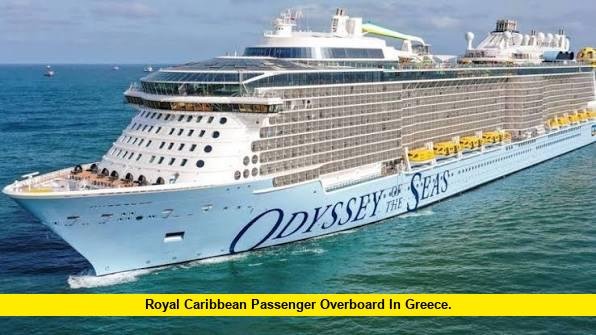

The royal caribbean passenger overboard Greece incident has drawn international attention after a 44-year-old woman from El Salvador was rescued alive following approximately 20 hours in the Ionian Sea. The passenger was aboard Royal Caribbean’s Odyssey of the Seas when she went overboard during a voyage near the Greek island of Zakynthos. Greek rescue teams, military aviation personnel, the cruise ship and other vessels participated in the search that ultimately led to her recovery.
The latest update centers on the circumstances surrounding the incident and the extraordinary rescue. Greek Coast Guard officials said the woman later told rescuers that she had jumped from the ship because she wanted to disembark. She was found alive inside a life ring, received initial medical assistance and was transported ashore for hospital evaluation. The incident has raised important questions about passenger safety, emergency response and the challenges of conducting search operations far from land.
Follow the latest developments in this case and share your thoughts on the safety measures cruise passengers should expect during international voyages.
Latest Update on the Royal Caribbean Passenger Overboard Incident
The incident occurred on October 9, 2026, while Odyssey of the Seas was sailing through the Ionian Sea southwest of Zakynthos, Greece. The passenger was reported overboard, prompting a search operation involving Greek maritime authorities and nearby vessels.
The search continued into October 10, when a cargo ship participating in the operation located the woman floating in a life ring. She was conscious when rescuers reached her, according to information released by the Greek Coast Guard.
The successful recovery brought an end to a search that had lasted approximately 20 hours. The woman was taken to a Greek port and then transported to a hospital for medical monitoring and examination.
Subsequent reporting added another significant detail: the woman reportedly told rescuers that she had intentionally jumped from the cruise ship because she wanted to leave the vessel. That account distinguishes the incident from an accidental fall, although the complete circumstances surrounding her actions remain a matter for the relevant authorities to examine.
The case has attracted attention because surviving such a prolonged period in open water is unusual. It also illustrates how quickly a situation aboard a large passenger vessel can become a complex international search-and-rescue operation.
What Happened Aboard Odyssey of the Seas?
Odyssey of the Seas was traveling on a Greek Isles itinerary that began in Civitavecchia, Italy. The voyage included destinations in the eastern Mediterranean before the ship headed toward Naples, Italy, on the final portion of its scheduled journey.
The woman went overboard while the vessel was sailing through the Ionian Sea. Once the incident was reported, the ship and responding authorities began efforts to locate her.
Initial information indicated that the passenger had gone into the water during the early morning hours. Authorities were subsequently alerted, and the search expanded to include additional maritime and aerial resources.
The distance between the incident area and the nearest coastline made the operation particularly challenging. Search personnel had to cover an area of open water where a person could be difficult to see, especially in changing light conditions and against the surrounding sea.
A person in the water also presents a much smaller visual target than a vessel. Even when a life ring is present, waves, distance and visibility can complicate detection from a ship or aircraft.
The successful rescue depended on locating the passenger and coordinating the transfer from the water to a rescue vessel. The operation ultimately demonstrated the importance of cooperation between commercial shipping and national emergency services.
Where Did the Passenger Go Overboard in Greece?
The incident took place in the Ionian Sea, southwest of Zakynthos, one of the Greek islands in the western part of the country. The surrounding waters are used by cruise ships, cargo vessels and other commercial and recreational traffic.
Reports placed the woman roughly 70 to 80 nautical miles southwest of Zakynthos, although published distance estimates vary. The important geographic detail is that she was far offshore rather than immediately beside a port or beach.
That distance had direct implications for the search. Rescue crews could not simply reach the nearest shoreline and expect to find her. They needed to locate a person in open water, determine the safest way to recover her and transport her to medical care.
The Ionian Sea is part of the Mediterranean region, but the incident highlights how different an offshore emergency can be from an incident in a protected harbor. A person who enters the water far from land may have limited access to immediate assistance, even when commercial vessels operate in the wider area.
Zakynthos provided a useful geographic reference for the search, but the operation extended well beyond the island’s coastal waters. The cargo ship that eventually spotted the passenger played a decisive role in bringing the search to a successful conclusion.
How the Search and Rescue Operation Unfolded
Greek maritime authorities activated an emergency response after receiving information that a passenger had gone overboard. The operation brought together several different resources rather than relying on the cruise ship alone.
The Hellenic Coast Guard deployed patrol and rescue vessels. A helicopter operated by the Greek military also participated, while nearby commercial ships were involved in the search. Odyssey of the Seas contributed to the efforts as authorities worked to locate the missing passenger.
Each resource offered a different advantage.
Coast Guard vessels could approach a person in the water and carry out a recovery. Aircraft could survey a larger area from above, potentially identifying a life ring or other visible sign that might be difficult to spot from sea level. Commercial ships already operating in the region could help extend the search area without waiting for specialized responders to reach every part of it.
The involvement of the cargo ship MSC Rossella III proved especially important. The vessel spotted the woman during the early hours of October 10, when she was floating in a life ring.
After the discovery, rescue personnel coordinated her recovery. A Greek Coast Guard vessel took her aboard, and she received first aid before being transported to shore.
The operation illustrates why cooperation between civilian shipping and government rescue services matters. Commercial vessels travel through extensive maritime corridors, and their crews can sometimes identify a person or object that specialized search teams have not yet located.
However, the successful outcome should not obscure the danger of the circumstances. The woman remained in open water for many hours, and the eventual rescue does not mean that comparable incidents will have similar outcomes.
How the Woman Survived Approximately 20 Hours in the Water
One of the most striking aspects of the incident is the length of time the passenger remained at sea. Greek Coast Guard information placed the duration at approximately 20 hours before she was recovered.
She was found inside a life ring, which was an important factor in her survival. A flotation device can help keep a person above the surface and reduce the effort required to remain afloat. It can also make a person easier for search crews to identify, particularly when the device has a bright color.
The woman was conscious when she was located. Rescue personnel provided first aid, and she was taken to a hospital for examination and monitoring.
The available information does not establish every factor that contributed to her survival. Her precise physical condition throughout the time in the water, the full environmental conditions and the details of how she maintained her position are not all publicly established.
It would therefore be misleading to attribute the outcome to a single cause. The life ring, the eventual sighting by a cargo ship and the coordinated response all formed part of the rescue, but the precise contribution of each factor cannot be measured from the public information alone.
The incident nevertheless provides a clear practical lesson for cruise passengers: flotation equipment and rapid reporting can be critical during a maritime emergency. Neither guarantees survival, and neither makes entering the water safe.
What the Passenger Reportedly Told Rescuers
Later reports supplied an important detail about the circumstances of the incident. According to a Greek Coast Guard spokesperson, the woman said she had jumped from the ship because she wanted to disembark.
That statement has become a central part of the public discussion surrounding the case. It suggests that the incident was not simply an accidental fall, but it does not by itself explain everything that happened before the passenger entered the water.
The publicly reported explanation should be distinguished from assumptions about her personal circumstances or state of mind. Without further reliable information, it would be inappropriate to speculate about her motives beyond the account attributed to the Coast Guard.
Reports also indicated that a psychiatric evaluation was ordered as part of the medical and legal follow-up. Such reporting does not establish a psychiatric diagnosis, nor does it provide a complete explanation for the woman’s actions.
The relevant authorities are responsible for examining the circumstances and determining whether any additional steps are necessary. Until more information becomes available, the reported statement about wanting to disembark remains the principal publicly described explanation.
The distinction matters because a serious maritime incident can involve several separate questions: what happened physically, when the ship’s crew became aware of it, how the search was organized and what circumstances led the passenger to enter the water. Those questions should not be treated as interchangeable.
The Passenger’s Medical Evaluation After Rescue
After she was recovered, the woman was transported to the port of Katakolo in western Greece and then taken to a hospital in nearby Pyrgos.
Her medical evaluation followed an extended period in the sea. Prolonged immersion can expose a person to cold stress, exhaustion, dehydration and other complications, depending on water temperature, weather, clothing, physical condition and other circumstances.
Hospital observation is important even when a rescued person appears conscious and responsive. Some effects of prolonged exposure may require medical assessment, and a person’s condition can change after the immediate emergency has ended.
Reports described medical monitoring and examinations, including a psychiatric evaluation ordered by a local prosecutor. The precise outcome of the complete medical assessment has not been established in the public information available for this update.
The woman’s identity has not been publicly established in the reporting reviewed for this article. Respecting that distinction is important, particularly when a case involves medical care and potentially sensitive personal circumstances.
The immediate priority after a rescue is to stabilize the person, assess injuries or exposure-related problems and provide appropriate treatment. Questions about the events aboard the ship can then be examined separately through the relevant investigative process.
Why Odyssey of the Seas Changed Its Cruise Itinerary
The search operation also affected the ship’s scheduled voyage. Odyssey of the Seas was heading toward Naples, Italy, when the passenger went overboard. The vessel participated in the search rather than simply continuing its planned itinerary.
The scheduled stop in Naples was ultimately canceled as the search continued. That decision affected passengers who had expected to visit the Italian port during the final part of their cruise.
Missing a scheduled destination can be disappointing for travelers, particularly those who have arranged excursions, transportation or sightseeing around a specific arrival time. However, an active search for a missing passenger presents a different set of priorities from routine itinerary management.
A vessel involved in an overboard emergency may need to change course, coordinate with rescue authorities and remain in the search area. These actions can affect arrival times, port calls and other scheduled activities.
The cancellation also illustrates an important distinction between the passenger experience and the operational responsibilities of a cruise ship. Guests purchase a planned itinerary, but maritime emergencies can require changes when safety and rescue operations take precedence.
There is no basis for assuming that every itinerary adjustment during an emergency follows the same procedure. Decisions depend on the circumstances, the ship’s position, the needs of the search and coordination with the authorities involved.
In this case, the canceled Naples stop was a direct consequence of the extended search effort. The rescue operation remained the immediate priority until the passenger was located and recovered.
What the Incident Reveals About Cruise Ship Safety
The incident highlights the challenges of responding when someone goes overboard from a large cruise ship.
Modern cruise ships operate with safety procedures intended to reduce risks and respond to emergencies. However, the distance between a person in the water and the vessel can increase rapidly, making early detection and accurate information especially important.
When a passenger enters the sea, several factors can influence the response: the time the incident occurred, when the crew became aware of it, the ship’s position, the availability of flotation equipment and the conditions in the surrounding water.
The time needed to identify an incident is particularly important. If a person is reported missing before anyone knows that they have entered the water, the search team may initially have to establish whether the individual is aboard the vessel or somewhere else.
Once an overboard situation is identified, responders need information that can help narrow the search area. The ship’s location, the estimated time of entry into the water and the direction of travel can all help determine where to look.
The Greece incident demonstrates the importance of coordination between a cruise operator and government rescue agencies. It also shows that other vessels can become essential participants in an emergency, even when they were not originally assigned to rescue duties.
An important distinction: A successful rescue does not establish whether every safety procedure worked as intended. That question requires a separate examination of the incident’s timeline, the available evidence and the actions taken by the relevant parties.
The outcome is encouraging, but the broader safety lessons depend on understanding the full sequence of events rather than treating survival alone as proof of a particular system’s effectiveness.
How Overboard Emergencies Differ From Other Cruise Incidents
Cruise ship emergencies vary considerably in their causes, risks and response requirements. A medical emergency inside a passenger cabin, an accident on a deck and a person entering open water each demand different procedures.
An onboard medical emergency may allow medical personnel to reach a passenger within minutes. A person who goes overboard can be separated from the ship almost immediately, and recovery may require a coordinated operation involving multiple vessels and aircraft.
The Greece incident illustrates this difference particularly clearly.
The passenger was far offshore, and the search continued for approximately 20 hours before a cargo ship located her. Her presence inside a life ring helped make recovery possible, but responders still needed to find her in a large area of open water.
Consider the practical difference between two situations. If a passenger needs assistance inside a ship’s public area, crew members may be able to reach that individual directly. If a passenger enters the sea far from land, the ship must locate a much smaller target while accounting for its own movement and the conditions affecting the person in the water.
These scenarios should not be compared simply by counting how long each emergency lasts. Their underlying challenges are different.
An overboard incident requires locating the person, determining the safest recovery method and transferring the individual to appropriate medical care. A prolonged search can also affect the ship’s itinerary and the activities of passengers who are not directly involved in the emergency.
Understanding these differences helps explain why cruise ships may change course and why multiple agencies can become involved in a single incident.
What Cruise Passengers Should Know About Overboard Safety
Passengers preparing for a cruise can take practical steps to become more familiar with safety procedures without assuming that every emergency can be prevented through individual precautions.
Pay attention to the safety briefing
Cruise lines provide safety information intended to help passengers understand emergency procedures. Guests should pay attention to instructions, learn where designated assembly stations are located and follow crew directions during an emergency.
These briefings are not merely formalities. They help passengers understand how the ship communicates important information and where they should go if an evacuation or other emergency response becomes necessary.
Follow rules around railings and restricted areas
Passengers should follow posted safety instructions, avoid climbing or sitting on railings and stay away from restricted areas. These precautions reduce unnecessary exposure to dangerous situations.
Railings and barriers are designed to support safety, but passengers should never treat them as places to climb or lean in ways that could lead to a fall.
Report a missing person or suspected overboard incident immediately
If a passenger sees someone enter the water or has a credible reason to believe a person has gone overboard, they should alert a crew member immediately.
Timely reporting can provide information that helps the crew establish what happened and begin the appropriate response. Witnesses should share the location, approximate time and any other relevant details they observed rather than attempting to conduct a dangerous rescue themselves.
Do not enter the water to attempt an untrained rescue
Jumping into the sea to assist another person can create an additional emergency. Open water presents risks that may not be obvious from a ship’s deck, and an untrained person may struggle to remain afloat or reach the individual safely.
Passengers should alert the crew and follow emergency instructions. Trained responders have equipment and procedures designed for recovery operations.
Follow official updates during an emergency
When a serious incident affects a cruise, passengers may receive instructions or itinerary information through announcements and other official communications.
Travelers should rely on information supplied by the ship and relevant authorities rather than treating unverified social media claims as established facts. This is particularly important when details about a missing passenger, an ongoing search or a medical emergency remain incomplete.
These precautions cannot eliminate every risk, but they can help passengers respond more appropriately when a dangerous situation develops.
What Happens Next in the Greek Investigation?
The incident was referred to the Katakolo Port Authority for investigation. The authorities’ examination is separate from the immediate rescue operation and may address the circumstances surrounding the passenger’s entry into the water.
The central questions include the sequence of events aboard the ship, the timing of the alert and the circumstances that led to the search. Investigators may consider relevant witness accounts and other available evidence as they establish what happened.
It is important not to assume that the investigation has reached a particular conclusion. The fact that the passenger reportedly said she jumped because she wanted to disembark does not, by itself, resolve every question about the incident.
Similarly, the reported psychiatric evaluation should not be interpreted as evidence of a specific condition or as a final explanation for her behavior.
Public reporting has not established a comprehensive final investigative finding for this update. Any conclusions about responsibility, procedural failures or other legal issues would require supporting evidence and appropriate findings from the relevant authorities.
The cruise line has also addressed the incident publicly. Royal Caribbean Group said its care team was providing support and assistance to the guest’s loved ones during the difficult situation.
The company’s statement reflects its response to the emergency, but it does not replace the authorities’ investigation. The complete account of the incident will depend on the information made available through the appropriate channels.
Why the Royal Caribbean Passenger Overboard Greece Case Matters to U.S. Travelers
Although the incident occurred in Greek waters, it is relevant to Americans who take international cruises.
Many U.S. travelers choose Mediterranean itineraries that combine several countries and ports in a single vacation. These journeys can involve long stretches at sea, changing weather conditions and travel through waters far from immediate shore-based assistance.
The Greece rescue illustrates how an unexpected emergency can affect both the individual passenger and the wider voyage. The woman required an extensive search and medical assistance, while the ship’s scheduled stop in Naples was canceled.
For prospective passengers, the case is a reminder to understand the safety information provided before and during a cruise. It also reinforces the importance of knowing how to report an emergency and why crew instructions must be followed promptly.
For the cruise industry, the case demonstrates the operational importance of communication among ship personnel, coast guards, aircraft crews and commercial vessels. Each participant can contribute information or resources that help locate someone in danger.
The incident should not be used to draw unsupported conclusions about the overall safety of Royal Caribbean or the cruise industry as a whole. A single event cannot establish a general safety rate or determine whether a company’s procedures are adequate across its fleet.
A more meaningful assessment would consider the available evidence about this specific incident, the response timeline and any findings released by the investigating authorities.
The passenger’s survival is the most significant immediate outcome. The circumstances surrounding the incident and the lessons that can be drawn from it remain important subjects for further examination.
Latest Status: What Is Known and What Remains Unclear
The principal facts available from public reporting establish that a 44-year-old woman from El Salvador went overboard from Odyssey of the Seas in the Ionian Sea on October 9, 2026, and was rescued on October 10 after approximately 20 hours in the water.
She was found conscious inside a life ring by a cargo ship participating in the search. Greek Coast Guard personnel recovered her, provided initial assistance and arranged for her transportation to a hospital.
The woman reportedly told rescuers that she had jumped because she wanted to disembark. Reports also described a psychiatric evaluation ordered as part of the follow-up to the incident.
The rescue required cooperation between the cruise ship, Greek maritime authorities, military aviation personnel and commercial shipping. The operation also led to the cancellation of the ship’s scheduled stop in Naples.
Several details should remain separate from these established elements. The full circumstances preceding the incident, the complete medical outcome and the final conclusions of the investigation have not been comprehensively established in the public information available for this update.
That distinction matters because developing news stories can produce new information after the immediate emergency has ended. Later findings may clarify the timeline or provide additional context, but they should not be anticipated or presented as facts before they become available.
For now, the case stands out as an extraordinary rescue following a prolonged period in open water. It also serves as a reminder that a cruise ship’s journey can change immediately when a passenger emergency requires a coordinated response.
Travelers following the case should pay attention to substantive developments concerning the investigation, the passenger’s recovery and any further statements from the responsible authorities.
The incident is a powerful example of how quickly maritime emergencies can develop and how important cooperation can be when a person’s life is at risk. It also underscores why responsible reporting must distinguish between what is known, what has been reported by officials and what remains unresolved.
What do you think this rescue reveals about cruise ship emergency preparedness? Share your thoughts in the comments and stay tuned for further developments in the Royal Caribbean case.