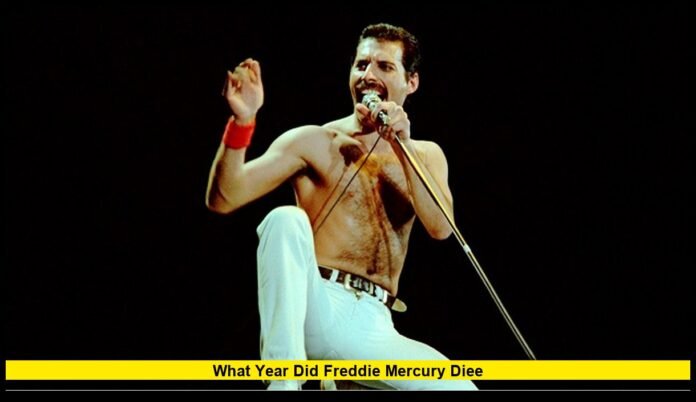

If you have searched what year did freddie mercury die, the answer is 1991. Freddie Mercury, the iconic frontman of Queen, died on November 24, 1991, at the age of 45. More than three decades later, his music, performances and influence remain firmly embedded in popular culture, with 2026 bringing renewed attention to his life as fans mark what would have been his 80th birthday.
When Did Freddie Mercury Die?
Freddie Mercury died on November 24, 1991, at his home in Kensington, London. He was 45 years old.
Mercury had spent the previous two decades becoming one of the most recognizable performers in rock music. As the lead vocalist and a major creative force behind Queen, he helped produce songs that became international classics.
His death came only about a day after he publicly confirmed that he had AIDS. His health had been the subject of considerable speculation for years, but Mercury had largely kept his medical condition private.
His official cause of death was bronchial pneumonia resulting from AIDS.
The news of his death shocked fans across the world and brought an abrupt end to the life of an artist who had transformed the possibilities of rock performance.
How Old Was Freddie Mercury When He Died?
Freddie Mercury was 45 years old when he died.
He was born Farrokh Bulsara on September 5, 1946, in Zanzibar. His family later moved to England, where Mercury studied art and graphic design while developing his musical ambitions.
His life in music eventually led him to Brian May and Roger Taylor, who were members of the band Smile. With the addition of John Deacon, Queen developed into one of the biggest rock groups of its generation.
Mercury’s career was remarkably productive considering that he died before reaching his mid-40s.
Freddie Mercury’s Early Life
Before becoming a global superstar, Mercury had a childhood shaped by several different cultures and environments.
He spent much of his early life in India and attended St. Peter’s School in Panchgani. Music became an important part of his education, and he learned piano at a young age.
During his school years, he became involved with a band called The Hectics. Those early performances gave him experience that would later contribute to his extraordinary stage presence.
After his family moved to England, Mercury continued pursuing art and music. He studied at Ealing College of Art, where he developed his artistic interests while also moving closer to a professional music career.
His meeting with Brian May and Roger Taylor proved to be a turning point.
How Freddie Mercury Became the Singer of Queen
Queen emerged in the early 1970s after Mercury joined forces with Brian May and Roger Taylor. John Deacon later completed the classic lineup.
Mercury was not simply the singer standing at the front of the stage. He played piano, wrote songs and contributed to Queen’s distinctive artistic identity.
His vision for Queen involved theatrical presentation, musical experimentation and a sense of grandeur. Those qualities became central to the band’s identity.
Queen’s breakthrough developed rapidly during the 1970s. The band’s music moved between hard rock, pop, progressive influences, opera and theatrical arrangements.
Mercury’s voice became one of the group’s defining characteristics.
Bohemian Rhapsody Changed Everything
One of the biggest turning points in Mercury’s career came with “Bohemian Rhapsody.”
Released in 1975, the song challenged conventional expectations about what a successful rock single could sound like. It combined ballad sections, intricate vocal harmonies, dramatic arrangements and operatic elements.
The song became a massive international success and helped establish Queen as a major force in popular music.
Its unusual structure could easily have been considered too unconventional for mainstream radio, but its success demonstrated Mercury and Queen’s willingness to take creative risks.
Decades later, “Bohemian Rhapsody” remains one of the most recognizable recordings associated with Mercury.
Freddie Mercury Became a Legendary Live Performer
Mercury’s influence extended far beyond recordings.
He developed a reputation as a commanding live performer who could communicate with enormous stadium audiences. His movements, clothing, gestures and interaction with crowds became essential parts of Queen’s live shows.
His ability to lead thousands of people through synchronized chants became particularly famous.
The 1985 Live Aid performance at Wembley Stadium remains one of the most important moments in Queen’s history. The band’s appearance lasted only a short time, but Mercury’s interaction with the audience became one of the most memorable sequences of the entire event.
The performance helped reinforce his reputation as a performer capable of controlling a huge crowd with remarkable confidence.
Freddie Mercury’s Solo Career
Although Queen was Mercury’s primary musical home, he also pursued solo projects.
His first major solo album, Mr. Bad Guy, arrived in 1985. The record allowed Mercury to explore musical ideas outside Queen’s established sound.
He later worked with Spanish soprano Montserrat Caballé, resulting in the album Barcelona.
The title song eventually became closely associated with the 1992 Summer Olympics in Barcelona.
Mercury’s solo work demonstrated that his creative interests went beyond traditional rock music. He had a strong appreciation for opera, theater and other forms of performance.
Freddie Mercury’s Final Years With Queen
Mercury continued working with Queen after the band’s enormous success during the 1980s.
Queen’s Magic Tour in 1986 became Mercury’s final concert tour with the group. The tour included major performances across Europe and culminated in the band’s famous Knebworth appearance on August 9, 1986.
The Knebworth show became Mercury’s final live performance with Queen.
In later years, Mercury increasingly focused on recording rather than touring.
Queen returned to the studio to create new music, and Mercury continued contributing vocals even as his health deteriorated.
The Innuendo Era
Queen’s final studio album released during Mercury’s lifetime was Innuendo, which arrived in 1991.
The album contained several songs that would become particularly meaningful after Mercury’s death.
Among them was “These Are the Days of Our Lives,” which became one of the final major Queen songs associated with Mercury’s career.
The music video is especially significant because Mercury’s physical condition was visibly different from his earlier appearances. Nevertheless, he remained focused on delivering a performance for the song.
Mercury’s determination to continue recording during this period has become an important part of the story surrounding Queen’s final years with him.
When Did Freddie Mercury Reveal His AIDS Diagnosis?
Mercury publicly confirmed that he had AIDS on November 23, 1991, one day before his death.
For years, newspapers and fans had speculated about his health. Mercury had chosen not to publicly discuss his medical condition in detail.
His final statement confirmed that he was HIV-positive and had AIDS.
The announcement was significant because HIV and AIDS were surrounded by considerable fear and misinformation during the early 1990s.
Mercury’s death the following day brought international attention to the disease and contributed to broader public awareness about the AIDS crisis.
What Was Freddie Mercury’s Cause of Death?
Freddie Mercury died from bronchial pneumonia caused by AIDS.
He had been seriously ill during the final period of his life, but he continued working on music whenever possible.
His death occurred at his London home on November 24, 1991.
News of his passing spread rapidly around the world. Fans gathered outside his home, while musicians and public figures expressed their grief.
For Queen, the loss meant the end of the band’s classic era with Mercury as its lead singer.
What Happened After Freddie Mercury Died?
Queen’s surviving members Brian May, Roger Taylor and John Deacon organized the Freddie Mercury Tribute Concert for AIDS Awareness at Wembley Stadium on April 20, 1992.
The event featured a remarkable collection of artists who performed Queen songs alongside Mercury’s former bandmates.
The concert also helped establish the Mercury Phoenix Trust, an organization created in Mercury’s memory to support HIV and AIDS-related work.
The tribute demonstrated the extraordinary reach Mercury had achieved during his lifetime.
Made in Heaven Preserved His Final Recordings
Mercury’s voice did not disappear from new Queen releases immediately after his death.
Queen released Made in Heaven in 1995. The album used vocal performances and musical material Mercury had recorded before his death.
It became a posthumous celebration of his work and provided fans with additional material featuring the singer.
The album’s significance lies partly in the fact that it represented the final studio project connected with Mercury’s voice.
Songs recorded during his final years gained a different emotional meaning after his death.
Why Did Freddie Mercury Die So Young?
The question what year did freddie mercury die is often followed by questions about why his life ended at such a young age.
Mercury died at 45 during a period when AIDS was a devastating global health crisis and effective modern HIV treatments were not yet available.
Medical care for people living with HIV has changed dramatically since the early 1990s. Treatments available today can allow many people with HIV to live long and healthy lives when they have access to appropriate care.
Mercury’s death therefore occurred during a very different era in the history of HIV treatment.
Freddie Mercury’s 80th Birthday in 2026
Mercury’s legacy has received renewed attention in 2026 because September 5 marked what would have been his 80th birthday.
Queen and Mercury-related organizations have marked the milestone with celebrations, archival material and special events.
His former bandmates Brian May and Roger Taylor have also continued discussing Queen’s history and Mercury’s extraordinary contribution to the group.
The anniversary has provided another opportunity for longtime fans and younger listeners to revisit Mercury’s work.
Queen Budapest Brings His 1986 Performance Back Into Focus
Another major development in 2026 is the renewed attention surrounding Queen Budapest, a restored presentation of Queen’s historic 1986 concert in Hungary.
The concert took place during the Magic Tour and is particularly important because it captures Mercury performing with Queen during the band’s final touring period.
The footage has been restored in 4K from original film material, with newly remixed audio.
The project is scheduled for theatrical and IMAX screenings beginning October 7, 2026, followed by physical and digital releases later in October.
The release is especially significant because 2026 marks 40 years since Queen performed in Budapest.
For fans, the project offers an opportunity to experience Mercury’s stage presence in a major performance recorded only several years before his death.
Freddie Mercury’s Music Continues to Reach New Generations
Mercury’s influence has not been limited to fans who discovered Queen during the 1970s and 1980s.
Younger generations continue to encounter his music through streaming services, movies, television, sporting events and social media.
The 2018 film Bohemian Rhapsody introduced Mercury and Queen to millions of additional viewers and generated renewed interest in the band’s catalog.
Songs such as “Don’t Stop Me Now,” “Somebody to Love,” “We Are the Champions,” “We Will Rock You” and “Radio Ga Ga” remain familiar to audiences around the world.
His influence can also be seen in the continuing popularity of theatrical rock performances and artists who use dramatic stage presentation as an important part of their identity.
A Legacy That Continues Decades Later
Freddie Mercury’s death ended a remarkable life, but it did not end his cultural influence.
His recordings continue to be played, his performances continue to be studied and his image remains instantly recognizable.
He helped redefine what a rock frontman could be. He could move from intimate piano performances to enormous stadium shows, from traditional rock to opera-inspired compositions, and from songwriting to elaborate visual performances.
His career lasted only a few decades, but its impact has endured for generations.
For those searching for the straightforward answer, what year did freddie mercury die can be answered with one number: 1991. The exact date was November 24, and Mercury was 45 years old.
Yet the story surrounding that date is much larger than the circumstances of his death. It is also the story of an artist who helped create some of the most enduring music of the 20th century and whose performances continue to attract audiences more than 30 years after his passing.
In 2026, as fans celebrate what would have been Mercury’s 80th birthday and revisit historic Queen performances, his artistic legacy remains as visible as ever.
What is your favorite Freddie Mercury performance or Queen song? Share your choice in the comments and stay connected for more music history and entertainment updates.