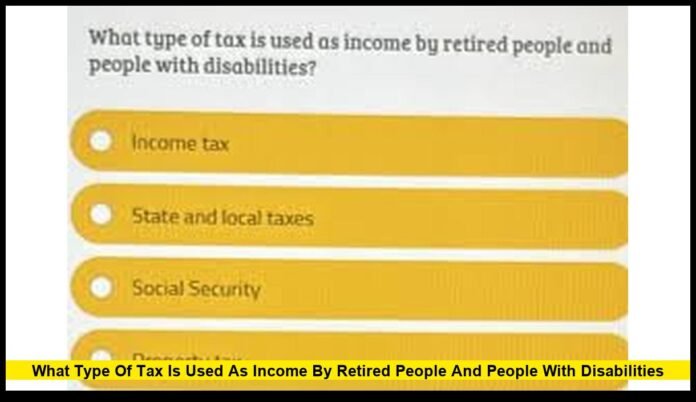

Many Americans wonder what type of tax is used as income by retired people and people with disabilities, especially as Social Security remains the financial backbone for millions in 2026. The answer centers on the Social Security payroll tax, commonly known as FICA tax, which funds retirement and disability benefits across the United States. This system continues to provide dependable monthly income to eligible individuals who have reached retirement age or qualify due to disability.
Understanding how this tax works—and how benefits are treated for federal tax purposes—helps retirees and disabled individuals make informed financial decisions.
The Foundation: Social Security Payroll Tax
The Social Security tax is a federal payroll tax collected under the Federal Insurance Contributions Act (FICA). Workers contribute a set percentage of their wages, and employers match that contribution. Self-employed individuals pay both portions through self-employment tax.
These payroll contributions fund:
- Retirement benefits
- Social Security Disability Insurance (SSDI)
- Survivor benefits
The money does not go into a personal savings account. Instead, it supports current beneficiaries while building eligibility for future benefits.
In 2026, employees continue to pay 6.2% of wages toward Social Security, while employers match that amount. Self-employed workers pay 12.4% through self-employment tax. Contributions apply up to the annual wage base limit set each year.
How Social Security Becomes Retirement Income
Retirement benefits begin as early as age 62. However, claiming early reduces monthly payments permanently. Full retirement age depends on birth year and currently falls between 66 and 67 for most retirees.
Those who delay claiming beyond full retirement age receive delayed retirement credits, which increase monthly benefits up to age 70.
Benefit amounts depend on:
- Lifetime earnings
- Work history
- Age at which benefits begin
Each year, benefits may increase through a cost-of-living adjustment (COLA). This adjustment helps protect retirees from inflation by raising monthly payments when consumer prices rise.
For many households, Social Security provides more than half of total retirement income. For others, it serves as a foundational income layer alongside savings and pensions.
Disability Income Through SSDI
Social Security Disability Insurance offers income protection for workers who can no longer engage in substantial employment due to a qualifying medical condition.
To qualify for SSDI, applicants must:
- Have sufficient work credits
- Meet federal disability standards
- Demonstrate inability to perform substantial gainful activity
SSDI payments are calculated using the same earnings formula used for retirement benefits. In most cases, when SSDI recipients reach full retirement age, their disability benefits automatically convert to retirement benefits without a change in payment amount.
This system ensures that workers who paid into Social Security receive income protection if they become disabled before retirement.
Supplemental Security Income (SSI) Explained
Supplemental Security Income differs from Social Security retirement and SSDI. SSI supports individuals who are aged, blind, or disabled and have limited income and financial resources.
Key distinctions include:
- Funded by general federal revenues
- Does not require prior work history
- Strict income and asset limits apply
SSI is needs-based rather than payroll-tax funded. Because it is not financed by FICA contributions, it operates separately from the Social Security trust funds.
Are Social Security Benefits Taxed?
While Social Security payroll tax funds retirement and disability income, the benefits themselves may be subject to federal income tax depending on total income.
Federal tax rules use a calculation known as provisional income. This includes:
- Adjusted gross income
- Nontaxable interest
- Half of Social Security benefits
If provisional income exceeds specific thresholds, up to 50% or 85% of Social Security benefits may be taxable.
Income thresholds currently remain:
- $25,000 for single filers
- $32,000 for married couples filing jointly
Those with income below these levels typically pay no federal income tax on their benefits.
It is important to note that benefits are never taxed at 100%. The maximum taxable portion remains 85%.
State Tax Treatment
State taxation varies significantly.
Some states:
- Do not tax Social Security benefits at all
- Provide income-based exemptions
- Have no personal income tax
States with no income tax include Florida, Texas, Nevada, Wyoming, South Dakota, Washington, Tennessee, and Alaska.
Retirees should review their state’s tax policy when planning retirement income strategies.
The Role of Social Security in Financial Security
Social Security plays a critical role in reducing poverty among older Americans and individuals with disabilities. It provides predictable monthly payments that continue for life.
Key benefits of the system include:
- Guaranteed income stream
- Inflation protection through COLA
- Disability protection during working years
- Survivor benefits for families
Without Social Security, many retirees would face serious financial hardship. The program continues to serve as the largest source of income for Americans over age 65.
How Benefits Are Calculated
The Social Security Administration calculates benefits using a worker’s highest 35 years of earnings. Earnings are adjusted for inflation, then averaged to determine a monthly amount.
If a worker has fewer than 35 years of earnings, zeros are included in the calculation. This reduces the average and lowers the benefit.
The formula is progressive. Lower-income workers receive a higher percentage of their prior earnings compared to higher-income workers.
This structure helps support individuals with modest lifetime wages.
Work Credits and Eligibility
Eligibility for retirement benefits generally requires 40 work credits. Workers earn up to four credits per year based on annual income.
For disability benefits, the required number of credits depends on age at disability onset.
These credits confirm participation in the Social Security payroll tax system.
Cost-of-Living Adjustments in 2026
Each year, Social Security benefits may increase based on inflation data. COLA adjustments help maintain purchasing power as prices rise.
Recent years have seen noticeable COLA increases due to inflation. Adjustments apply automatically to both retirement and disability benefits.
This feature distinguishes Social Security from many private pensions that do not adjust for inflation.
Other Income Sources and Tax Considerations
Although Social Security tax provides core income, retirees may receive additional funds from:
- Employer pensions
- 401(k) withdrawals
- Traditional IRA distributions
- Investment dividends
- Part-time employment
These income streams are generally subject to federal income tax. Required minimum distributions (RMDs) apply to many retirement accounts starting at age 73.
Careful income planning can help manage overall tax exposure in retirement.
Why the Social Security Tax System Matters in 2026
The payroll tax structure continues to function as the foundation of retirement and disability income in the United States.
Workers contribute during employment years. In return, they gain:
- Retirement security
- Disability protection
- Survivor coverage for family members
This insurance-based model spreads risk across generations. It remains a core component of federal financial policy.
Understanding what type of tax is used as income by retired people and people with disabilities allows Americans to better prepare for retirement and evaluate long-term income expectations.
Quick Overview
- Social Security payroll tax funds retirement and disability benefits
- Employees and employers each contribute 6.2% of wages
- Benefits may be partially taxable at the federal level
- SSI operates separately and is not payroll-tax funded
- State taxation rules vary
These elements define how retirement and disability income operates across the country.
Planning Ahead
Americans approaching retirement should review:
- Estimated Social Security benefit statements
- Full retirement age details
- Potential tax impact based on total income
- State tax policies
Those living with disabilities should understand eligibility standards and work credit requirements.
Clear knowledge of the system reduces uncertainty and supports smarter financial planning.
Social Security remains the primary tax-funded income system supporting retired Americans and individuals with disabilities today. It delivers consistent monthly payments backed by payroll contributions collected during working years.
What questions do you have about retirement or disability income? Share your thoughts and stay informed about changes that could affect your financial future.