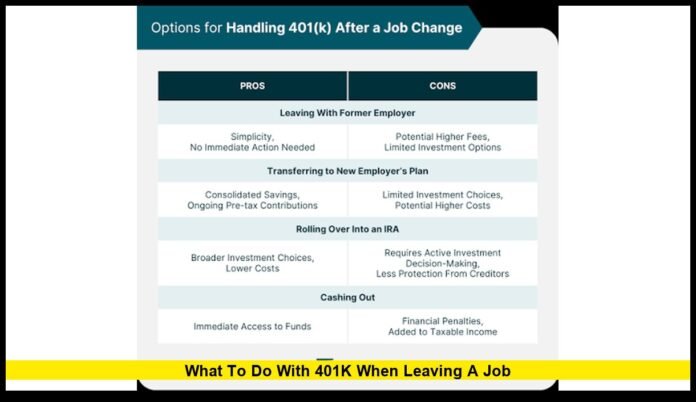
 when leaving a job, including rollover options, tax rules, employer matches, and withdrawal penalties.)
Understanding what to do with 401k when leaving a job is essential for protecting your retirement savings when you resign, retire, or move to another employer. Your existing 401(k) generally remains yours, but you must decide whether to keep it with your former employer, transfer it to a new workplace retirement plan, roll it into an individual retirement account (IRA), or withdraw the money.
Each choice can affect your taxes, investment opportunities, account fees, and access to your savings. Making the right decision can help you preserve valuable retirement benefits and avoid unnecessary financial losses.
You do not automatically have to cash out your retirement account when your employment ends. In many cases, you can keep your savings invested while deciding which option best fits your financial goals.
Before taking action, review your account balance, employer matching contributions, investment performance, and the rules governing distributions. These details can help you determine the most practical next step.
What Happens to Your 401(k) After You Leave Your Job?
Leaving a company does not automatically eliminate your 401(k) account. The money you contributed generally remains yours, along with vested employer contributions and any investment gains or losses.
However, you usually stop making contributions through your former employer’s payroll. Your account remains subject to the plan’s investment options, administrative fees, and distribution requirements.
You generally have four primary options:
- Keep your existing 401(k): Leave the funds in your former employer’s plan if the plan allows it.
- Transfer to a new 401(k): Consolidate your retirement savings with your next employer if its plan accepts rollovers.
- Open an IRA rollover: Move eligible funds into a traditional IRA or Roth IRA, depending on the account type and transaction.
- Withdraw the money: Receive a distribution, potentially triggering income taxes and an early-withdrawal tax.
You should compare these choices before requesting a distribution. Once you take money out, correcting the transaction may become more complicated, particularly if you miss an applicable rollover deadline.
1. Keep Your 401(k) With Your Former Employer
Leaving your retirement savings in your former employer’s plan may be suitable if the account offers affordable investments and useful plan features.
You can generally leave the funds invested without making an immediate rollover decision, provided your account meets the plan’s requirements.
Advantages of keeping your old 401(k)
- You avoid taking an unnecessary taxable distribution.
- You may retain access to low-cost institutional investments.
- Your retirement money can continue growing or declining with market performance.
- You have time to compare other retirement accounts before transferring your balance.
Employer-sponsored retirement plans covered by federal retirement-plan law generally have important creditor protections, although exceptions apply.
However, maintaining an old account also has disadvantages. Your former employer’s plan may charge administrative fees, limit investment choices, or offer withdrawal features that no longer meet your needs.
Keeping several retirement accounts can also make it harder to monitor your overall investments and maintain a consistent retirement strategy.
Can Your Former Employer Close Your 401(k) Account?
Certain retirement plans can distribute small account balances after an employee leaves.
Under applicable federal rules, plans may generally force out eligible vested balances of $7,000 or less, subject to plan terms and legal requirements. Depending on the balance and the plan’s procedures, the money may be paid directly to you or transferred automatically into an IRA.
For balances exceeding $1,000 but not exceeding $7,000, an automatic rollover to an IRA may apply if you do not make an election and the relevant requirements are satisfied. Smaller balances may be distributed directly under the plan’s rules.
If you receive a notice about your account, read it carefully. Check the deadline, the proposed distribution method, and any fees associated with an automatic rollover.
2. Transfer Your Old 401(k) to Your New Employer
If you have accepted another job, transferring your previous retirement savings to your new employer’s 401(k) can simplify your financial arrangements.
Instead of tracking several workplace retirement accounts, you may be able to manage your savings through one plan.
However, your new employer must accept incoming rollovers. Some plans accept traditional 401(k) money but impose different requirements on Roth funds or other account components.
Benefits of Moving Your Money to a New 401(k)
Consolidating your retirement savings can make it easier to monitor your total balance and investment allocation.
Your new plan may also offer competitive fees, a suitable selection of investment funds, and convenient account management.
Keeping money in an employer-sponsored plan may be particularly useful if you want to preserve certain plan protections or may need access to employer-plan withdrawal exceptions in the future.
Still, compare the available investments and administrative costs before transferring your money. A new employer’s plan is not automatically better than your existing account.
Steps to Complete a 401(k) Rollover
Follow this process to reduce the risk of mistakes:
- Contact your new employer’s retirement plan administrator.
- Ask whether the plan accepts incoming rollovers from your previous employer.
- Confirm which types of retirement funds the plan can receive.
- Review the receiving plan’s fees, investment choices, and distribution rules.
- Request the necessary rollover paperwork from both administrators.
- Choose a direct rollover when appropriate.
- Confirm that the funds arrive in the new account and are invested according to your instructions.
Keep copies of the transfer confirmation and any related tax documents.
3. Roll Your 401(k) Into an IRA
An individual retirement account offers another option for managing retirement savings after leaving an employer.
An IRA may provide access to a wider range of investments than a workplace plan. It can also help you consolidate funds from multiple former employers.
However, IRA fees, investment expenses, creditor protections, and withdrawal rules can differ from those of employer-sponsored plans.
Traditional 401(k) to Traditional IRA
A direct rollover from a traditional 401(k) into a traditional IRA generally allows eligible pretax savings to remain tax-deferred.
You normally do not owe immediate federal income tax on a properly completed rollover of eligible funds. Taxable consequences may arise if you receive the money personally and fail to complete the transaction correctly.
Before opening an account, compare the provider’s fees, available investments, account services, and withdrawal policies.
Roth 401(k) to Roth IRA
If your workplace plan includes a designated Roth account, you can generally transfer eligible funds to a Roth IRA.
Roth accounts have different tax treatment from traditional accounts. Qualified Roth IRA withdrawals can be tax-free when the applicable requirements are satisfied.
Keep your account statements and rollover records. Your contribution history and the timing of previous Roth account activity may matter when determining whether a future distribution qualifies for tax-free treatment.
Can You Convert a Traditional 401(k) Into a Roth IRA?
Yes. However, moving pretax 401(k) money into a Roth IRA generally creates taxable income on the taxable amount converted.
For example, if you convert $20,000 of fully pretax retirement savings into a Roth IRA, that amount generally becomes part of your federal taxable income for the year.
The actual tax depends on your filing status, income, deductions, and other circumstances.
A Roth conversion may suit some people who want to pay taxes now in exchange for potential tax-free qualified withdrawals later. However, the immediate tax expense can be substantial.
Consider your current income and future retirement plans before making the conversion.
4. Cash Out Your 401(k) After Leaving a Job
Withdrawing your retirement savings provides immediate access to cash, but it can significantly reduce the money available for retirement.
The taxable portion of a traditional 401(k) distribution generally counts as ordinary income for federal income tax purposes. State income taxes may also apply.
If you are younger than 59½, an additional 10% federal tax may apply to the taxable amount unless you qualify for an exception.
How Much Tax Could You Pay?
Suppose your traditional 401(k) contains $40,000 and you withdraw the entire balance.
If the entire amount is taxable and the additional 10% tax applies, the early-distribution tax would equal $4,000. Ordinary federal income taxes could increase the total cost, and state taxes may apply.
Eligible rollover distributions paid directly to you generally face mandatory 20% federal income tax withholding. This withholding does not necessarily represent your final tax bill.
You also lose the opportunity to keep the withdrawn money invested inside a tax-advantaged retirement account.
When Should You Consider Cashing Out?
A withdrawal may be necessary if you face urgent expenses and have no reasonable alternatives. Nevertheless, compare the consequences before taking money from your retirement savings.
Review your emergency fund, essential expenses, and other financial resources. Confirm whether an exception to the additional 10% tax applies before requesting a distribution.
Remember that avoiding the early-withdrawal tax does not automatically eliminate ordinary income taxes.
Important 401(k) Rollover Rules You Should Know
Several rules can affect how and when you move retirement funds.
The 60-Day Rollover Deadline
When an eligible retirement distribution is paid directly to you, you generally have 60 days from receiving the money to complete an eligible rollover.
If you miss the deadline, the amount not properly rolled over may become taxable. An early-distribution tax may also apply unless an exception covers the transaction.
The IRS may waive the deadline in qualifying circumstances, but a waiver is not automatic.
A direct rollover generally makes the process easier because the funds move between retirement accounts without first being paid to you.
The 20% Federal Withholding Requirement
Many eligible rollover distributions paid directly to an individual are subject to mandatory 20% federal income tax withholding.
For example, if your plan distributes $10,000 directly to you, it may withhold $2,000 and send you the remaining $8,000.
If you intend to roll over the entire $10,000 within the applicable deadline, you generally need to replace the withheld $2,000 with other money.
Otherwise, the portion not rolled over may become taxable.
A direct rollover generally avoids this mandatory withholding and can reduce the risk of an unintended taxable distribution.
Different Account Types Require Careful Handling
Traditional and Roth retirement savings do not always follow the same rollover rules.
Traditional pretax funds generally move to a traditional IRA or an eligible employer plan without immediate federal income tax when the transaction satisfies the applicable requirements.
Designated Roth funds generally move to a Roth IRA or an eligible plan that accepts them.
Pretax money moved into a Roth IRA generally creates taxable income on the taxable amount converted. Check your account composition before requesting a transfer.
What Happens to Your Employer Matching Contributions?
Your retirement account may contain personal contributions, employer matching contributions, and investment gains or losses.
Your own salary-deferral contributions are generally fully vested. Employer contributions may be subject to a vesting schedule.
Vesting determines how much of the employer-funded portion you own when you leave the company.
For example, if your employer’s plan requires a specified period of service before matching contributions become fully vested, leaving early may result in forfeiture of some unvested amounts.
Review your statement to determine your vested balance. Do not assume the full account balance belongs to you if the plan includes unvested employer contributions.
Your account value may also change because of investment performance, regardless of your vesting status.
What If You Have an Outstanding 401(k) Loan?
Leaving your employer can affect repayment of a 401(k) loan.
Depending on the plan’s terms, you may need to continue repayments under an available arrangement or face an offset of the unpaid loan balance against your retirement account.
An unpaid loan can result in a taxable deemed distribution in certain circumstances. A qualifying plan loan offset may be eligible for rollover treatment under special rules, potentially allowing additional time beyond the ordinary 60-day deadline.
Contact your former plan administrator immediately if you have a loan balance.
Ask about repayment arrangements, the timing of any offset, and the tax consequences. Do not assume that transferring your remaining retirement savings automatically settles the outstanding loan.
Can You Avoid the 10% Early-Withdrawal Tax?
Some retirement distributions made before age 59½ qualify for exceptions to the additional 10% federal tax.
One important exception may apply to qualifying distributions from an employer retirement plan if you separate from service during or after the calendar year in which you turn 55.
Certain public safety employees may qualify under separate age rules. Other exceptions cover specific circumstances, such as qualifying disability, terminal illness, domestic abuse, and certain emergency expenses, subject to their individual requirements.
An exception to the 10% additional tax does not necessarily make the distribution exempt from income tax.
Rolling your 401(k) into an IRA can also affect your available withdrawal exceptions. The age-55 separation-from-service exception generally applies to qualifying employer-plan distributions rather than ordinary IRA withdrawals.
If you expect to need retirement money before age 59½, compare the consequences of keeping the funds in your workplace plan with those of completing a rollover.
How to Protect Your 401(k) After Leaving Your Job
Take these practical steps to manage your retirement savings responsibly:
- Locate your former employer’s retirement account.
- Review your balance, investments, and vested employer contributions.
- Check whether you have an outstanding loan.
- Compare investment costs and administrative fees.
- Determine whether your new employer accepts rollovers.
- Compare traditional IRA, Roth IRA, and employer-plan options.
- Request a direct rollover when it suits your circumstances.
- Verify that the receiving account has received the money.
- Keep all rollover confirmations and tax documents.
- Update your beneficiary information and contact details.
These steps can help you avoid unnecessary taxes, reduce administrative problems, and maintain better control over your retirement savings.
Frequently Asked Questions (FAQs)
1. What should I do with my 401(k) when leaving a job?
You can generally leave the funds in your former employer’s plan, transfer them to a new employer’s 401(k), roll eligible funds into an IRA, or withdraw the money. Compare the fees, investments, and tax consequences before choosing.
2. Do I have to roll over my 401(k) when I quit?
No. You may be able to keep your retirement account with your former employer if the plan allows it. Small balances may be subject to automatic distribution or rollover rules.
3. Is it better to leave my 401(k) or move it?
The best choice depends on your financial situation. Keeping the account may make sense if it has low fees and suitable investments. Moving it may simplify your retirement accounts or provide better investment options.
4. Can I move my old 401(k) to my new employer?
Yes, if your new employer’s plan accepts eligible incoming rollovers. Confirm the plan’s requirements and arrange the transfer with both administrators.
5. Will I pay taxes when transferring my 401(k)?
A properly completed rollover of eligible traditional funds into a traditional IRA or qualifying employer plan generally avoids immediate federal income tax. Converting pretax funds into a Roth IRA generally creates taxable income.
6. Can I cash out my 401(k) after quitting?
You may be able to withdraw your balance under your former plan’s rules. However, the taxable amount may be subject to income taxes and an additional 10% tax if you are under age 59½ and no exception applies.
7. What happens to my 401(k) if I have less than $7,000?
Your former employer may be permitted to distribute your account under applicable small-balance rules. Depending on the balance and plan requirements, the money may be paid to you or transferred automatically to an IRA.
8. Do I lose my employer’s matching contributions when I leave?
You generally keep the vested portion of your employer’s contributions. Unvested matching funds may be forfeited under the plan’s vesting schedule.
9. What happens to my 401(k) loan after I leave my job?
Your plan may require repayment or offset the unpaid balance against your account. Depending on the circumstances, the outstanding amount may create a taxable event.
10. What is the 60-day rollover rule?
For many eligible distributions paid directly to you, you generally have 60 days to complete an eligible rollover. Missing the deadline can result in taxes unless an applicable exception or waiver applies.
11. Can I withdraw my 401(k) before age 59½ without a penalty?
Some qualifying withdrawals are exempt from the additional 10% federal tax. Eligibility depends on your circumstances and the specific exception. Ordinary income taxes may still apply.
12. Will my 401(k) continue growing after I leave my job?
Your account can continue gaining or losing value while the money remains invested. Investment performance and account fees affect the balance, so growth is not guaranteed.
Final Thoughts
Deciding what to do with your retirement savings after leaving an employer requires careful consideration of taxes, investment choices, account fees, and future financial needs. Keeping your old 401(k), transferring it to a new employer’s plan, or rolling it into an IRA may all be reasonable options depending on your circumstances.
Before taking a distribution, review your plan’s rules and confirm the tax treatment of the transaction. A thoughtful decision today can help protect the retirement savings you have worked hard to build.
Have you recently changed jobs and decided what to do with your old 401(k)? Share your experience in the comments and stay informed about important retirement-planning updates.