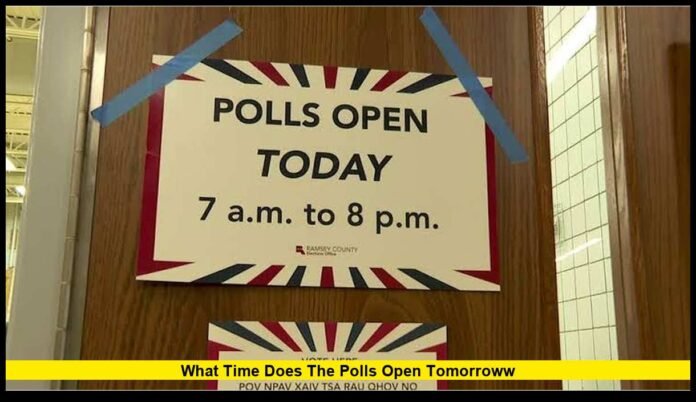

What time does the polls open tomorrow is a common question for Americans planning when to cast their ballots. The answer depends on the state, county, and election taking place in the voter’s area. As of November 3, 2026, Tuesday is the scheduled date of the U.S. general election. Wednesday, November 4, is the following day, so voters must distinguish between Election Day voting and any separate local election scheduled for tomorrow.
Across the country, polling places follow different operating schedules. Many states generally open at 7 a.m. local time, while others begin voting at 6 a.m., 6:30 a.m., or 7:30 a.m. Certain jurisdictions allow local officials to determine opening times within state requirements.
These differences make it important to check the correct schedule before leaving home. A general estimate can help with planning, but the official hours for an assigned voting location provide the most reliable answer.
Is Tomorrow Election Day in the United States?
The 2026 U.S. general election is scheduled for Tuesday, November 3, 2026. Therefore, Wednesday, November 4, is not the nationwide general Election Day.
This distinction matters for anyone planning to vote in federal, state, or local contests. Election schedules depend on the specific jurisdiction, and some communities may hold separate special or municipal elections outside the regular federal election calendar.
Voters should confirm three details before making plans:
- The exact date of the election.
- The state and county responsible for administering it.
- Whether voting takes place at a traditional polling station, a designated voting center, or through another authorized method.
The word “tomorrow” changes meaning every day. An election article published before November 3 may describe Election Day as an upcoming event, but that wording becomes outdated after the date arrives.
For readers checking voting information on November 3, the immediate priority is to verify today’s general-election schedule. Anyone considering a visit on November 4 should first determine whether a separate election or authorized voting service is scheduled in their area.
What Time Do Polling Places Usually Open?
There is no universal opening time for polling places throughout the United States. State election laws establish the general framework, while local election officials manage polling locations and provide instructions for voters.
In many states, voting begins at 7 a.m. Other jurisdictions open earlier, and some permit local variation.
Typical opening times include:
- 6 a.m.: Arizona, Connecticut, Illinois, New Jersey, and Virginia generally open polls at this time for statewide general elections.
- 6:30 a.m.: Ohio and North Carolina generally begin voting at 6:30 a.m.
- 7 a.m.: California, Florida, Georgia, Pennsylvania, and Texas generally open polling places at 7 a.m.
- 7:30 a.m.: Arkansas generally begins voting at 7:30 a.m.
- 8 a.m.: Idaho and certain Nebraska jurisdictions generally begin voting at this time, depending on the applicable time zone and local rules.
These are general schedules rather than guarantees for every polling location. Some states permit municipalities or counties to establish different hours, and election arrangements can differ for local contests.
Voters should also distinguish between the opening of a traditional polling place and the opening of an early voting center. Those facilities may follow separate schedules.
State-by-State Polling Hours for Voters
The following table summarizes typical opening and closing times for statewide general elections. Local variations may apply, so voters should verify their specific location before traveling.
| State | Typical opening time | Typical closing time |
|---|---|---|
| Alabama | 7 a.m. | 7 p.m. |
| Alaska | 7 a.m. | 8 p.m. |
| Arizona | 6 a.m. | 7 p.m. |
| Arkansas | 7:30 a.m. | 7:30 p.m. |
| California | 7 a.m. | 8 p.m. |
| Colorado | 7 a.m. | 7 p.m. |
| Connecticut | 6 a.m. | 8 p.m. |
| Delaware | 7 a.m. | 8 p.m. |
| Florida | 7 a.m. | 7 p.m. |
| Georgia | 7 a.m. | 7 p.m. |
| Hawaii | 7 a.m. | 7 p.m. |
| Idaho | 8 a.m. | 8 p.m. |
| Illinois | 6 a.m. | 7 p.m. |
| Indiana | 6 a.m. | 6 p.m. |
| Iowa | 7 a.m. | 8 p.m. |
| Kansas | 7 a.m. | 7 p.m. Central Time |
| Kentucky | 6 a.m. | 6 p.m. |
| Louisiana | 6 a.m. | 8 p.m. for Tuesday elections |
| Maine | Generally 6–8 a.m. | 8 p.m. |
| Maryland | 7 a.m. | 8 p.m. |
| Massachusetts | Generally 7 a.m. | 8 p.m. |
| Michigan | 7 a.m. | 8 p.m. |
| Minnesota | 7 a.m. | 8 p.m. |
| Mississippi | 7 a.m. | 7 p.m. |
| Missouri | 6 a.m. | 7 p.m. |
| Montana | 7 a.m. | 8 p.m. |
| Nebraska | 8 a.m. Central Time | 8 p.m. Central Time |
| Nevada | 7 a.m. | 7 p.m. |
| New Hampshire | Varies by municipality | No earlier than 7 p.m. |
| New Jersey | 6 a.m. | 8 p.m. |
| New Mexico | 7 a.m. | 7 p.m. |
| New York | 6 a.m. | 9 p.m. |
| North Carolina | 6:30 a.m. | 7:30 p.m. |
| North Dakota | Generally 7–9 a.m. | Generally 7–9 p.m. |
| Ohio | 6:30 a.m. | 7:30 p.m. |
| Oklahoma | 7 a.m. | 7 p.m. |
| Oregon | Generally 7 a.m. for in-person voting locations | Generally 8 p.m. |
| Pennsylvania | 7 a.m. | 8 p.m. |
| Rhode Island | 7 a.m. | 8 p.m. |
| South Carolina | 7 a.m. | 7 p.m. |
| South Dakota | 7 a.m. | 7 p.m. |
| Tennessee | Varies by county | 7 p.m. Central or 8 p.m. Eastern |
| Texas | 7 a.m. | 7 p.m. |
| Utah | 7 a.m. | 8 p.m. |
| Vermont | Towns determine opening times within state rules | 7 p.m. |
| Virginia | 6 a.m. | 7 p.m. |
| Washington | Varies by voting location | Generally 8 p.m. |
| West Virginia | 6:30 a.m. | 7:30 p.m. |
| Wisconsin | 7 a.m. | 8 p.m. |
| Wyoming | 7 a.m. | 7 p.m. |
Important: All times are local unless otherwise stated. This table provides general reference information for statewide elections, not confirmation that every location will operate on the same schedule. Time zones, municipal rules, special elections, and voting methods can affect the hours.
States that primarily conduct elections by mail may offer in-person voting services without operating conventional polling places in the same way as other states.
How to Find Your Exact Polling Place
Knowing the opening time is only one part of preparing to vote. You must also identify the correct location for your residential address.
Election officials assign voters to particular precincts or designated voting areas. A polling place that served you in an earlier election may have changed, so checking your location again is worthwhile.
Follow these steps before traveling:
- Confirm your registration. Make sure your registration information reflects your current residential address.
- Identify your assigned location. Use the official polling-place lookup service for your state or county.
- Check the operating hours. Confirm when the specific location opens and closes.
- Review local instructions. Determine whether you must vote in an assigned precinct or may use an authorized vote center.
- Check for last-minute changes. Review official notices about relocated facilities, accessibility, or local election arrangements.
Your polling place generally depends on your residential address. Attempting to vote at an unauthorized location may cause delays or require additional procedures.
If you have recently moved, contact your election office to determine how the address change affects your registration and voting location.
What Should Voters Bring on Election Day?
Preparing the necessary documents can make the voting process more straightforward. Requirements vary by state, so voters should not assume that the same identification rules apply nationwide.
Before leaving home, consider bringing:
- Acceptable identification: Required in some states and situations.
- Voter information: Registration details or a voter information card, if available.
- Sample ballot: A useful reference for reviewing candidates and ballot questions.
- Polling-place details: The confirmed address and operating hours.
- Accessibility information: Details about accommodations you may need.
Some states require photo identification, while others accept alternative documents or provide different procedures for verifying eligibility.
A voter registration card is not universally required to cast a ballot. The applicable rules depend on the state and the voter’s circumstances.
If you are uncertain about identification requirements, review the official instructions before arriving. Election workers can explain the procedures that apply at your location.
When Is the Best Time to Arrive at the Polls?
The best time to vote depends on your daily schedule, transportation arrangements, and local turnout.
Some voters prefer arriving shortly after the polling place opens so they can vote before work. Others find midday or evening more convenient.
However, no particular hour guarantees a short line. Traffic can change throughout the day, and waiting times depend on the number of voters, available equipment, and staffing.
To make your visit easier:
- Allow additional time for travel and parking.
- Check whether your location has accessibility accommodations.
- Review your ballot before arriving.
- Avoid waiting until the last possible moment.
- Follow any instructions posted at the polling place.
If your schedule is flexible, you can consider the travel conditions and any local information available from election officials.
Remember that the opening time is the earliest scheduled time for voting, not a guarantee that you will finish within a particular number of minutes.
Can You Vote If You Arrive Near Closing Time?
Many jurisdictions allow eligible voters who are already in line when polls close to cast their ballots. The exact procedures depend on local election rules.
If you reach a polling place close to the deadline, ask an election worker where the official line ends and whether you can remain eligible to vote.
Do not assume that arriving after the posted closing time will allow you to enter the voting process. It is safer to arrive with enough time to account for unexpected delays.
Voters who are already waiting should follow the instructions of election officials rather than leave the line because the posted closing time has arrived.
If transportation problems, severe weather, or another unexpected event could delay your arrival, check whether your jurisdiction provides official guidance about voting procedures.
What If You Cannot Vote in Person?
In-person Election Day voting is not the only method available in the United States. Depending on state law and the particular election, eligible voters may have other options.
Early In-Person Voting
Many states offer voting before Election Day. Early voting schedules differ by jurisdiction, and locations may operate during hours that do not match Election Day hours.
Some communities provide early voting at election offices or designated centers. Check the relevant schedule before visiting.
Voting by Mail
Mail and absentee voting rules differ across the country. Some states send ballots to eligible voters automatically, while others require an application or another eligibility step.
Voters must follow the instructions for completing and returning their ballots. Deadlines can depend on when a ballot must be received or postmarked, so checking the rules for the specific election is essential.
Accessible Voting Services
Voters with disabilities can seek information about accessible voting locations and available accommodations. Election officials can explain the services offered and any arrangements that should be made before arrival.
If you need assistance, contact your local election office to learn about accessible equipment, authorized assistance, and alternative voting methods.
How Washington’s Voting System Differs
Washington is an important example for voters who expect every state to use traditional polling stations.
The state primarily conducts elections by mail. Voters generally receive ballots at their registered addresses and can return them through authorized methods.
Designated voting centers provide in-person services, including accessible voting equipment and assistance. These centers do not necessarily follow the same operating pattern as conventional precinct polling places in other states.
Washington voters should check the rules for their county, including ballot-return deadlines, official drop-box locations, and voting-center hours.
For the November 3, 2026, general election, the state’s election calendar identifies November 3 as the deadline for depositing a ballot in an official drop box by 8 p.m. local time.
Anyone planning to vote in Washington should verify the applicable instructions rather than rely on a general table of polling-place opening times.
Frequently Asked Questions
1. What time do most polling places open in the United States?
Many states generally open polling places at 7 a.m. local time. Other states begin at 6 a.m., 6:30 a.m., or 7:30 a.m. Exact hours depend on the jurisdiction.
2. Is November 4, 2026, the national Election Day?
No. The regularly scheduled 2026 U.S. general election takes place on Tuesday, November 3. November 4 is the following day, although a separate local election may be scheduled in some communities.
3. How can I check polling hours near my home?
Use your state’s or county’s official polling-place lookup service. Confirm your assigned location, opening time, closing time, and any special instructions.
4. Do all states require photo identification?
No. Identification requirements differ by state. Some require photo ID, while others accept alternative documents or use different verification procedures.
5. Can I vote at any polling place in my state?
Not necessarily. Some jurisdictions require voters to visit their assigned precinct, while others allow eligible voters to use designated vote centers. Follow the rules that apply to your location.
6. Can I vote before the polls open on Election Day?
You may be able to vote through early in-person voting or an authorized mail ballot, depending on your state. Early voting locations and schedules differ from Election Day arrangements.
7. What happens if I am still in line when the polls close?
Many jurisdictions allow voters who are already in line at closing time to vote. Ask an election worker for instructions and follow the applicable procedures.
8. Are polling places open on November 4, 2026?
There is no nationwide general Election Day scheduled for November 4. Whether a local voting facility operates that day depends on the election calendar and jurisdiction.
9. Why do polling hours differ between states?
States establish their own election laws, and local officials administer voting locations. These differences affect opening times, closing times, precinct assignments, and available voting methods.
10. What is the safest way to plan a voting visit?
Confirm the election date, registration status, assigned location, and official hours. Check identification rules and allow enough time to travel and vote.
Final Takeaway: Confirm Your Local Voting Schedule
Polling hours are not the same throughout the United States, and the correct schedule depends on your state, local election rules, and voting location. As of November 3, 2026, the scheduled U.S. general Election Day is today, while November 4 is the following day. Anyone planning to vote tomorrow should first verify that a separate election or authorized voting service is available in their jurisdiction.
Have you checked your local voting schedule? Share your questions in the comments and stay informed about the latest election updates.