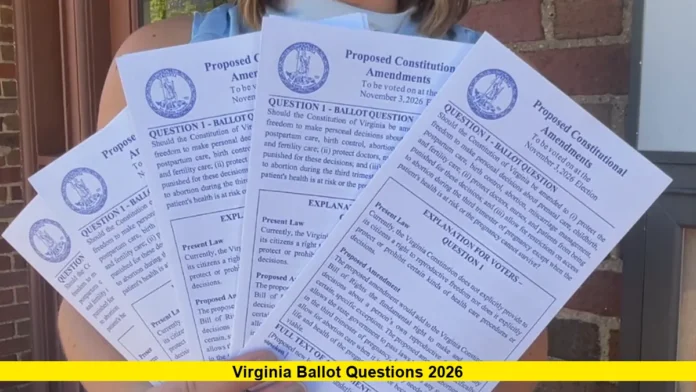

Virginia ballot questions 2026 are a major part of the November 3 general election, with voters across the Commonwealth deciding on three proposed constitutional amendments. The measures address reproductive freedom, marriage equality, and voting rights for people convicted of felonies. Each proposal could change how Virginia protects individual rights under its state constitution.
Election Day is Tuesday, November 3, 2026. Virginia voters will decide the three statewide constitutional questions, while additional local referendums may appear on ballots depending on the voter’s county or city.
These proposals address different areas of public policy. However, all three ask voters to consider whether specific rights, restrictions, or eligibility rules should be written differently into Virginia’s Constitution.
What Are the Three Virginia Ballot Questions in 2026?
Virginia’s November ballot features three proposed constitutional amendments:
- Question 1: Reproductive freedom. This proposal would establish constitutional protections for reproductive decision-making, including pregnancy-related health care and abortion.
- Question 2: Marriage equality. This amendment would remove Virginia’s constitutional prohibition on same-sex marriage and establish equal treatment for legally valid marriages.
- Question 3: Voting rights. This proposal would establish a fundamental right to vote and change rules governing voting eligibility for people convicted of felonies and certain individuals who lack the capacity to understand voting.
Each amendment is a separate ballot question. Voters can support one proposal and oppose another, depending on their views about the specific constitutional changes.
Virginia Ballot Question 1: Reproductive Freedom
The first amendment concerns reproductive freedom and would add an explicit fundamental right to reproductive decision-making to Virginia’s Constitution.
The proposed protections cover several aspects of reproductive health care, including prenatal care, childbirth, postpartum care, contraception, abortion, miscarriage management, and fertility care. The amendment also addresses government restrictions and penalties connected to reproductive decisions.
What Would Question 1 Change?
Virginia’s Constitution does not currently contain an explicit fundamental right to reproductive freedom in the form proposed by this amendment.
If voters approve Question 1, the state constitution would recognize a fundamental right to reproductive freedom and establish a legal standard for government interference. The proposed language would require restrictions to serve a compelling state interest and use the least restrictive means to achieve that interest.
The amendment also includes specific provisions concerning third-trimester abortion. It would permit regulation during that stage of pregnancy while protecting abortion care when a physician determines it is medically indicated to protect the pregnant individual’s life or physical or mental health, or when the fetus is not viable.
The proposal addresses potential penalties involving pregnancy outcomes, including miscarriage, stillbirth, and abortion. It would also protect individuals who voluntarily assist another person in exercising the proposed reproductive rights.
Why Is Question 1 Important?
Question 1 would place reproductive freedom directly into the state constitution rather than leaving the issue entirely to ordinary legislation and government policy.
Supporters of reproductive-rights protections view constitutional recognition as a safeguard against future restrictions on personal medical decisions. The amendment’s specific language, however, defines the scope of the proposed protection and addresses circumstances in which the state could regulate reproductive care.
A yes vote would approve the proposed constitutional language. A no vote would reject the proposed change.
The precise legal consequences would depend on the amendment’s final text and how courts interpret and apply its provisions.
Virginia Ballot Question 2: Marriage Equality
The second proposal focuses on marriage equality. It would remove Virginia’s constitutional prohibition on same-sex marriage and establish protections for marriage between two adults regardless of sex, gender, or race.
The amendment would also require legally valid marriages to receive equal treatment under the law.
What Would Question 2 Change?
Virginia’s Constitution currently contains language defining marriage as a union between one man and one woman. Question 2 proposes removing that restriction and replacing it with language protecting marriage equality.
If approved, the amendment would establish that the state cannot deny a marriage license to two adults based on sex, gender, or race, as specified in the proposal.
It would also require the state to treat legally valid marriages equally. This change would address the constitutional framework governing marriage rather than eliminate other legal requirements that apply to marriage.
Why Is Question 2 on the Ballot?
The proposal asks voters whether Virginia’s Constitution should explicitly reflect marriage equality.
Same-sex marriage is legally recognized nationwide under existing federal constitutional law. Virginia’s proposed amendment would address the state’s conflicting constitutional language and remove the prohibition contained in its own constitution.
Approval would change the state constitution itself. It would not automatically remove every other law governing marriage, divorce, family relationships, or related legal matters.
The main issue for voters is whether to replace the existing constitutional restriction with the proposed marriage-equality protections.
Virginia Ballot Question 3: Voting Rights and Felony Convictions
The third amendment addresses the fundamental right to vote and the restoration of voting rights for people convicted of felonies.
Under the proposal, a person convicted of a felony would remain ineligible to vote while incarcerated but would automatically regain voting rights upon release from incarceration.
The amendment also proposes changes to the constitutional language concerning individuals who lack the capacity to understand the act of voting.
What Would Question 3 Change?
Virginia currently uses a restoration process for people with felony convictions. The proposed amendment would replace that approach with automatic restoration of voting rights upon release from incarceration.
If approved, the change would remove the need for an individual restoration decision from the governor as a condition of regaining voting rights after release.
The amendment would not allow people convicted of felonies to vote while incarcerated. Instead, it would establish release from incarceration as the point when the constitutional voting restriction ends.
Eligible individuals would still need to satisfy applicable voter-registration requirements and complete the necessary registration process before voting.
Changes to Voting Eligibility Language
Question 3 would also revise existing constitutional language concerning mental capacity and voting eligibility.
The proposal would replace the existing provision related to people found mentally incompetent with language addressing individuals who lack the capacity to understand the act of voting.
This change concerns a separate eligibility issue from the restoration of voting rights after incarceration. Both provisions appear in the same amendment, but they address different circumstances.
The proposed language would establish a revised constitutional framework for voting rights and the qualifications that apply to individuals seeking to exercise them.
How Question 3 Could Affect Formerly Incarcerated Virginians
The proposed amendment could significantly change the voting-rights restoration process for Virginians convicted of felonies.
Under the proposed system, eligible individuals would regain voting rights automatically upon release from incarceration instead of waiting for a separate restoration decision.
This approach would establish a clearer constitutional rule about when the voting restriction ends. It could also make the process more predictable for people returning to their communities after incarceration.
However, automatic restoration would not eliminate the need to register to vote. Individuals would still need to follow the applicable procedures and verify their eligibility before participating in an election.
How Virginia Constitutional Amendments Become Law
Virginia follows a specific process for amending its state constitution.
A proposed amendment must receive the required approval from the General Assembly in two successive legislative sessions before it can go before voters. Once the proposal satisfies those requirements, it appears on the ballot for a statewide decision.
Legislative approval alone does not make the proposed language part of the constitution. Voters must approve the measure through the required election process.
The three 2026 proposals have reached the ballot through this constitutional amendment process. Each appears as a separate question, allowing voters to make an independent decision about each proposed change.
Constitutional amendments differ from ordinary legislation because they alter the state’s fundamental legal framework. Once adopted through the required process, an amendment becomes part of the constitution and governs according to its language and applicable legal interpretations.
Are There Other Virginia Ballot Questions in 2026?
Yes. Some Virginia voters will also see local ballot measures on November 3.
These questions vary by county, city, and town. They may include proposals involving school construction funding, local sales taxes, bond measures, and other community-specific issues.
For example, some local governments are considering additional sales taxes to support public school construction or renovation projects. Other localities may have different financial or local-government proposals.
These local questions are separate from the three statewide constitutional amendments. The statewide questions are common across Virginia, but local referendums depend on where a voter lives.
Voters should review their sample ballots to determine which additional measures apply to their communities.
How to Check Your Virginia Ballot Before Election Day
Reviewing a sample ballot can help voters understand the decisions they will face before arriving at their polling place.
Voters should check the following information:
- Constitutional amendments: Read the complete wording of Questions 1, 2, and 3.
- Local referendums: Identify any additional questions involving taxes, schools, bonds, or local government.
- Polling location: Confirm the assigned Election Day voting location.
- Voter registration: Verify registration status and any applicable identification requirements.
- Voting arrangements: Check the rules for in-person voting and the return of any previously requested mail ballot.
Virginia’s regular voter-registration deadline for the November 3 election was October 23, 2026. Virginia also permits eligible voters to register during the applicable same-day registration period, using a provisional ballot under the relevant procedures.
Voters who need to register or update their information should confirm the requirements with their local registrar before heading to the polls.
When Do Polls Open in Virginia on November 3, 2026?
Virginia polling places are scheduled to open at 6 a.m. and close at 7 p.m. local time on Election Day.
Anyone who is in line to vote when the polls close at 7 p.m. must be allowed to cast a ballot.
The early-voting period ran from September 18 through October 31, 2026. That period has ended, so voters who have not already voted early should prepare to vote at their assigned polling place on Election Day.
The deadline to request a mailed ballot was October 23 at 5 p.m. Voters who already possess mail ballots should follow the applicable return instructions and deadlines rather than assuming every ballot can be returned through the same method.
Checking voting arrangements in advance can help prevent confusion and ensure that voters understand the applicable requirements.
What Happens After Virginia Voters Decide the Questions?
After Election Day, election officials count and report the votes. The results then proceed through the applicable canvassing and certification process.
A proposed amendment does not become part of Virginia’s Constitution simply because it appears on the ballot. Voter approval is an essential part of the constitutional amendment process.
If voters approve a proposal, the constitutional change proceeds according to the applicable legal requirements. If voters reject it, that proposed change will not become part of the constitution through the November election.
Preliminary election-night results may provide an early indication of the outcome, but certified results provide the authoritative final determination.
Each amendment will have its own outcome. Virginia voters could approve all three, reject all three, or approve some while rejecting others.
What Virginia Voters Should Know About the 2026 Ballot Questions
The November 3 election gives Virginia voters an opportunity to decide three significant constitutional proposals.
Question 1 concerns reproductive freedom and the constitutional protection of reproductive health decisions. Question 2 addresses marriage equality and the removal of the state’s constitutional prohibition on same-sex marriage. Question 3 concerns voting rights, including automatic restoration for people convicted of felonies upon release from incarceration.
Each proposal would make a distinct change to Virginia’s Constitution. Voters should evaluate the precise language of each question instead of assuming that the three measures must be supported or opposed together.
Local ballot measures may add other decisions, depending on the voter’s county or city. Reviewing a sample ballot and confirming the assigned polling location can help voters prepare for Election Day.
Understanding what each amendment would change is the best way to make an informed decision. The final outcomes will determine which proposed constitutional changes receive voter approval.
Have you reviewed all three Virginia ballot questions for 2026? Share your thoughts in the comments and stay updated as official election results become available.