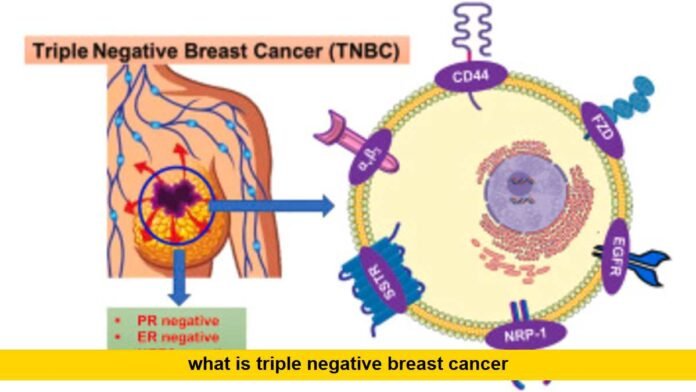

Understanding what is triple negative breast cancer has become increasingly important as researchers develop new ways to diagnose and treat this challenging form of breast cancer. Triple negative breast cancer (TNBC) is a distinct disease subtype characterized by the absence of three major biological markers: estrogen receptors, progesterone receptors, and human epidermal growth factor receptor 2 (HER2). This combination influences how the disease behaves and which medicines doctors can use.
Although TNBC can be more aggressive than several other breast cancer subtypes, medical research has created additional treatment possibilities. Chemotherapy remains central to care, while immunotherapy, genetic testing, and newer targeted medicines are changing treatment decisions for eligible patients.
The disease can affect women of different ages and, less commonly, men. Recognizing warning signs, understanding diagnostic results, and receiving specialist care can make an important difference in managing the condition.
Why Triple Negative Breast Cancer Requires Specialized Care
Breast cancer is not a single disease. Doctors classify tumors according to their cellular characteristics, including whether they contain receptors that respond to particular hormones or growth signals.
In triple negative disease, laboratory analysis finds no estrogen receptors, no progesterone receptors, and no qualifying HER2 positivity. Consequently, conventional hormone-blocking medicines and standard HER2-directed therapies are generally unsuitable.
This does not mean that treatment options are limited to supportive care. Several established therapies can attack TNBC through different biological mechanisms.
The subtype represents approximately 10% to 15% of breast cancer diagnoses. It is also disproportionately diagnosed among younger women and Black women, making awareness and equitable access to screening and treatment important public health concerns.
Symptoms Can Be Subtle Before Diagnosis
The warning signs are not always obvious. Some patients discover a breast abnormality themselves, while others learn about a possible tumor after undergoing routine imaging.
Symptoms that deserve medical attention include:
- A newly developed lump or firm area in the breast.
- Swelling affecting part or all of the breast.
- Changes in breast size, shape, or appearance.
- Skin dimpling, thickening, or unusual redness.
- A nipple that becomes inverted.
- Unusual nipple discharge.
- A lump or swelling in the armpit.
Breast pain can occur, but pain alone does not establish a cancer diagnosis. Similarly, many breast lumps are benign.
A persistent change should be examined by a healthcare professional. Mammography and ultrasound can help identify suspicious areas, while a biopsy is generally required to establish whether cancer is present.
How Doctors Confirm the Diagnosis
A tissue biopsy provides the information needed to classify the tumor. A pathologist examines the collected sample and performs receptor testing to determine whether the cancer is estrogen-positive, progesterone-positive, or HER2-positive.
A triple-negative result means the tumor does not meet the positive criteria for any of these three markers.
Doctors may also recommend genetic counseling and testing. This is particularly relevant for patients with a personal or family history suggesting inherited cancer susceptibility.
BRCA1 and BRCA2 mutations are important because they can influence both cancer risk and treatment selection. Patients with certain inherited mutations may qualify for medicines that target weaknesses in cancer-cell DNA repair.
Imaging examinations, including MRI or CT scans, may be used when additional information about tumor size or possible spread is needed.
Treatment Decisions Depend on the Disease Stage
There is no universal treatment plan for every patient. An oncology team considers the tumor’s size, lymph node involvement, genetic findings, other biomarkers, and the patient’s general health.
For many patients with higher-risk early disease, chemotherapy is administered before surgery. This approach, known as neoadjuvant treatment, can reduce tumor size and provide valuable information about how effectively the cancer responds.
Pembrolizumab, an immunotherapy medicine, is combined with chemotherapy before surgery in eligible patients with high-risk early-stage disease. Treatment may continue after surgery according to the established regimen.
Surgery can involve removing the tumor while preserving the breast or performing a mastectomy. The decision depends on the extent of the disease, medical considerations, and patient preferences.
Radiation may follow surgery to lower the likelihood of cancer returning in the treated area.
For patients with certain inherited BRCA mutations, olaparib may be appropriate after chemotherapy and surgery when eligibility requirements are met.
Major Treatment Developments in 2026
The treatment landscape has continued to change, particularly for patients with advanced disease.
Two important U.S. regulatory developments in 2026 have added options for specific groups.
Datroway receives an additional breast cancer indication
On May 22, 2026, the FDA approved datopotamab deruxtecan, marketed as Datroway, for adults with unresectable or metastatic TNBC who are not candidates for PD-1 or PD-L1 inhibitor therapy.
The medicine belongs to a class known as antibody-drug conjugates. These treatments use an antibody to deliver a cancer-killing drug to cells carrying a particular target.
Trodelvy receives new first-line indications
On June 24, 2026, the FDA approved sacituzumab govitecan, marketed as Trodelvy, for two first-line treatment situations involving unresectable locally advanced or metastatic TNBC.
One indication covers patients who are not candidates for PD-1 or PD-L1 inhibitor-based treatment. The other allows its use with pembrolizumab in eligible patients whose tumors meet the specified PD-L1 expression threshold.
These approvals are significant because they provide additional choices for patients who previously had fewer suitable treatment pathways.
However, neither medicine is appropriate for every patient. Doctors must evaluate biomarkers, previous therapies, medical history, and potential side effects before recommending treatment.
What Survival Statistics Tell Patients
Prognosis remains one of the most important concerns following diagnosis. Recent U.S. National Cancer Institute statistics provide a clearer picture of outcomes according to the extent of disease at diagnosis.
For women diagnosed with triple-negative breast cancer between 2016 and 2022, the reported five-year relative survival estimates are:
| Disease extent | Five-year relative survival |
|---|---|
| Localized | 92.8% |
| Regional | 68.3% |
| Distant | 14.9% |
| All stages combined | 78.7% |
These figures show why identifying the disease before it spreads can be important.
However, survival statistics describe groups of patients rather than individual outcomes. They cannot determine how long a particular person will live or whether treatment will be successful.
New medicines may also improve outcomes beyond what older survival data can capture.
Can the Disease Return After Treatment?
Recurrence remains a concern, especially during the first several years after treatment.
Cancer may return in the original breast area, nearby lymph nodes, or distant organs. Metastatic disease can involve the lungs, liver, bones, or brain.
The risk depends on factors such as the original stage, tumor characteristics, lymph node involvement, and response to treatment.
Follow-up care is therefore important even when examinations show no evidence of cancer. Patients should report unexplained symptoms or new physical changes to their medical team.
Why Genetic Testing and Research Matter
Researchers are increasingly examining the molecular differences between individual TNBC tumors. This work may help identify which patients are most likely to benefit from particular medicines.
Genetic testing can also provide information relevant to family members when an inherited mutation is identified.
Clinical trials remain another important avenue for patients who qualify. Studies are evaluating new drug combinations, immune-based treatments, antibody-drug conjugates, and other approaches designed to improve disease control.
For patients facing an advanced diagnosis, asking an oncologist about appropriate clinical trials may provide access to emerging treatment strategies.
What Patients Should Discuss With Their Oncologist
A breast cancer diagnosis often raises difficult questions about treatment effectiveness, side effects, recurrence, and long-term health. Patients should understand their pathology results and ask whether genetic testing, immunotherapy, or targeted medicines are appropriate.
It is also reasonable to seek a second opinion when treatment decisions are complex.
The central question of what is triple negative breast cancer is no longer answered only by describing an aggressive tumor subtype. It also involves understanding the growing range of treatment possibilities available through modern oncology.
Although significant challenges remain, developments in immunotherapy, precision medicine, and antibody-drug conjugates are creating new opportunities for patients. Continued research and timely access to specialist care will remain essential to improving outcomes