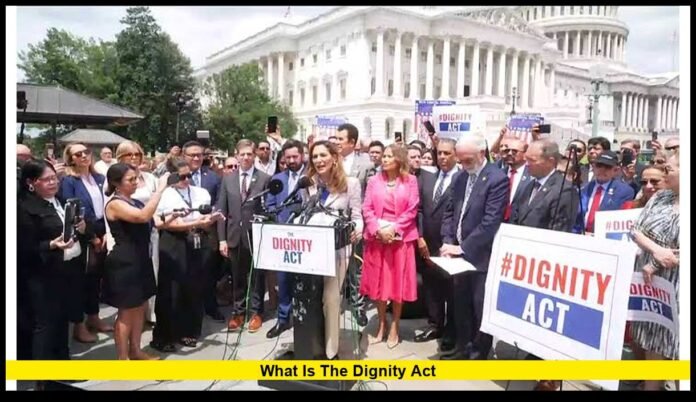

The Dignity Act is a proposed bipartisan immigration reform bill in the U.S. Congress that seeks to address border security, immigration enforcement, undocumented immigrants who have lived in the United States for years, workforce verification, asylum procedures, and protections for certain immigrants who arrived as children. Officially called the DIGNIDAD (Dignity) Act of 2025, the legislation aims to combine stronger border measures with a proposed legal-status program for eligible undocumented immigrants and a pathway to permanent residency for certain Dreamers.
The bill has attracted attention because it attempts to address several major immigration issues through a single legislative package rather than treating border enforcement and immigration relief as separate political debates. However, the Dignity Act has not become law, and its proposed programs are not currently available. As of the latest update, the legislation remains pending in Congress, meaning people cannot apply for Dignity Program benefits or receive legal status under the bill.
For immigrants, families, employers, and communities across the United States, understanding what the Dignity Act proposes—and what it does not currently provide—is important amid continuing immigration policy debates.
What Is the Dignity Act of 2025?
The Dignity Act is formally titled the Dignity for Immigrants while Guarding our Nation to Ignite and Deliver the American Dream Act of 2025. Its Spanish-inspired legislative name is DIGNIDAD, and it was introduced as H.R. 4393 during the 119th Congress.
The legislation was introduced on July 15, 2025, by Representative María Elvira Salazar of Florida, along with Representative Veronica Escobar of Texas and other lawmakers from both parties. It was designed as a broad immigration reform proposal that would address immigration enforcement, border security, employment verification, asylum processing, and immigration relief for certain people already living in the United States.
The bill is notable for its bipartisan approach. Supporters argue that immigration reform should recognize the economic and social contributions of long-term undocumented immigrants while improving border security and enforcing immigration laws.
The official bill text can be reviewed through the Congress.gov Dignity Act legislative page.
Is the Dignity Act a Law Yet?
No. The Dignity Act has not been passed into law.
As of the latest available legislative information, H.R. 4393 remains a pending bill. It has been referred to multiple House committees, including:
- House Committee on the Judiciary
- House Committee on Homeland Security
- House Committee on Ways and Means
- House Committee on Transportation and Infrastructure
- House Committee on Education and Workforce
- House Committee on Oversight and Government Reform
- House Committee on Armed Services
The bill has not completed the committee process, passed the House, or passed the Senate. It therefore has not been signed by the president and does not create any new immigration benefits.
A separate House resolution, H.Res. 1560, was introduced in September 2026 to provide for consideration of the Dignity Act. However, that resolution also remains pending and has not itself advanced the bill into law.
The distinction is important: a proposed immigration program is not the same as an active federal immigration program. Until Congress passes legislation and it becomes law, the provisions described in the Dignity Act remain proposals.
What Would the Dignity Act Do?
The Dignity Act is structured around multiple areas of immigration policy. Its provisions are intended to create a compromise between immigration enforcement and relief for certain undocumented immigrants.
The proposal broadly addresses:
- Border security and enforcement
- Immigration processing and asylum procedures
- Employment verification
- Legal status for certain long-term undocumented immigrants
- Protections and immigration pathways for eligible Dreamers
- Changes to immigration-related penalties and requirements
The legislation is not simply an amnesty proposal, nor is it solely a border-security bill. It combines enforcement-related provisions with immigration relief, making it a comprehensive immigration reform proposal.
The Dignity Program: Proposed Legal Status for Certain Undocumented Immigrants
One of the most closely watched parts of the legislation is the proposed Dignity Program.
The program would establish a legal-status framework for certain undocumented immigrants who meet the bill’s eligibility requirements. The proposal is intended to address people who have lived in the United States for years, contributed to their communities, worked, raised families, and built lives in the country without having a permanent immigration status.
Under the proposed framework, qualifying participants could potentially receive a form of lawful status that would allow them to remain in the United States under specified conditions.
The proposal is generally described as offering a renewable, limited-duration status, rather than automatically granting permanent residency.
This distinction is crucial for people searching for information about the Dignity Act. The program, as proposed, would not automatically give every eligible person a green card or U.S. citizenship.
Would the Dignity Program Provide Work Authorization?
The proposed program is designed to allow qualifying participants to work legally in the United States, subject to the bill’s requirements and conditions.
If enacted in its current form, eligible individuals could potentially gain authorization to work while maintaining the required participation status.
That could have significant practical consequences for people who currently work without formal authorization. Legal employment authorization could potentially make it easier to:
- Apply for jobs through formal hiring processes
- Complete employment eligibility verification
- Work with employers that require documentation
- Receive employment-related protections
- Demonstrate lawful authorization to work
- Plan for greater stability in their personal and professional lives
However, work authorization under the Dignity Act is not currently available because the bill has not become law.
Who Could Qualify for the Dignity Act?
Eligibility would depend on the final legislation enacted by Congress, if the proposal advances.
The introduced bill establishes eligibility requirements and conditions intended to identify people who meet the program’s standards. The proposed framework focuses on certain long-term undocumented immigrants who were present in the United States before a specified cutoff date and who meet additional requirements.
Potential eligibility considerations could include:
- The applicant’s date of arrival in the United States
- Length of residence in the country
- Immigration history
- Criminal history and other disqualifying circumstances
- Compliance with program requirements
- Payment of applicable fees or penalties
- Other conditions established in the legislation
Meeting one requirement would not necessarily guarantee eligibility. Immigration programs often contain several conditions, exclusions, and screening requirements, and the Dignity Act would be no different.
Because the legislation has not been enacted, no federal agency has issued final application instructions, eligibility regulations, forms, or official procedures for the proposed program.
People should therefore avoid assuming that they qualify based solely on having lived in the United States for a certain number of years.
Does the Dignity Act Offer a Green Card?
One of the most important questions surrounding the legislation is whether it would create a direct pathway to a green card for undocumented immigrants.
The proposed Dignity Program is not itself a general pathway to permanent residency or citizenship. The bill’s Dignity status is structured as a nonimmigrant legal status rather than permanent resident status.
That means people participating in the proposed program would not automatically become lawful permanent residents simply because they received Dignity status.
The bill contains a separate framework addressing certain Dreamers, which is an important distinction.
Dignity Status Versus Permanent Residency
These immigration categories are fundamentally different:
| Immigration benefit | What it generally means |
|---|---|
| Dignity status under the proposed bill | A proposed renewable legal status under specified conditions |
| Work authorization | Permission to work legally, subject to applicable requirements |
| Green card | Lawful permanent resident status |
| U.S. citizenship | Citizenship acquired through applicable legal processes |
The Dignity Act’s proposed status would not automatically provide all the rights and benefits associated with permanent residency.
People who hope to obtain green cards should not assume that participating in a future Dignity Program would automatically lead to citizenship.
What Does the Dignity Act Say About Dreamers?
The bill also addresses Dreamers, generally referring to people who came to the United States as children and have grown up in the country.
For many Dreamers, immigration status has affected access to education, employment opportunities, long-term financial planning, and the ability to travel or remain with family members.
The Dignity Act includes a separate proposed framework for certain Dreamers that could provide a pathway toward permanent residency if they meet the legislation’s requirements.
The proposed provisions are intended to recognize the circumstances of individuals who arrived in the United States at a young age and have spent much of their lives in the country.
Eligibility would depend on the exact statutory requirements, including applicable age, arrival, education, service, or other qualifying conditions outlined in the legislation.
As with other parts of the bill, these proposed benefits are not currently available.
How the Dignity Act Could Affect Border Security
The Dignity Act is not limited to immigration relief for people already living in the United States. It also contains significant border-security provisions.
Supporters of the bill argue that a comprehensive immigration reform package should address unauthorized crossings, improve enforcement capabilities, and establish more predictable procedures for people attempting to enter the country.
The border-related provisions are intended to strengthen immigration enforcement and improve the government’s ability to manage border operations.
Depending on the final legislation, proposed measures include areas such as:
- Border infrastructure
- Border Patrol resources
- Enforcement operations
- Immigration-related penalties
- Border processing procedures
- Changes to asylum processing
Supporters see the enforcement provisions as a central component of the political compromise behind the legislation.
The idea is that immigration relief for certain people who have lived in the United States for years would be paired with stronger enforcement measures and changes designed to discourage future unauthorized immigration.
What Would the Dignity Act Change About Asylum?
The bill also proposes changes to asylum-related procedures.
Asylum is a legal protection available under U.S. immigration law to eligible individuals who meet the statutory requirements involving persecution or a well-founded fear of persecution based on protected grounds.
The Dignity Act includes proposed provisions affecting how asylum claims and border-related immigration cases are processed.
These proposals could change aspects of the system for people seeking protection at or near the U.S. border.
However, the legislation does not currently change the asylum process because it remains a pending bill.
People seeking asylum should continue to rely on existing federal law, official government guidance, and qualified immigration legal assistance rather than assuming that proposed Dignity Act provisions are already in effect.
Mandatory E-Verify and Employment Verification
Another major component of the Dignity Act concerns employment verification.
The proposal includes provisions related to Mandatory E-Verify, which would expand the use of the federal employment eligibility verification system.
E-Verify is an online system employers use to compare information provided by employees on Form I-9 against government records to determine employment eligibility.
The bill’s employment-related provisions are intended to strengthen the verification process and address the employment of people who are not authorized to work in the United States.
If the proposal became law, employers could face changes to their verification responsibilities, while employees and job applicants could be affected by new requirements and procedures.
For businesses, the potential changes could involve:
- New employment verification obligations
- Changes to hiring procedures
- Compliance requirements
- Recordkeeping responsibilities
- Additional verification steps
- Changes to employer policies and practices
Employers should not change their current compliance procedures solely because the Dignity Act has been introduced. The existing law and currently applicable federal requirements remain in effect unless new legislation or regulations change them.
Readers can learn about the current federal employment verification system through the official E-Verify website.
Could the Dignity Act Help Families Stay Together?
Family stability is another major reason the bill has attracted attention.
Many undocumented immigrants have lived in the United States for years or decades. Some have U.S.-citizen children, spouses, relatives, homes, businesses, and established connections to their communities.
The uncertainty surrounding immigration status can create challenges involving employment, education, healthcare access, travel, finances, and family planning.
The Dignity Act’s proposed legal-status framework could potentially provide qualifying individuals with greater stability if it became law.
For some families, the possibility of a renewable legal status and work authorization could mean fewer concerns about employment eligibility and greater ability to plan for the future.
Nevertheless, the bill does not currently provide legal protections to families. Immigration enforcement, deportation proceedings, and existing immigration laws continue to operate under current federal law.
Would Applicants Have to Pay Fees or Meet Program Requirements?
The proposed legislation includes requirements and conditions for participation in its immigration relief provisions.
The program is not envisioned as an unconditional benefit. Eligible participants would have to comply with the requirements established by the legislation, including applicable fees, penalties, documentation, and other program conditions.
Depending on the final legislative language and any regulations adopted after enactment, requirements could include:
- Filing the required application
- Providing identifying and immigration-related documentation
- Completing applicable background checks
- Paying required fees or financial obligations
- Meeting program eligibility requirements
- Complying with continuing program conditions
- Maintaining eligibility for renewal, where applicable
The final cost of participation, application procedures, payment arrangements, and renewal rules would depend on the law enacted and the regulations issued by the responsible federal agencies.
There is currently no official Dignity Act application fee because the program does not exist as an active federal immigration benefit.
Anyone claiming that they can collect money to submit an official Dignity Act application today should be treated with caution.
What Is the Latest Dignity Act Status in Congress?
The Dignity Act remains pending in Congress.
The legislation was introduced in the House on July 15, 2025, as H.R. 4393. It was referred to multiple committees because the bill covers several areas of federal policy, including immigration, border security, employment, transportation, education, government oversight, and national security.
As of the latest available status, the bill has not received the votes necessary to become law.
A separate resolution, H.Res. 1560, was introduced in September 2026 to establish procedures for considering the Dignity Act in the House. That resolution was referred to the House Committee on Rules and has not been adopted.
The legislation could potentially receive further consideration if congressional leaders schedule hearings, committee action, debate, or a vote. However, there is no confirmed date for passage, and no guarantee that the bill will advance.
Readers should watch for official congressional announcements rather than relying on social media posts or unverified claims about imminent approval.
What Happens If the Dignity Act Passes?
If Congress eventually passes the legislation and the president signs it into law, the federal government would need to implement the new provisions.
That process could involve:
- Issuing official application instructions
- Establishing eligibility rules
- Creating forms and application systems
- Setting fees and payment procedures
- Establishing deadlines
- Conducting background checks
- Providing processing guidance
- Publishing regulations or agency instructions
- Creating renewal and compliance procedures
Immigration programs often require substantial administrative preparation before applicants can begin filing.
Therefore, even if the Dignity Act were to pass, people should wait for official federal announcements before submitting applications or paying fees to anyone claiming to offer access to the program.
What Undocumented Immigrants Should Do While the Bill Is Pending
People interested in the Dignity Act can take practical steps without assuming that the proposal will become law.
1. Keep Important Immigration Documents Organized
Individuals may want to maintain copies of documents that could be relevant to future immigration applications, including:
- Passports and identity documents
- Birth certificates
- Previous immigration paperwork
- Notices from immigration agencies
- Employment records
- Tax documents
- Proof of residence
- School records
- Marriage certificates
- Documents showing family relationships
- Records of previous immigration applications or proceedings
These documents may be useful for a variety of immigration matters, although the Dignity Act’s final requirements could differ from the proposed text.
2. Avoid Unverified Application Services
Because the Dignity Act has not become law, there is no official application process for the proposed Dignity Program.
Individuals should be cautious of anyone advertising:
- Dignity Act registration
- Guaranteed Dignity status
- Guaranteed work permits through the bill
- Guaranteed green cards
- Early access to government applications
- Special enrollment or reservation services
- Paid application preparation for a program that is not open
The official USCIS information on avoiding immigration scams explains how people can protect themselves from fraudulent immigration services and misleading claims.
3. Speak With a Qualified Immigration Professional
Immigration cases can involve complicated legal questions, including prior deportation orders, unlawful entry, criminal records, pending applications, family-based petitions, asylum claims, and other issues.
A qualified immigration attorney or authorized legal representative can help evaluate an individual’s existing options under current law.
That advice should not depend on the Dignity Act becoming law.
4. Monitor Official Legislative Updates
The most reliable way to follow the bill is to check its official congressional record.
The complete proposed legislation is available through the official H.R. 4393 bill text, where readers can examine the introduced version rather than relying solely on summaries or social media posts.
People should pay attention to whether the bill receives:
- A committee hearing
- A committee vote
- A revised bill version
- A House floor vote
- Senate consideration
- Final passage
- Presidential action
These developments would represent meaningful changes in the bill’s legislative status.
Dignity Act Compared With Current Immigration Law
The Dignity Act would make proposed changes to federal immigration policy, but existing immigration laws remain applicable while Congress considers the legislation.
| Issue | Current situation | What the Dignity Act proposes |
|---|---|---|
| Dignity Program | No Dignity Program currently exists | Proposed legal status for qualifying immigrants |
| Work authorization | Governed by current immigration and employment laws | Proposed work authorization for eligible participants |
| Green cards | Existing immigration pathways remain applicable | Separate proposed pathway for certain Dreamers |
| Citizenship | Governed by current federal law | No general automatic citizenship pathway through Dignity status |
| Border security | Existing enforcement laws and policies apply | Additional border-security and enforcement provisions |
| E-Verify | Existing federal requirements apply | Proposed expansion and mandatory verification provisions |
| Asylum | Existing asylum laws and procedures apply | Proposed changes to asylum and border-processing procedures |
| Applications | No Dignity Act application is available | Application process would require implementation if enacted |
The most important takeaway is that the Dignity Act is a proposal for future immigration reform, not a currently available immigration benefit.
Why the Dignity Act Is Receiving Attention
Immigration reform continues to be a major political and policy issue in the United States. Lawmakers face competing priorities involving border enforcement, undocumented immigrants who have lived in the country for years, workforce needs, asylum procedures, and the treatment of people who arrived as children.
The Dignity Act attempts to address several of these issues together.
Supporters view the legislation as a possible compromise that could combine immigration enforcement with relief for certain long-term undocumented residents. They argue that the United States needs a system that recognizes the realities of people who have established lives in the country while also improving border management and enforcement.
The bill’s supporters also point to the potential economic and workforce implications of providing eligible individuals with legal status and work authorization.
Critics, however, may disagree about whether the enforcement provisions are sufficient, whether the proposed legal-status program is appropriate, or whether the legislation would adequately address broader immigration-system challenges.
These disagreements could influence whether the bill receives additional congressional support.
What Readers Should Watch for Next
The future of the Dignity Act will depend on congressional action.
Important developments to watch include whether lawmakers schedule committee hearings, whether the legislation receives amendments, whether congressional leadership brings it to the House floor, and whether bipartisan negotiations produce changes to the bill.
The proposal could also be revised before any potential vote. Immigration legislation often changes significantly during negotiations, meaning the provisions in the introduced version may not necessarily be identical to any final legislation.
For immigrants and families following the issue, the best approach is to distinguish between the bill’s current proposed language, political discussions about the legislation, and official government actions.
Until the Dignity Act becomes law and the government establishes an official program, there is no Dignity Program application, no official enrollment period, and no guaranteed immigration benefit available under H.R. 4393.
Final Thoughts
The Dignity Act is an important proposed immigration reform measure because it attempts to address border security, employment verification, asylum procedures, and the immigration status of certain long-term undocumented residents within one legislative framework. It also includes separate proposed provisions for certain Dreamers that could potentially create a pathway to permanent residency.
However, the Dignity Act has not become law, and its proposed benefits are not currently available. Its future will depend on congressional negotiations, committee action, potential votes, and whether the legislation ultimately receives the support needed to pass both chambers of Congress and become law.
What do you think about the Dignity Act and its proposed balance between border security and immigration relief? Share your views in the comments and stay tuned for the latest updates on U.S. immigration legislation.