
Election administration is receiving renewed attention across the United States as communities debate whether traditional ballots provide enough flexibility for modern political contests. What is ranked choice voting has become an important question for voters seeking to understand an election system that allows multiple candidate preferences to be recorded on a single ballot. Instead of choosing only one person, voters can arrange candidates according to their individual priorities, potentially influencing how the final winner is determined.
The method has become part of a wider national conversation about political representation, third-party participation, election costs, and public confidence in voting procedures. While some jurisdictions have embraced the approach, others have restricted its use or decided to retain conventional voting methods.
The growing disagreement highlights an important issue: changing how ballots are counted can affect not only election results but also how candidates campaign and how voters participate.
A Different Way to Measure Electoral Support
Traditional plurality elections measure how many voters select each candidate as their single choice. The candidate receiving the largest number of votes wins, even when most voters selected somebody else.
Ranked elections collect additional information by recording the order in which voters prefer candidates. This creates an opportunity to consider backup selections when the leading candidates do not immediately satisfy the required winning standard.
The approach is particularly relevant in elections featuring several candidates from different political parties or independent campaigns. Rather than forcing voters to make a single selection, it allows them to communicate a more complete set of preferences.
However, ranking candidates does not mean every selection receives equal weight. The counting system follows a specific order, beginning with voters’ highest-ranked available choices.
Why the First Count May Not Decide the Election
One distinctive feature of the method is that the initial vote totals might not establish the final winner.
Imagine a city election featuring four candidates. One candidate receives 38% of first-choice votes, while the remaining support is distributed among the other three contenders.
If the election requires a majority of continuing ballots, the leading candidate has not yet secured victory. Officials must examine the lowest-performing candidate and determine where those voters’ ballots should go next.
After that candidate leaves the contest, eligible ballots move to their next-ranked remaining choices. Additional rounds follow until the winning requirement is satisfied.
The process can produce a different outcome from a conventional plurality election. It can also produce the same winner if one candidate secures sufficient first-choice support immediately.
The Political Importance of Backup Preferences
The ability to identify backup candidates is one of the most discussed features of ranked elections.
Consider a voter who strongly supports an independent candidate but also prefers a Democratic candidate over the Republican candidate. On a conventional ballot, that voter may worry about splitting support between candidates with similar positions.
A ranked ballot allows the independent candidate to receive the first preference while the Democratic candidate receives the next preference.
If the independent candidate is eliminated, the ballot may transfer to the Democratic candidate. This provides voters with an opportunity to support a less-established contender without necessarily giving up another preferred option.
For independent campaigns, this feature can make participation more attractive to voters who otherwise fear that supporting a smaller campaign could affect the outcome in an unintended way.
The American Map of Ranked Election Systems
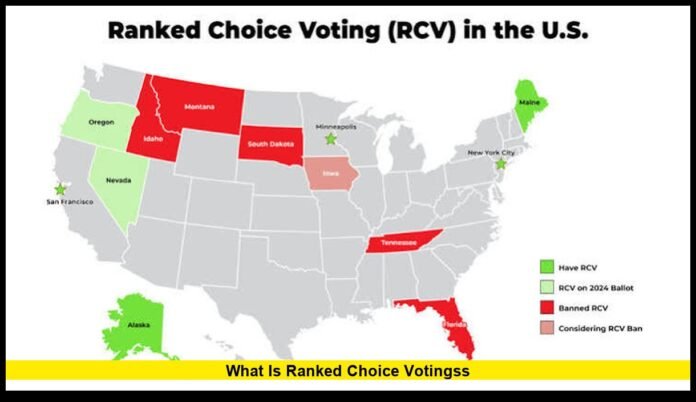
Adoption across the country remains uneven. Some jurisdictions use ranked ballots for municipal contests, while others apply them to selected statewide or federal elections.
Maine and Alaska are notable examples of states that have used the system in specified elections. Hawaii also uses ranked voting for certain special elections.
At the municipal level, several communities have adopted their own approaches. Minneapolis and San Francisco are among the cities with experience using ranked ballots for local contests.
Washington, D.C., also began implementing ranked choice voting for covered elections in 2026. Its introduction demonstrates how election procedures can change within a jurisdiction even when the national system remains largely based on conventional voting.
The legal environment is not uniform. Some states have enacted restrictions or prohibitions, while others allow local governments or state election authorities to use ranked methods under defined circumstances.
As of November 2026, voters should check the rules applicable to their specific jurisdiction rather than relying on national generalizations.
How the Method Could Influence Campaign Strategies
Candidates competing under ranked voting rules may need to think beyond their strongest supporters.
In a traditional election, campaigns frequently concentrate on securing enough direct votes to finish ahead of their opponents. In a ranked contest, attracting voters who might place a candidate second can also become valuable.
This may encourage candidates to communicate with people who have different political priorities. It could also influence debate strategies, advertising, coalition-building, and public appearances.
Nevertheless, campaign behavior depends on individual candidates and political circumstances. Ranked voting does not automatically eliminate negative advertisements, partisan disagreements, or aggressive campaign tactics.
Its potential influence is best understood as a change in electoral incentives rather than a guarantee of more cooperative politics.
The Cost and Technology Questions
Election officials must consider operational requirements before introducing a different counting method.
These can include voting equipment, ballot design, software compatibility, staff preparation, testing, public education, and procedures for reporting results.
Some jurisdictions may already have the technology and experience needed to administer ranked elections. Others may need substantial preparation before adopting the system.
Counting can also require additional time, especially when a large number of candidates participate and several rounds are necessary.
However, the overall cost cannot be determined simply by looking at the number of counting rounds. Officials must consider the complete election process, including whether the method replaces separate runoff contests and what administrative resources are already available.
Transparency is particularly important. Voters should be able to understand how officials count ballots, how transfers occur, and how final results are certified.
Can Every Voter Use the System Easily?
Accessibility is a major consideration in any election reform proposal.
Voters need clear instructions, understandable ballot layouts, and assistance options that meet applicable accessibility requirements. People unfamiliar with ranking may require additional explanations before casting their ballots.
Election offices can address these challenges through sample ballots, voter education programs, translated materials, accessible voting equipment, and public demonstrations.
The treatment of incomplete ballots also deserves attention. If a voter ranks only one candidate and that candidate is eliminated, the ballot may no longer participate in subsequent rounds.
This does not necessarily invalidate the entire ballot. It means the ballot has no remaining eligible preference to transfer.
Will Ranked Voting Become a National Standard?
A nationwide transition is not automatic. Election administration in the United States is decentralized, with state and local authorities playing major roles in establishing voting procedures.
Changes generally depend on legislation, ballot initiatives, local decisions, and the legal authority available to election officials.
Some communities may continue adopting the system because they believe it addresses problems associated with crowded elections. Others may reject it because of concerns about complexity, costs, or administrative requirements.
The future will likely depend on measurable election outcomes, public understanding, legal developments, and the experiences of jurisdictions already using the method.
For voters, the most important consideration is knowing which rules apply to the election in which they are participating.
What Voters Should Remember
Understanding what is ranked choice voting helps explain why an election’s first reported totals do not always represent its final outcome. The method gives voters an opportunity to identify multiple preferences and allows eligible ballots to transfer when candidates are eliminated.
Its supporters view this as a way to improve voter choice and address vote splitting. Critics emphasize the importance of simplicity, transparent administration, and accessible procedures.
Neither perspective removes the need for accurate election management. Every voting method requires clear rules, secure ballot handling, reliable counting, and public confidence.
As more American communities examine their election systems, ranked voting will remain an important subject in discussions about how the country chooses its representatives.