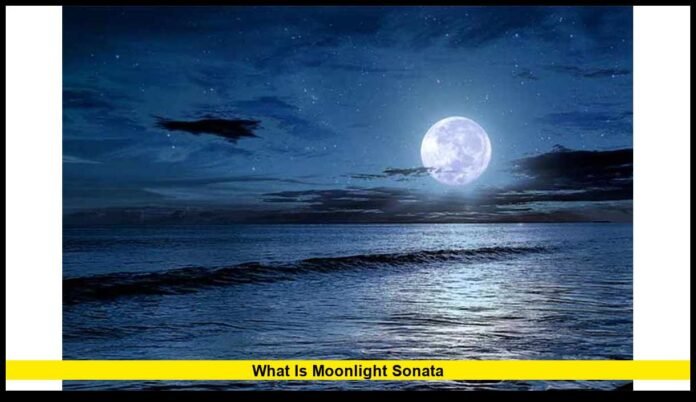

The question What is Moonlight Sonata leads to the story of one of the most recognizable piano compositions in the history of classical music. Created by German composer Ludwig van Beethoven, the Moonlight Sonata is admired for its beautiful opening melody, emotional intensity, unusual musical structure, and dramatic conclusion. More than two centuries after its creation, the composition continues to attract listeners, inspire professional pianists, and introduce new audiences to the world of classical music.
Officially titled Piano Sonata No. 14 in C-sharp minor, Op. 27, No. 2, the composition was written in 1801 and published in 1802. Beethoven originally described the work as Sonata quasi una fantasia, meaning a sonata in the manner of a fantasy. Its familiar nickname came later, when German poet and music critic Ludwig Rellstab compared the atmosphere of its opening movement to moonlight shining across Lake Lucerne in Switzerland.
The composition stands out because Beethoven organized its three movements differently from many traditional piano sonatas of his time. It begins with a slow and reflective passage, moves into a shorter and lighter middle section, and finishes with an energetic movement filled with dramatic musical expression.
Each section contributes something different to the overall experience. The opening creates an atmosphere of introspection, the middle movement provides contrast, and the finale reveals Beethoven’s remarkable ability to combine technical complexity with emotional intensity.
The Moonlight Sonata is much more than a familiar piano melody. Its history, musical construction, dedication, and influence offer an important look into Beethoven’s artistic development and the evolution of Western classical music.
What Is Moonlight Sonata and Why Is It Famous?
The Moonlight Sonata is a three-movement composition for solo piano written by Ludwig van Beethoven. It belongs to his collection of numbered piano sonatas and carries the catalogue designation Opus 27, No. 2.
The composition became famous primarily because of its memorable first movement. Its repeating triplet accompaniment, gentle melodic line, and restrained musical atmosphere create a sound that many listeners recognize immediately.
However, the complete work offers considerably more variety than its opening section suggests.
Beethoven builds the composition around three contrasting musical experiences. The first movement establishes a reflective atmosphere, the second introduces a graceful and lighter character, and the third delivers a powerful conclusion.
This arrangement makes the work especially interesting from a musical perspective.
Many classical sonatas begin with a relatively fast opening movement that introduces the central musical ideas. Beethoven takes another approach here, placing the slowest and most familiar section at the beginning.
He gradually increases the musical energy until the finale becomes the emotional center of the composition.
The Moonlight Sonata is also famous because it demonstrates how a single piano can produce a wide range of musical effects. Beethoven uses harmony, rhythm, melody, dynamics, and changes in tempo to create an experience that feels both intimate and dramatic.
Today, musicians perform it in concert halls, students study it in piano lessons, and audiences enjoy it through recordings, films, television, and digital music platforms.
Who Was Ludwig van Beethoven?
Ludwig van Beethoven was a German composer and pianist whose work transformed classical music.
He was born in Bonn in December 1770 and developed an interest in music during childhood. His father recognized his musical abilities and encouraged him to study piano and composition.
Beethoven eventually moved to Vienna, where he established himself as a talented pianist and an ambitious composer.
His career developed during a period of significant change in European music. The Classical tradition associated with composers such as Mozart and Haydn provided the foundation for his early work, but Beethoven increasingly explored new musical structures and expressive possibilities.
His compositions helped establish important characteristics of the Romantic period, including stronger emotional contrasts, greater dramatic intensity, and a more individual approach to musical expression.
Some of his most famous works include:
- Symphony No. 5 in C minor.
- Symphony No. 9 in D minor.
- Piano Sonata No. 8, known as the Pathétique.
- Piano Sonata No. 14, known as the Moonlight Sonata.
- Piano Sonata No. 23, known as the Appassionata.
- Violin Concerto in D major.
- Piano Concerto No. 5, commonly called the Emperor Concerto.
Beethoven also produced 32 numbered piano sonatas, which remain central to classical piano education and performance.
The Moonlight Sonata represents an important part of this collection because it demonstrates his willingness to experiment with traditional musical forms.
His personal struggles also shaped his life as a musician. During his early thirties, Beethoven began experiencing progressive hearing difficulties. Despite the increasing challenges, he continued composing and eventually produced some of his greatest works.
When Did Beethoven Compose Moonlight Sonata?
Beethoven composed the Moonlight Sonata in 1801, when he was approximately 30 years old.
The composition belongs to an important stage of his creative development. During this period, he was gaining recognition in Vienna while exploring increasingly individual approaches to piano music.
The sonata was published in 1802 by the Viennese publisher Giovanni Cappi.
Its original publication identified the composition as Sonata quasi una fantasia. It also appeared with another piano sonata under the same opus number, Op. 27.
The designation indicated that Beethoven wanted to move beyond some of the conventional expectations associated with the traditional sonata.
The surviving original manuscript is held by the Beethoven-Haus in Bonn, Germany. The autograph is nearly complete, although its first and final pages are missing.
This loss means that historians cannot examine the entire original manuscript or establish every detail of the composer’s initial presentation.
Nevertheless, the published score provides substantial information about the work’s structure and musical character.
The Moonlight Sonata emerged during a period when Beethoven was increasingly interested in developing compositions that combined established musical forms with greater freedom of expression.
Why Is It Called the Moonlight Sonata?
The name Moonlight Sonata is one of the most recognizable titles in classical music, but Beethoven did not create it.
The nickname originated from the German poet and music critic Ludwig Rellstab.
Several years after Beethoven’s death, Rellstab compared the atmosphere of the first movement to the image of moonlight shining across Lake Lucerne in Switzerland.
His description created a memorable visual association with the music.
Listeners could imagine a quiet lake, a nighttime landscape, and the gentle movement of water beneath the moonlight.
The comparison eventually became widely associated with Beethoven’s composition.
However, the nickname was a later interpretation rather than an official title supplied by the composer.
Beethoven’s original description, Sonata quasi una fantasia, referred to the composition’s musical character and unusual organization.
The distinction matters because the name Moonlight Sonata can sometimes create the impression that Beethoven intended to describe a particular nighttime scene.
There is no confirmed evidence that he composed the work to represent moonlight, a lake, or a specific landscape.
Instead, Rellstab’s interpretation helped establish an enduring public identity for the composition.
Today, the nickname is so familiar that many people recognize it more easily than its formal musical designation.
Who Was Moonlight Sonata Dedicated To?
Beethoven dedicated the Moonlight Sonata to Countess Giulietta Guicciardi, a young woman he knew through his social and musical connections in Vienna.
She became one of his piano pupils around 1801.
Historical accounts indicate that Beethoven developed romantic feelings for her. Their relationship has attracted attention because the dedication appeared during a period of personal uncertainty in the composer’s life.
The dedication is documented in the original publication of the work.
However, the precise relationship between Beethoven’s personal feelings and the composition’s musical character remains uncertain.
Some interpretations connect the emotional atmosphere of the first movement with his affection for Giulietta.
Others emphasize the broader musical and historical circumstances surrounding its creation.
There is no definitive statement from Beethoven establishing that the sonata was written as a direct musical account of their relationship.
It is therefore more accurate to describe Giulietta as the person to whom Beethoven dedicated the composition rather than claim that the work tells a confirmed romantic story.
This distinction also helps separate historical evidence from later storytelling that has surrounded the Moonlight Sonata.
Understanding the Three Movements of Moonlight Sonata
The Moonlight Sonata contains three movements, each with a different tempo, musical structure, and emotional character.
Together, they create a composition that develops from a quiet beginning toward an intense conclusion.
First Movement: Adagio Sostenuto
The first movement is the most famous part of the Moonlight Sonata.
It opens with a continuous sequence of triplets that creates a gentle, flowing sound. A restrained melody appears above this repeating accompaniment, gradually developing throughout the movement.
Beethoven uses C-sharp minor to establish a reflective musical atmosphere.
The opening is unusual because it avoids the energetic introduction common in many traditional sonatas.
Instead, the music begins quietly and maintains a measured pace.
The repeating accompaniment plays an important role in creating the movement’s identity. The notes flow continuously, giving the impression of movement without introducing a strong rhythmic interruption.
The melody develops above this pattern, allowing the pianist to create subtle differences in emphasis and expression.
One of the greatest challenges for performers is maintaining the balance between the accompaniment and the melody.
If the repeated notes become too prominent, the main musical line can lose its expressive quality. If the melody becomes too forceful, the delicate atmosphere may disappear.
Beethoven’s musical instructions encourage a sustained and controlled performance.
The first movement is also notable for its harmonic development. Although the music maintains a recognizable atmosphere, changes in harmony create moments of tension and release.
These details make the movement more complex than it may initially appear.
Its emotional character has led listeners to associate it with sadness, solitude, reflection, and nighttime imagery.
Nevertheless, the music does not have one officially established meaning. Its emotional impact depends partly on the listener’s experience and the pianist’s interpretation.
Second Movement: Allegretto
The second movement offers a noticeable change in character.
Marked Allegretto, it introduces a lighter and more graceful musical atmosphere after the seriousness of the opening.
The movement is written in D-flat major, creating a tonal contrast with the surrounding C-sharp minor movements.
Its musical structure includes a main section and a contrasting trio.
Although it is relatively short, the second movement has an important role in the complete composition.
It gives listeners a moment of contrast before the intense finale begins.
Its rhythm and melodic character are more relaxed, but Beethoven still incorporates interesting musical details.
The movement requires accurate articulation, balanced dynamics, and careful attention to timing.
Pianists must preserve its graceful character without making it sound overly mechanical.
The Allegretto is sometimes overlooked because the first and third movements receive more public attention.
However, it contributes significantly to the overall balance of the Moonlight Sonata.
Without this contrasting section, the movement from the reflective opening to the dramatic conclusion would feel very different.
Third Movement: Presto Agitato
The third movement is the energetic and technically demanding conclusion of the Moonlight Sonata.
Marked Presto agitato, it moves at a much faster pace than the opening movement.
Beethoven returns to C-sharp minor and introduces rapid musical passages, powerful rhythms, and dramatic changes in intensity.
The finale requires advanced piano technique.
Performers must coordinate both hands while maintaining speed, accuracy, and control over the changing musical patterns.
Unlike the restrained first movement, the third movement creates a sense of urgency.
Its rapid passages and powerful accents produce a dramatic contrast that changes the listener’s understanding of the complete composition.
The movement is also important because it reveals the structural purpose of Beethoven’s arrangement.
He does not place the most energetic music at the beginning. Instead, he gradually builds toward a powerful final section.
This approach gives the composition a strong sense of development.
For piano students, the finale presents challenges involving finger control, hand coordination, stamina, and dynamic precision.
Professional performers must also consider the emotional direction of the music rather than focusing only on speed.
The third movement is one of the main reasons the Moonlight Sonata remains an important work for advanced pianists.
What Makes Moonlight Sonata Different From Other Classical Piano Sonatas?
The Moonlight Sonata stands out because Beethoven changes the traditional organization of a three-movement piano sonata.
During the Classical period, composers frequently followed a fast-slow-fast arrangement.
The first movement usually introduced the main musical themes and established the work’s overall structure.
The second movement provided a slower contrast, while the finale often brought the composition to an energetic conclusion.
Beethoven uses a different approach.
He begins with a slow movement, follows it with a shorter Allegretto, and saves the most dramatic musical material for the end.
This arrangement changes the listener’s experience.
Rather than presenting the composition’s strongest energy immediately, Beethoven allows the music to develop gradually.
His original designation, Sonata quasi una fantasia, also reflects this creative approach.
The word fantasy suggests a more flexible and imaginative musical character.
Beethoven still uses recognizable musical organization, but he gives the composition a distinctive direction.
Another important feature is the instruction to perform the movements without pauses between them.
This helps maintain continuity and allows the three sections to contribute to one connected musical experience.
The result is a composition that feels different from many traditional sonatas while remaining grounded in the established piano tradition.
What Does Moonlight Sonata Mean?
The Moonlight Sonata does not have an officially confirmed storyline.
Beethoven did not provide a documented explanation stating that the composition represents a particular event or sequence of emotions.
Nevertheless, its musical qualities have encouraged several interpretations.
The first movement is often associated with introspection, loneliness, sadness, or quiet contemplation.
Its repeating accompaniment and restrained melody create an atmosphere that encourages careful listening.
The second movement offers a lighter perspective. Some listeners associate it with elegance, calmness, or a temporary emotional release.
The third movement introduces a much more dramatic character. Its rapid passages and strong musical contrasts can create feelings of excitement, tension, or emotional urgency.
When listeners experience the three movements together, they may interpret the work as a progression from reflection toward emotional intensity.
However, this interpretation should not be confused with a confirmed program created by Beethoven.
The composition is an instrumental work rather than a musical illustration of a documented story.
Its lasting appeal partly comes from the freedom it gives listeners to develop their own emotional responses.
How Difficult Is Moonlight Sonata to Play on Piano?
The difficulty of the Moonlight Sonata varies considerably between its three movements.
The first movement may appear easier because it moves slowly and uses a recognizable repeating pattern.
However, a successful performance requires excellent control over timing, dynamics, phrasing, and the balance between melody and accompaniment.
The second movement is shorter and generally less technically demanding than the finale, but it still requires accuracy and musical sensitivity.
The third movement is considerably more challenging.
Its rapid passages require advanced finger technique, coordination between both hands, and the ability to maintain consistent speed.
A pianist must also control the musical intensity without sacrificing clarity.
For beginners, simplified versions of the first movement may provide a useful introduction to Beethoven’s music.
However, performing the complete original sonata requires a much higher level of preparation.
Students should build their technical abilities gradually rather than attempting the finale at full speed immediately.
Teachers often divide difficult passages into smaller sections, practice them slowly, and gradually increase the tempo as accuracy improves.
This approach helps develop both technical confidence and musical understanding.
How Long Does Moonlight Sonata Take to Perform?
A complete performance of the Moonlight Sonata generally lasts around 15 to 17 minutes.
The exact duration depends on the pianist’s tempo, musical interpretation, and approach to the individual movements.
The first movement takes the longest because of its slow and sustained character.
The second movement is relatively brief, while the third movement moves considerably faster.
Some performances may finish sooner, while others take longer.
These differences do not necessarily indicate that a pianist is playing incorrectly.
Beethoven’s music allows room for interpretation, particularly in the expressive first movement.
For listeners, hearing the complete composition provides a better understanding of its musical development than listening only to the famous opening.
What Key Is Moonlight Sonata Written In?
The Moonlight Sonata is primarily written in C-sharp minor.
This key is identified in the composition’s official title and forms the tonal foundation of the first and third movements.
The second movement moves into D-flat major, providing a contrast in the overall musical arrangement.
C-sharp minor contains seven sharps in its standard key signature.
The tonal relationships between the movements help create a connection between the beginning and the finale.
For music students, the composition provides an opportunity to study minor-key harmony, melodic development, chord progressions, and changes in musical atmosphere.
Understanding its key can also help pianists become more familiar with the notes and harmonic relationships used throughout the work.
How Did Beethoven’s Hearing Loss Relate to the Composition?
Beethoven’s hearing difficulties are an important part of his biography.
He began experiencing hearing problems during the late 1790s, and the condition became increasingly serious during the early nineteenth century.
By the time he composed the Moonlight Sonata in 1801, he was already dealing with significant concerns about his hearing.
These difficulties affected his personal life and created uncertainty about his future as a performing musician.
In 1802, Beethoven wrote the document now known as the Heiligenstadt Testament.
In it, he described his emotional struggles and the difficulties associated with his growing hearing loss.
However, the Moonlight Sonata was composed before that document.
It would be inaccurate to describe the composition as a work written after Beethoven had become completely deaf.
His hearing continued to deteriorate over the following years, but he remained active as a composer.
Some listeners connect the emotional character of the sonata with the difficulties he experienced during this period.
Although that connection can be discussed as an interpretation, no definitive evidence establishes hearing loss as the specific subject of the composition.
Why Does Moonlight Sonata Continue to Attract Audiences?
The Moonlight Sonata remains popular because it combines musical sophistication with a sound that many people can appreciate without formal training.
Its opening is recognizable, its structure is distinctive, and its emotional development creates a memorable listening experience.
Several factors contribute to its continuing popularity.
A memorable opening melody: The first movement introduces a distinctive musical pattern that listeners can recognize after hearing only a short passage.
Three contrasting movements: The work moves between reflection, grace, and dramatic intensity, offering more variety than a single familiar melody.
Educational importance: Piano students regularly encounter Beethoven’s sonatas while developing technique and learning classical musical interpretation.
Cultural recognition: The composition has appeared in films, television programs, and other forms of entertainment, helping it reach audiences outside traditional concert settings.
Professional performances: International pianists continue to record and perform the sonata, introducing new interpretations to different generations.
Emotional accessibility: Listeners can appreciate the music without understanding its technical construction or historical background.
These qualities help explain why the Moonlight Sonata continues to occupy an important position in the international classical music repertoire.
Moonlight Sonata in Modern Music and Popular Culture
Although the Moonlight Sonata originated in the early nineteenth century, it remains familiar in modern entertainment.
The first movement is particularly popular in films, television, advertisements, and digital content.
Its recognizable sound can establish an atmosphere of reflection, tension, sadness, or mystery.
The composition also appears frequently in piano tutorials and educational videos.
Digital platforms have made it easier for listeners to compare performances by different pianists and explore all three movements.
Some recordings emphasize the delicate qualities of the opening, while others highlight the dramatic contrast between the first and third movements.
Modern technology has also made classical music more accessible to people who may not attend traditional concerts.
However, digital popularity does not replace the importance of live performance.
Hearing the sonata played in a concert hall offers an opportunity to experience the piano’s sound, dynamic range, and musical detail directly.
The continued presence of the composition in both traditional and digital settings demonstrates its lasting cultural importance.
What Can Piano Students Learn From Moonlight Sonata?
The Moonlight Sonata offers valuable lessons for musicians at different stages of their development.
Its three movements require different musical skills, making the complete composition useful for studying several aspects of piano performance.
Students working on the first movement can develop control over repeating triplets, melodic balance, and sustained musical expression.
The second movement provides opportunities to improve articulation, timing, and rhythmic precision.
The third movement challenges students to develop speed, coordination, accuracy, and stamina.
The composition also teaches an important lesson about interpretation.
Playing the correct notes is only one part of performing Beethoven successfully.
Pianists must understand how the music develops, where the main melodies appear, and how changes in dynamics influence the listener’s experience.
The sonata also introduces students to the transition between Classical and Romantic musical styles.
By studying the work, musicians can understand how Beethoven used traditional forms while creating a more individual and expressive approach to composition.
For these reasons, the Moonlight Sonata remains a valuable part of piano education.
Final Thoughts
Understanding what is Moonlight Sonata means looking beyond its famous opening melody and exploring the composer, history, musical structure, and cultural significance behind the work.
Written by Ludwig van Beethoven in 1801 and published in 1802, the composition became one of the defining examples of his creative approach to piano music.
Its three movements create a distinctive musical experience. The first introduces a reflective atmosphere, the second provides a graceful contrast, and the third concludes with remarkable energy and technical complexity.
The familiar nickname came from Ludwig Rellstab’s comparison between the opening movement and moonlight over Lake Lucerne. Beethoven himself used the designation Sonata quasi una fantasia, reflecting his interest in a more imaginative approach to traditional musical organization.
Its dedication to Countess Giulietta Guicciardi also connects the composition to an important period in Beethoven’s personal life, although the precise relationship between that dedication and the music’s emotional meaning remains uncertain.
More than 200 years after its creation, the Moonlight Sonata continues to attract professional musicians, students, historians, and everyday listeners.
Its importance comes from more than its recognizable melody. The composition demonstrates how musical structure, expressive performance, and technical creativity can work together to produce an enduring artistic achievement.
Whether experienced through a live piano performance, a recording, or a music lesson, Beethoven’s Moonlight Sonata remains a remarkable contribution to the history of classical music.
Frequently Asked Questions
Q1. What is Moonlight Sonata in simple terms?
Moonlight Sonata is a famous classical piano composition written by Ludwig van Beethoven. It contains three movements and is officially titled Piano Sonata No. 14 in C-sharp minor, Op. 27, No. 2.
Q2. Who composed Moonlight Sonata?
German composer Ludwig van Beethoven composed the Moonlight Sonata in 1801. It was published in 1802.
Q3. Why did Beethoven write Moonlight Sonata?
Beethoven did not leave a confirmed explanation of a specific story or event behind the composition. Its musical structure and expressive qualities reflect his creative experimentation during the early nineteenth century.
Q4. Who gave Moonlight Sonata its name?
German poet and music critic Ludwig Rellstab popularized the nickname by comparing the first movement with moonlight over Lake Lucerne in Switzerland.
Q5. How many movements are in Moonlight Sonata?
The composition contains three movements: Adagio sostenuto, Allegretto, and Presto agitato.
Share your thoughts about Beethoven’s Moonlight Sonata in the comments, and stay updated for more fascinating stories about classical music, legendary composers, and timeless masterpieces.