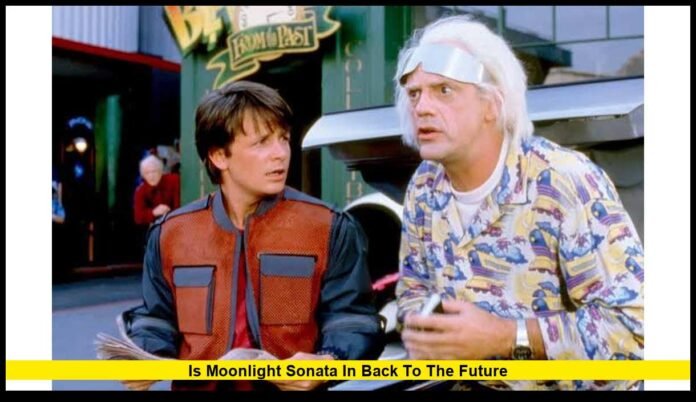

If you have been wondering, Is Moonlight Sonata in Back to the Future, the answer is no. Ludwig van Beethoven’s famous piano composition, officially known as Piano Sonata No. 14 in C-sharp minor, Op. 27, No. 2, is not listed among the officially credited songs or the released soundtrack selections for the original 1985 film. Although Back to the Future features several memorable musical moments, Beethoven’s celebrated Moonlight Sonata is not an identified part of its soundtrack.
Music plays an important role throughout the Back to the Future franchise. From Marty McFly’s rock-and-roll performance to Alan Silvestri’s dramatic orchestral compositions, the movies use music to establish different time periods, develop characters, and make important scenes more memorable. This mixture of classical-sounding orchestral music, 1950s hits, and 1980s pop songs can sometimes make it difficult to identify a particular piece.
The confusion surrounding Moonlight Sonata is understandable because Beethoven’s composition is one of the most recognizable piano works in popular culture. Its gentle opening, emotional atmosphere, and familiar melody have appeared in countless films, television programs, advertisements, and other forms of entertainment.
However, there is an important distinction between music that sounds classical and an actual performance of Beethoven’s composition. The orchestral score in Back to the Future was composed by Alan Silvestri, and its musical identity is separate from Beethoven’s piano sonata.
This article examines the soundtrack, the music associated with the film’s most recognizable scenes, the role of classical music in the trilogy, and why viewers may associate Moonlight Sonata with the time-travel adventure.
What Is Moonlight Sonata and Who Composed It?
Before examining the music in Back to the Future, it helps to understand the composition behind the question.
Moonlight Sonata is one of the best-known classical piano compositions in history. It was written by German composer and pianist Ludwig van Beethoven, who remains one of the most influential figures in Western classical music.
The composition was completed in 1801 and published in 1802. Its formal title is Piano Sonata No. 14 in C-sharp minor, Op. 27, No. 2. Beethoven dedicated the work to Countess Giulietta Guicciardi, one of his piano students.
The nickname Moonlight Sonata became popular after Beethoven’s death. German music critic and poet Ludwig Rellstab compared the first movement to moonlight shining over Lake Lucerne. That description helped establish the name by which the composition is recognized today.
The sonata contains three movements:
- Adagio sostenuto: The opening movement is slow, reflective, and atmospheric. Its repeating piano accompaniment gives it a distinctive sound.
- Allegretto: The second movement is lighter and more graceful, creating a contrast with the emotional opening.
- Presto agitato: The final movement is energetic, technically demanding, and dramatically different from the first two movements.
The opening movement is particularly recognizable because of its flowing triplet accompaniment and expressive melody. It is frequently used in popular culture when filmmakers want to establish an emotional, mysterious, or reflective atmosphere.
This widespread use explains why viewers sometimes associate the composition with movies that contain dramatic orchestral music.
However, recognizing the general atmosphere of a classical composition is not the same as identifying the actual recording. In the case of Back to the Future, the official soundtrack information does not identify Beethoven’s Moonlight Sonata as one of its musical selections.
What Music Is Actually Featured in Back to the Future?
The original Back to the Future, released in 1985, has a distinctive soundtrack combining original orchestral compositions with popular songs from different musical eras.
The film follows Marty McFly, played by Michael J. Fox, as he accidentally travels from 1985 to 1955 in a modified DeLorean created by the eccentric scientist Dr. Emmett Brown, played by Christopher Lloyd.
Music helps audiences understand the difference between the two periods. Songs associated with the 1980s establish Marty’s original environment, while recordings from the 1950s help bring the earlier setting to life.
The official motion picture soundtrack includes several recognizable recordings.
1. The Power of Love – Huey Lewis and the News
One of the most recognizable songs associated with the movie is The Power of Love.
Performed by Huey Lewis and the News, the song appears early in the film and became closely associated with the franchise. Its upbeat rock sound reflects the energy and personality of the 1980s.
The song was also commercially successful and helped establish the movie’s musical identity beyond the theater.
2. Back in Time – Huey Lewis and the News
Back in Time is another important song connected to the original movie.
Its title directly reflects the central concept of the story. The track became particularly recognizable through its association with the film’s closing credits.
3. Earth Angel – The Penguins
Earth Angel (Will You Be Mine) is one of the most emotionally significant musical selections in the movie.
The song plays during the Enchantment Under the Sea dance sequence, an important moment in the story involving Marty, George McFly, and Lorraine Baines.
Its romantic sound reflects the musical culture of the 1950s and supports the emotional atmosphere of the scene.
4. Johnny B. Goode – Chuck Berry
Perhaps the most famous musical performance in the movie takes place when Marty performs Johnny B. Goode with the Starlighters.
The scene is memorable because Marty introduces a style of guitar-driven rock music to an audience in 1955.
His energetic performance becomes one of the defining moments of the entire franchise.
5. Night Train – Jimmy Forrest
Night Train is another important musical selection associated with the film’s 1950s dance sequence.
The instrumental recording contributes to the atmosphere of the event and helps establish the period setting.
6. The Wallflower (Dance with Me Henry) – Etta James
Performed by Etta James, this recording contributes to the movie’s collection of music from the 1950s.
Its inclusion reflects the film’s attention to the popular music culture of the period.
7. Time Bomb Town – Lindsey Buckingham
Time Bomb Town brings a different musical style to the soundtrack.
Performed by Lindsey Buckingham, the song contributes to the modern musical atmosphere surrounding Marty and his original 1985 environment.
These recordings demonstrate that the movie’s musical identity is built around a combination of popular songs and original orchestral music rather than Beethoven’s classical piano repertoire.
Who Composed the Back to the Future Movie Score?
Alan Silvestri is the composer responsible for the original orchestral score of Back to the Future.
Silvestri created the musical themes that accompany the movie’s time-travel sequences, dramatic discoveries, emotional moments, and major action scenes.
His compositions are an important reason the movie remains recognizable decades after its theatrical release.
Unlike a collection of previously recorded popular songs, an original film score is written specifically to support the story.
For example, the orchestral music accompanying the DeLorean’s time-travel sequences helps communicate excitement and anticipation. The recurring musical themes also create continuity between scenes that take place in different decades.
Silvestri’s work uses a large orchestral sound, memorable melodies, and dramatic musical changes.
His approach is different from Beethoven’s piano sonata, even when both types of music create emotional or dramatic experiences.
Why Alan Silvestri’s Music Is Important
Several elements make the score particularly effective:
- Recognizable themes: The main musical ideas return throughout the film and help connect important moments.
- Dramatic orchestration: Brass, strings, percussion, and other orchestral instruments contribute to the movie’s adventurous atmosphere.
- Emotional storytelling: The music supports the relationships between Marty, Doc Brown, and other characters.
- Time-travel atmosphere: Changes in musical intensity help communicate the excitement and danger of traveling through time.
- Musical continuity: Related themes help maintain a consistent identity across the trilogy.
Silvestri’s work became so closely associated with the franchise that the main theme remains recognizable even to people who have not watched the movies recently.
His contributions also continued through Back to the Future Part II and Back to the Future Part III.
Is Moonlight Sonata in Back to the Future Part II?
Back to the Future Part II, released in 1989, continues the story of Marty McFly and Doc Brown.
The sequel takes the characters to 2015 before introducing an alternative version of 1985 and revisiting events connected to the original movie.
Alan Silvestri returned as the composer, creating additional orchestral music that develops the musical identity established in the first film.
The sequel’s soundtrack includes compositions associated with its major sequences, including Hill Valley in 2015, the hoverboard chase, and the events surrounding the alternate timeline.
Its musical selections also reflect the film’s futuristic setting and its more complicated time-travel storyline.
The official soundtrack information identifies Silvestri’s original score rather than Beethoven’s Moonlight Sonata.
There is no official confirmation that Moonlight Sonata was used as an identifiable musical selection in Back to the Future Part II.
It is important not to confuse the dramatic orchestral passages in the movie with Beethoven’s actual composition.
Is Moonlight Sonata in Back to the Future Part III?
The third movie, Back to the Future Part III, arrived in 1990 and takes Marty and Doc Brown into the American Old West of 1885.
This installment has a different atmosphere from its predecessors because much of the story takes place in a historical Western setting.
Alan Silvestri again composed the original orchestral score.
The music combines the familiar musical identity of the franchise with sounds appropriate for the Western setting.
The film includes several recognizable musical moments, including the use of the Howdy Doody theme, Stars and Stripes Forever, and other period-related selections.
Marty also references contemporary popular music through his performance and humming of familiar songs.
The soundtrack’s musical identity is therefore quite different from a Beethoven piano recital.
Does Part III Include Beethoven’s Moonlight Sonata?
The available official soundtrack information does not identify Moonlight Sonata as a featured composition.
The released score selections for the trilogy also do not list the Beethoven sonata.
There is no official confirmation establishing that the piece appears in the third movie.
Consequently, viewers looking for Moonlight Sonata in the original trilogy should not expect to find it among the officially identified soundtrack selections.
Why Do People Associate Moonlight Sonata With Back to the Future?
There are several reasons someone might search for Moonlight Sonata in connection with Back to the Future.
The most important is the distinctive sound of the film’s orchestral score.
Silvestri’s compositions frequently use dramatic arrangements that can create feelings of mystery, anticipation, excitement, and emotion.
Beethoven’s Moonlight Sonata is also strongly associated with dramatic scenes in movies and television.
When people remember a particular musical atmosphere without remembering its exact melody, they may associate one familiar classical composition with another piece of music.
1. Both Use Music to Create Strong Emotions
Moonlight Sonata is famous for its emotional opening movement.
Its slow pace and repeating notes can create a reflective atmosphere.
Similarly, Back to the Future uses music to strengthen the emotional impact of important scenes.
The difference is that Silvestri’s music was specifically composed for the movie, while Beethoven’s sonata is an independent classical composition written more than a century before the film’s story takes place.
2. Both Are Recognizable Across Generations
Beethoven’s music has remained popular for centuries.
Likewise, Back to the Future has continued attracting audiences since its original theatrical release in 1985.
Both have become recognizable elements of popular culture.
This shared cultural familiarity may contribute to online searches connecting the two.
3. Classical Music Is Often Used in Science Fiction and Fantasy
Classical music frequently appears in films, television programs, and advertisements.
Filmmakers sometimes use established compositions to create a particular atmosphere or communicate something about a character.
However, this does not mean that every film featuring orchestral music includes a famous Beethoven composition.
In Back to the Future, the original score is an important part of the storytelling, but its credited composer is Alan Silvestri.
4. Musical Memories Can Become Confused
Another possible explanation is that viewers remember a melody from another movie or television program and associate it with a different production.
Moonlight Sonata has appeared in numerous entertainment contexts, making it easy to recognize even when its original setting is forgotten.
Without a specific scene, recording, or audio example, it would not be appropriate to claim that a particular remembered passage from Back to the Future is Beethoven’s composition.
How to Recognize Moonlight Sonata Compared With the Back to the Future Theme
One practical way to answer the question is to compare the musical characteristics of both compositions.
Although they can both create dramatic experiences, they have different musical structures and purposes.
| Musical characteristic | Moonlight Sonata | Back to the Future theme |
|---|---|---|
| Composer | Ludwig van Beethoven | Alan Silvestri |
| Original period | 1801 | 1985 |
| Musical style | Classical piano sonata | Orchestral film score |
| Main sound | Piano | Full orchestra |
| Atmosphere | Reflective and emotional | Adventurous and dramatic |
| Purpose | Independent classical composition | Film storytelling |
The most recognizable part of Moonlight Sonata is its opening movement.
It begins with a repeating triplet accompaniment beneath a sustained melody. The result is a flowing, gentle sound that remains recognizable even when performed by different pianists.
The Back to the Future theme, by comparison, has a much more cinematic orchestral character.
It uses dramatic instrumental arrangements and a memorable melody that supports the movie’s adventurous storyline.
A Simple Listening Test
If you are trying to identify the music you remember from the movie, consider the following:
- If you hear a solo piano playing the recognizable opening pattern of Beethoven’s sonata, you may be listening to Moonlight Sonata.
- If you hear a dramatic orchestral theme associated with Marty and Doc’s adventures, it may be Alan Silvestri’s film score.
- If you hear energetic guitar music during the 1955 dance performance, you are more likely hearing the film’s rock-and-roll selections.
This distinction is useful because soundtrack music can sometimes sound familiar without being the same composition.
Why Music Is So Important to the Back to the Future Franchise
Music is not simply background entertainment in Back to the Future. It is an essential storytelling element.
The three movies use music to establish the identity of different historical periods while helping audiences understand the characters’ experiences.
The first film, in particular, uses songs from two decades to establish the contrast between Marty’s original life and the world he encounters after traveling to 1955.
In 1985, Marty is surrounded by contemporary rock music.
When he arrives in the 1950s, he encounters a different musical culture, including early rock-and-roll and rhythm-and-blues recordings.
The contrast becomes particularly important during the Enchantment Under the Sea dance.
Marty’s performance of Johnny B. Goode introduces the musical style associated with a later generation to people living in an earlier period.
This creates one of the movie’s most entertaining sequences.
The Role of Music in Establishing Different Time Periods
Each installment uses music to support its setting.
- Back to the Future (1985): Combines 1980s popular music with songs associated with the 1950s.
- Back to the Future Part II (1989): Uses orchestral music and period-related songs to support its futuristic and alternate-timeline storylines.
- Back to the Future Part III (1990): Introduces a Western atmosphere through its musical arrangements and selections.
This approach helps distinguish the different settings without relying entirely on costumes, dialogue, and visual effects.
It also gives the franchise a musical identity that remains recognizable across all three movies.
Latest Updates: What the Back to the Future Soundtrack Reveals
The Back to the Future franchise celebrated its 40th anniversary in 2025, bringing renewed attention to the original film, its music, and its cultural influence.
One notable soundtrack development was the release of a special trilogy collection featuring selections from the original film recordings.
The collection brought together orchestral score selections from all three movies, including music composed by Alan Silvestri.
The original film selections included recognizable titles such as:
- Back to the Future
- Skateboard Chase
- Marty’s Letter
- Clocktower, Part 1
- Clocktower, Part 2 and Helicopter
- ’85 Lone Pine Mall
- 4 X 4
- Doc Returns
The Part II selections included music associated with Hill Valley in 2015, the story’s alternate timeline, and other major sequences.
Part III selections included Main Titles, Indians, Point of No Return, and End Credits.
Has Moonlight Sonata Been Officially Added to the Soundtrack?
There is no verified announcement establishing that Beethoven’s Moonlight Sonata has been added to the official Back to the Future soundtrack.
The anniversary collection’s published track listing does not identify the composition.
The original soundtrack information also identifies other songs and Silvestri’s original music without listing Moonlight Sonata.
This distinction matters because soundtrack releases do not necessarily contain every piece of music or sound heard in a finished movie. An absent album listing alone cannot establish that a composition was never heard in any version or related promotional material.
Nevertheless, there is no verified official confirmation that Moonlight Sonata is a featured composition in the original trilogy.
As of the latest available information, the established musical identity of the franchise remains centered on Alan Silvestri’s score and its credited popular music selections.
Why the Search Question Continues to Attract Attention
The question Is Moonlight Sonata in Back to the Future is an example of how familiar music and popular movies can become connected in viewers’ memories.
People often search for a particular composition after hearing something that reminds them of it.
In this case, the association may come from the movie’s emotional orchestral passages, its memorable musical themes, or the broader use of classical music in entertainment.
The question also highlights the difference between an original movie score and a classical composition.
An original score is written to support a specific production. A classical work such as Moonlight Sonata already exists independently and can be incorporated into a film through licensing and recording arrangements.
The two approaches can create similar emotional effects, but they are not interchangeable.
For anyone researching the music of Back to the Future, the official soundtrack and film credits provide the clearest starting point.
They identify Alan Silvestri as the composer and document the well-known songs associated with the movie.
Final Thoughts
The answer to Is Moonlight Sonata in Back to the Future is no, based on the officially identified soundtrack and music credits. Beethoven’s famous piano sonata is not listed as a featured composition in the original film’s soundtrack or the published selections for the trilogy.
Instead, the franchise is known for Alan Silvestri’s original orchestral compositions, Huey Lewis and the News’ popular songs, and memorable recordings from the 1950s.
The combination of these musical styles gives the movies their distinctive identity and helps make their most important scenes unforgettable.
Although Moonlight Sonata and the Back to the Future score can both create powerful emotional experiences, they are separate musical works by different composers.
There is no verified official announcement confirming that Beethoven’s composition is part of the franchise’s soundtrack.
For viewers interested in the movie’s music, exploring Alan Silvestri’s original score and the songs featured throughout the trilogy offers a much clearer picture of what makes the franchise’s soundtrack so memorable.
Frequently Asked Questions
Q1. Is Moonlight Sonata in Back to the Future?
No. Beethoven’s Moonlight Sonata is not listed among the officially credited songs or released soundtrack selections for the original Back to the Future movie. There is no official confirmation identifying it as a featured composition.
Q2. Who composed the music for Back to the Future?
Alan Silvestri composed the original orchestral score for Back to the Future. He also returned to compose the music for both sequels, helping establish a consistent musical identity throughout the trilogy.
Q3. Is Beethoven’s Moonlight Sonata used in Back to the Future Part II?
Moonlight Sonata is not identified in the official soundtrack information for Part II. The sequel primarily features Alan Silvestri’s original orchestral score alongside other musical selections.
Q4. Does Back to the Future Part III feature Moonlight Sonata?
There is no official confirmation that Moonlight Sonata appears as a featured composition in Part III. Its published soundtrack selections do not identify Beethoven’s piano sonata.
Q5. What is the most famous song in Back to the Future?
Johnny B. Goode, performed by Marty McFly with the Starlighters, is among the movie’s most recognizable musical moments. The Power of Love by Huey Lewis and the News is another particularly famous song associated with the film
Enjoyed learning about the music behind Back to the Future? Share your thoughts in the comments and stay updated for more movie soundtrack facts, classic film discoveries, and entertainment news.