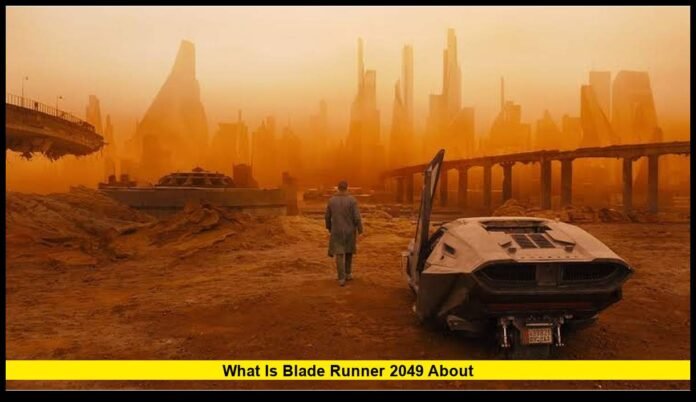

What is Blade Runner 2049 about? The science-fiction thriller centers on Officer K, a replicant police officer whose investigation uncovers a secret capable of transforming the future of artificial life. Released in 2017, the film follows K through a mystery involving a hidden birth, forgotten memories, and Rick Deckard, a former blade runner whose past holds crucial answers. Directed by Denis Villeneuve, the movie combines futuristic detective fiction with questions about identity, freedom, love, and the meaning of being human.
Ryan Gosling leads the cast as Officer K, while Harrison Ford returns as Deckard. Ana de Armas plays Joi, K’s holographic companion, and Jared Leto portrays Niander Wallace, a powerful businessman whose company manufactures replicants. Their intersecting stories create a mystery that gradually becomes more personal for K.
Set in Los Angeles in 2049, the film presents a society shaped by environmental damage, corporate influence, and artificial intelligence. Replicants perform essential tasks, but many remain subject to discrimination and strict control. When K discovers evidence that a replicant gave birth, he finds himself investigating a development that could challenge the entire social order.
The movie runs approximately 164 minutes and serves as a direct sequel to Ridley Scott’s 1982 film, Blade Runner. Its story stands on its own while continuing the earlier film’s exploration of artificial life. Understanding the mystery, the characters, and the final scenes helps explain why K’s journey reaches beyond a conventional police investigation.
What Is Blade Runner 2049 About? The Main Story Explained
The central story follows K as he investigates an event that authorities consider impossible. As a blade runner, he tracks down older replicants who have escaped their assigned roles. His professional responsibilities require him to enforce a system that treats beings like himself as controlled products.
K initially approaches his work with discipline. He follows orders, completes assignments, and avoids questioning the structure of the world around him. His latest investigation changes that routine when he discovers evidence of a replicant’s death connected to childbirth.
The discovery creates an immediate problem for the LAPD. Replicants are manufactured, and their reproduction is not supposed to occur naturally. If they can produce children, their existence could become independent of the corporations that create them.
K receives orders to find the child and eliminate the evidence. However, the investigation leads him toward people and events connected to the original Blade Runner. He eventually discovers that Rick Deckard may know the truth about the mysterious birth.
As K follows the clues, he begins to question his own memories. A childhood experience appears to connect him directly to the mystery, encouraging him to believe that he might be the person everyone seeks.
That possibility changes the investigation from a professional assignment into a personal search for identity. K wants to know whether his life has a special purpose and whether his memories reveal something extraordinary about his origins.
The film’s central conflict develops through this uncertainty. K must determine what happened while confronting the possibility that the answers he wants may not define him in the way he expects.
The Futuristic Setting: Los Angeles in 2049
The film presents a future in which technology has advanced dramatically, but the benefits of progress remain unevenly distributed. Los Angeles is crowded, polluted, and dominated by towering buildings and enormous advertisements.
Artificial intelligence appears throughout everyday life. Holographic companions provide personalized interaction, while bioengineered replicants perform physical labor and other demanding assignments.
Yet the society shown in the movie has not solved its fundamental problems. Environmental damage has reduced the quality of life, economic inequality remains visible, and powerful corporations influence the direction of technological development.
The world also reflects the consequences of an earlier disaster known as the 2022 blackout. This event forms part of the franchise’s history and helps explain the damaged infrastructure and social instability visible in the sequel.
Outside Los Angeles, the landscape becomes increasingly desolate. Abandoned structures, industrial ruins, and isolated settlements contrast with the crowded urban environment.
These locations reinforce K’s isolation. Although he lives among millions of people and interacts with advanced technology, he struggles to find a secure place in society.
The setting also establishes why replicants matter so much. Humanity relies on artificial beings for essential work, yet the institutions that control them continue to deny them equal standing.
This contradiction gives the story its wider significance. The conflict is not simply about whether machines can think. It concerns the rights of beings that can reason, experience attachment, and make decisions while remaining under the control of their creators.
Who Is Officer K? Ryan Gosling’s Character Explained
Officer K is the central character and the audience’s entry point into the mystery. Ryan Gosling portrays him as a controlled and observant replicant who initially accepts the limits imposed on his life.
K works for the LAPD as a blade runner. His assignments involve locating older replicants and retiring those who have escaped control. The job requires him to confront beings who share his artificial origins.
His professional identity creates an unusual conflict. K serves a system that does not fully recognize his individuality, even though he possesses the intelligence needed to investigate complex cases.
At home, K experiences a different kind of isolation. His relationship with Joi provides companionship, but it also highlights the difficulty of forming connections in a world shaped by artificial products and commercial technology.
The investigation involving the mysterious birth gives K a reason to examine his own life. His apparent childhood memory seems to offer evidence that he might possess an identity beyond the one assigned to him.
For a time, K believes he may be uniquely important. The possibility gives him hope that his existence has a special meaning.
His journey becomes more complicated when the evidence contradicts that belief. K must decide what matters when he can no longer rely on the idea that he is destined for greatness.
The character’s development is central to the film’s emotional impact. He begins as an officer who follows orders and ends as someone who makes an independent choice with significant consequences for another person.
What Are Replicants in Blade Runner 2049?
Replicants are bioengineered beings designed to perform work for humans. They possess human appearances and advanced capabilities, but their creators determine their intended functions and impose restrictions on their lives.
The original Blade Runner explored the conflict between these artificial beings and the society that controls them. The sequel revisits the issue through a newer generation of replicants and the corporations responsible for producing them.
K represents a model designed to follow instructions. His obedience makes him useful to the LAPD, but it does not eliminate his capacity to question his circumstances.
Older replicants, including Sapper Morton, reveal another side of this system. Their attempts to live outside corporate control expose the risks associated with refusing their assigned roles.
The distinction between artificial creation and human experience drives the film’s philosophical questions. Replicants may be manufactured, but the story shows that their lives involve more than the functions their creators intended.
Their treatment raises questions about ownership and freedom. If a being can think, form relationships, and make meaningful decisions, should its artificial origin determine how society treats it?
The movie does not offer a simple legal or scientific answer. Instead, it presents situations in which the characters must decide whether they will follow established rules or recognize the individuality of others.
Replicants are therefore essential to both the mystery and the film’s broader examination of power. Their existence challenges a social structure built on the assumption that manufactured life must remain subordinate.
How the Investigation Begins
K’s investigation begins at a protein farm where he confronts Sapper Morton. The encounter provides the first major step toward the mystery surrounding replicant reproduction.
After completing his assignment, K discovers evidence connected to a female replicant who died after giving birth. The remains suggest that the event occurred despite the accepted belief that replicants cannot reproduce naturally.
The discovery creates an urgent problem for the LAPD. Lieutenant Joshi, K’s superior, understands that the information could threaten the balance between humans and replicants.
Joshi orders K to locate the child and eliminate the evidence. She fears that news of the birth could trigger conflict and destabilize the existing social order.
K begins examining the evidence, including records and clues connected to Rachael, the replicant who shared a relationship with Deckard in the original film.
The case takes him through several locations and introduces people whose interests conflict. Some want the secret destroyed, while others hope the discovery will create new opportunities for replicants.
As the investigation progresses, K finds evidence that seems to connect him to the child. This apparent connection makes the case more emotionally complicated and changes the way he understands his own past.
The mystery works on two levels. K must solve a criminal investigation, but he must also determine whether his memories can provide reliable evidence about his identity.
Why the Replicant Birth Matters
The possibility of replicant reproduction represents a major turning point in the film’s fictional world.
Until this discovery, corporations control replicant production. They decide how these beings are created and how they will serve human society. Natural reproduction would challenge that arrangement.
A replicant population capable of producing children could grow without depending entirely on corporate manufacturing. That possibility would give replicants a future beyond the system that currently controls them.
For Wallace, the discovery represents a scientific and commercial opportunity. He wants to understand the process because it could help his corporation produce replicants on a much larger scale.
For the replicants seeking independence, the same discovery carries a different meaning. It suggests that their population might possess the ability to survive and grow without remaining completely dependent on human creators.
The secret therefore creates competing interests. Corporate leaders want control over the discovery, authorities fear social upheaval, and the replicant resistance sees a potential path toward freedom.
K’s investigation connects these interests through a single question: who has the right to determine the future of artificial life?
The film uses this conflict to examine the consequences of treating living beings as property. The ability to create life becomes a source of power, while the possibility of independent reproduction threatens the institutions that profit from that control.
Rick Deckard’s Role in the Story
Rick Deckard, played by Harrison Ford, is a former blade runner whose past connects the sequel to the original movie.
Deckard’s relationship with Rachael provides the foundation for the mystery surrounding the child. Their history becomes especially important after K discovers evidence of the replicant birth.
By 2049, Deckard has disappeared from ordinary society. He lives in isolation, separated from the institutions and relationships that once shaped his life.
K searches for him because Deckard may possess information about the child’s identity. Finding him becomes essential to understanding what happened years earlier.
Deckard’s return also gives the sequel an emotional connection to the original film. His experiences demonstrate that earlier decisions can continue to shape lives long after the immediate events have passed.
The relationship between Deckard and K is not simply a meeting between an older character and a new protagonist. Both men must confront difficult questions about loyalty, personal responsibility, and the consequences of their choices.
Deckard understands the danger of revealing the truth. K, meanwhile, wants answers that might explain his apparent connection to the mystery.
Their meeting brings these competing needs into focus and helps move the story toward its final revelation.
Joi and the Question of Artificial Companionship
Joi, portrayed by Ana de Armas, is a holographic companion designed to provide personalized interaction. She lives with K through a digital projection system and offers emotional support in his otherwise isolated life.
Unlike K, Joi is not a biological replicant. She is a digital product whose personality and interactions are shaped by the technology behind her.
Her relationship with K raises questions about affection and authenticity. Joi appears to care about him, encourages his ambitions, and responds to his emotional needs.
However, the commercial nature of her existence complicates their relationship. Her personality is designed to appeal to a customer, making it difficult to separate individual emotional experiences from programmed behavior.
K still values their time together. His attachment shows that the experience of companionship can have emotional importance even when the nature of the other participant remains uncertain.
Joi also encourages K to imagine that he might be more than an ordinary replicant. Her support becomes part of his growing belief that his memories could reveal a special identity.
The film does not provide a definitive answer about the nature of Joi’s consciousness. Instead, it allows the audience to consider whether an emotional connection must be entirely independent of programming to matter.
Her character broadens the film’s discussion of artificial intelligence beyond biological replicants. She represents a different form of artificial existence, one built around interaction, companionship, and personal attachment.
Niander Wallace and Corporate Control
Niander Wallace, played by Jared Leto, leads the corporation responsible for manufacturing replicants.
His ambition extends beyond producing advanced artificial beings. He wants to overcome the limitations that restrict their numbers and reduce the obstacles to expanding their use across human settlements.
The discovery of a replicant birth attracts Wallace because it could provide a new method of increasing the replicant population. His interest is tied to corporate power as much as scientific curiosity.
Wallace views the discovery through the lens of what it could accomplish for his organization. The possibility of natural reproduction becomes a potential means of extending the corporation’s influence.
His assistant Luv helps pursue the corporation’s objectives. She acts decisively and becomes a direct threat to K as the investigation develops.
Wallace’s character highlights the danger of concentrating control over artificial life in the hands of a powerful institution. His ambitions place corporate expansion above the freedom of individual replicants.
This conflict gives the film a political dimension. The question is not merely whether replicants can reproduce, but whether that ability will give them independence or become another tool for corporate control.
The Major Twist: Is Officer K the Missing Child?
One of the most important moments in Blade Runner 2049 occurs when K begins to believe that he might be the child connected to the mysterious birth.
During his investigation, K discovers a memory of a childhood experience involving a wooden horse. The memory feels unusually vivid, especially because it appears to contain details that connect to the evidence he has uncovered.
K starts to believe that the memory may prove he was born rather than manufactured. If that interpretation were correct, he would occupy a unique position in the history of replicants.
This possibility gives K something he has rarely experienced: hope that his life might have a special purpose. Instead of seeing himself as an officer created to follow orders, he begins to imagine that his origins could distinguish him from every other replicant.
However, the investigation eventually reveals that the memory does not belong to him. Dr. Ana Stelline, the memory designer, created the childhood memory based on her own experience.
K’s apparent connection to the past therefore does not establish that he is Deckard’s child. The revelation forces him to abandon the belief that he occupies the center of the mystery.
This discovery is essential to the film’s meaning. K initially believes that being extraordinary would give his existence value. When that possibility disappears, he must determine whether he can still make meaningful decisions.
His transformation demonstrates that a person’s importance does not depend on having a remarkable origin. K becomes significant through his actions rather than through a special identity.
Blade Runner 2049 Ending Explained
The final sequence brings K’s personal development together with the mystery surrounding Deckard’s family.
After learning that he is not the child, K continues his investigation. He eventually confronts Luv, Wallace’s assistant, during a struggle involving Deckard.
Their confrontation becomes violent, and K suffers serious injuries. Nevertheless, he manages to defeat Luv and continue with his plan.
K brings Deckard to the location where Ana Stelline works. There, Deckard finally has the opportunity to reunite with his daughter.
Ana’s identity resolves the central mystery. She is the child born to Rachael, and her survival explains why Deckard has spent years protecting the secret.
K remains outside while Deckard enters the building. The moment offers a quiet conclusion to a story filled with danger, uncertainty, and competing interests.
The film does not explicitly confirm whether K survives his injuries. He lies in the snow, and the final images leave his physical fate unresolved.
However, the emotional significance of the ending is clear. K no longer needs to prove that he is special. He has made a decision that allows another person to experience something meaningful.
His actions also distinguish him from the obedient officer introduced at the beginning. Rather than following instructions from his superiors, he chooses his own course of action.
The ending does not solve every problem in the fictional world. Wallace remains powerful, and the wider conflict over replicant freedom continues. Instead, the film concludes K’s personal journey while leaving the larger struggle unresolved.
The Meaning Behind K’s Final Decision
K’s final decision represents the difference between wanting recognition and acting according to personal values.
Earlier in the movie, he hopes that his memories will reveal a special identity. He wants to believe that he is the child whose existence could change society.
Once he discovers the truth, that hope disappears. Yet his desire to help Deckard does not disappear with it.
K’s choice demonstrates that an individual can act meaningfully without receiving public recognition or proving an extraordinary background.
He helps Deckard reach Ana because he decides that the reunion matters. The decision is his own, rather than an instruction imposed by the LAPD or the Wallace Corporation.
This development gives the film a different perspective on heroism. K does not become important because society discovers his identity. He becomes important because he acts despite the limitations imposed on him.
The distinction also reinforces the film’s examination of freedom. K’s artificial origins do not prevent him from making a decision that challenges the expectations of the institutions controlling his life.
The Main Themes of Blade Runner 2049
Identity and Personal History
K’s investigation begins with a question about another replicant but gradually becomes a search for his own identity.
His childhood memory appears to provide an answer, yet the discovery that it belongs to Ana reveals the limits of memory as proof of personal history.
The film suggests that identity involves more than remembering events. It also develops through relationships, choices, and the meaning people assign to their experiences.
Freedom and Individual Rights
Replicants live within a system that controls their purpose and restricts their independence. The possibility of natural reproduction threatens this arrangement because it could allow replicants to develop beyond corporate control.
The film asks whether creators should possess unlimited authority over the beings they produce.
Artificial Intelligence and Emotional Connections
K’s relationship with Joi demonstrates how artificial companions might influence human-like emotional experiences.
The movie does not resolve whether Joi’s apparent affection reflects independent consciousness or programmed behavior. Instead, it examines how K experiences the relationship and how it shapes his understanding of himself.
Corporate Power and Exploitation
Wallace’s ambitions reveal how corporations can use technology to strengthen their influence.
His interest in replicant reproduction focuses on increasing production and extending the reach of his organization. This objective conflicts with the possibility that replicants might gain greater independence.
Sacrifice and Meaning
K’s final actions provide the clearest expression of the film’s central idea.
He does not need to be the missing child to make a difference. His decision to help Deckard reunite with Ana gives his life meaning through action rather than recognition.
Why Blade Runner 2049 Is Different From Typical Science-Fiction Movies
Many science-fiction films emphasize rapid action, technological spectacle, or conflicts between humans and machines. Blade Runner 2049 takes a more reflective approach.
The movie includes violent confrontations and a complex investigation, but it frequently pauses to examine its characters and surroundings.
Director Denis Villeneuve builds tension through silence, lighting, visual composition, and gradual discoveries. These techniques encourage viewers to consider what the characters experience rather than simply follow the next development in the plot.
The cinematography by Roger Deakins plays a major role in this approach. The film contrasts crowded urban environments with isolated landscapes, creating a visual distinction between society’s enormous scale and the vulnerability of individuals.
The soundtrack and sound design also contribute to the atmosphere. Music and environmental sounds create unease without requiring constant dialogue.
This deliberate pacing may challenge viewers who prefer fast-moving action. However, it supports the story’s philosophical focus and gives its major revelations room to develop.
The result is a science-fiction film that uses futuristic technology to examine familiar human concerns, including loneliness, belonging, prejudice, and the desire to find meaning.
How Blade Runner 2049 Continues the Original Film’s Story
The 1982 Blade Runner introduced a world in which artificial beings challenged the assumptions of human society. Its story followed Deckard as he hunted replicants who had escaped their assigned roles.
His encounters with those replicants complicated the distinction between human and artificial life. His relationship with Rachael made that conflict personal and established the foundation for the sequel.
Blade Runner 2049 revisits those questions through K’s investigation. Instead of focusing primarily on Deckard’s work as a blade runner, it examines the consequences of the earlier film’s events and the possibility that replicants could reproduce.
Deckard’s return connects the two stories, but K remains the central character. His investigation introduces a new perspective on memory, individuality, and the desire to belong.
Watching the original movie first helps explain Deckard’s history and the significance of Rachael. Nevertheless, the sequel provides enough information for viewers to understand its main mystery.
Together, the films examine how society responds when artificial beings begin to challenge the boundaries that define their existence.
Latest Blade Runner Franchise Update
As of November 2, 2026, Blade Runner 2049 remains a completed feature film, while the franchise is preparing to return with Blade Runner 2099.
The upcoming limited series is scheduled to premiere on Prime Video on November 25, 2026. All eight episodes are set to arrive on the same day.
The series stars Michelle Yeoh and Hunter Schafer. Its story takes place 50 years after the events of Blade Runner 2049 and introduces a new generation of characters in a changed Los Angeles.
Silka Luisa serves as creator and showrunner, while Ridley Scott is an executive producer.
The series represents the next major screen installment in the franchise, but it should not be confused with a direct continuation of Officer K’s individual story. The 2017 film retains its own narrative conclusion.
For viewers interested in the wider universe, the upcoming series offers another opportunity to explore the relationship between artificial life, human society, and the institutions that shape the future.
Frequently Asked Questions
What is Blade Runner 2049 about in simple terms?
The film follows Officer K, a replicant police officer who discovers evidence that a replicant gave birth. His investigation leads him to Rick Deckard and a secret that could change the future of artificial life.
Who plays Officer K in Blade Runner 2049?
Ryan Gosling plays Officer K, a replicant employed by the LAPD. His investigation forces him to reconsider his memories, his identity, and the purpose of his existence.
Is Blade Runner 2049 a sequel to the 1982 movie?
Yes. The 2017 film continues the story of the original Blade Runner, taking place 30 years after the events of the earlier movie.
Is K Deckard’s son?
No. K initially suspects that he might be the child born to Deckard and Rachael, but the film reveals that the childhood memory supporting his belief belongs to Dr. Ana Stelline.
Who is Ana Stelline?
Ana Stelline is a memory designer who creates memories for replicants. She is also revealed to be the daughter of Deckard and Rachael.
What happens to Deckard at the end?
Deckard reaches the facility where Ana works and reunites with his daughter. K’s actions make the meeting possible.
Does K die at the end of Blade Runner 2049?
The movie does not explicitly confirm K’s death. He lies injured in the snow after helping Deckard, leaving his ultimate fate unresolved.
Why does Wallace want to find the child?
Wallace wants to understand replicant reproduction because it could help his corporation increase production and extend its control over artificial life.
What does Joi represent in the movie?
Joi represents artificial companionship and the uncertainty surrounding digital emotions. Her relationship with K raises questions about whether programmed interactions can create meaningful emotional experiences.
How long is Blade Runner 2049?
The film runs approximately 164 minutes, or 2 hours and 44 minutes.
Is Blade Runner 2049 suitable for children?
The movie carries an R rating in the United States because of its mature content, including violence, language, nudity, and sexual material. Parents should review its content before deciding whether it is suitable for younger viewers.
When does Blade Runner 2099 come out?
Blade Runner 2099 is scheduled to premiere on Prime Video on November 25, 2026. The limited series takes place 50 years after the events of Blade Runner 2049.
Final Thoughts
Blade Runner 2049 combines a futuristic detective story with a deeper examination of identity, freedom, and personal responsibility. Officer K’s investigation begins with an extraordinary discovery, but its most important revelation concerns the meaning of an ordinary life. His journey shows that a person’s value does not depend on a remarkable origin or recognition from society. Instead, meaningful choices can define an individual even when the world refuses to acknowledge their humanity.
What do you think about Officer K’s final decision and the movie’s ending? Share your interpretation and keep following the latest developments in the Blade Runner universe.