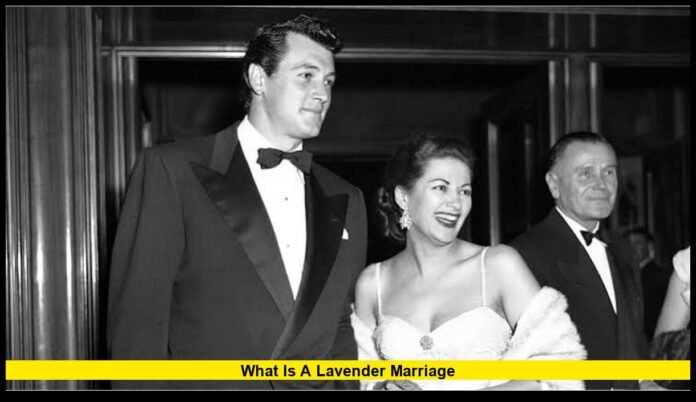

What is a lavender marriage? It is generally a marriage between a man and a woman in which one or both partners are LGBTQ+ and the relationship is used, at least partly, to maintain a heterosexual public image. The term has a long connection to LGBTQ+ history, especially Hollywood, and it has returned to public attention in the U.S. after reality television personality Hailey Glassman recently spoke openly about describing her own marriage this way.
The term can sound unfamiliar to people who have never encountered it before. It does not refer to the color lavender, a particular wedding style or a specific legal category of marriage.
Instead, it describes a relationship shaped by sexual orientation, privacy and social expectations. Historically, such marriages could provide protection when being openly gay, lesbian or bisexual carried serious professional and personal consequences.
Today, the circumstances can be very different. Same-sex marriage is legal throughout the United States, and LGBTQ+ visibility has changed dramatically. Yet the concept continues to appear in conversations about identity, family expectations, relationships and celebrity culture.
What Does a Lavender Marriage Mean?
A lavender marriage traditionally describes a marriage between a man and a woman where one or both spouses are LGBTQ+ and the marriage helps conceal that identity from the public.
The arrangement can take different forms.
Two LGBTQ+ people of different genders might knowingly marry each other. A gay man and a lesbian woman, for example, could create a marriage that allows both people to appear heterosexual to relatives, colleagues and the wider public.
Another possibility involves an LGBTQ+ person marrying a heterosexual partner who knows about the person’s sexual orientation and agrees to the arrangement.
The circumstances can vary considerably.
The central idea is not simply that one spouse is LGBTQ+. The important element is the role that the marriage plays in presenting a heterosexual relationship to other people.
That distinction matters because not every mixed-orientation marriage qualifies.
A gay person can genuinely marry someone of another gender for emotional, romantic or family reasons. In that situation, outside observers should not automatically label the relationship a lavender marriage.
Why Did Lavender Marriages Become Necessary?
The history of these marriages is closely connected to discrimination against LGBTQ+ people.
For much of U.S. history, openly identifying as gay or lesbian could carry major social and professional risks. People could lose employment, face public humiliation, experience family rejection or encounter other forms of discrimination.
The entertainment industry provided a particularly important example.
During Hollywood’s Golden Age, studios carefully managed the public image of actors and actresses. A star’s personal reputation could influence whether audiences accepted that performer and whether a studio believed the person remained commercially valuable.
Studio contracts also included morality provisions that could punish behavior considered damaging to an actor’s public image.
In that environment, appearing heterosexual could have significant professional value.
Marriage could help create that appearance.
Lavender Marriage and Old Hollywood
Hollywood became strongly associated with the history of lavender marriages because studios exercised substantial control over stars’ public identities.
Actors were not simply expected to perform on screen. Their public personalities were also carefully promoted.
A successful leading man was often presented as a desirable bachelor or devoted husband. A leading actress was similarly marketed through carefully controlled stories about romance, beauty and family life.
For LGBTQ+ performers, openly discussing same-sex relationships could threaten that carefully created image.
Some entered opposite-sex marriages to reduce public scrutiny. In other cases, studios or professional advisers reportedly encouraged relationships that would reinforce a heterosexual image.
These arrangements were not identical.
Some involved genuine friendship and affection. Others were reportedly difficult relationships that eventually ended in divorce.
The historical record also contains uncertainty surrounding some famous couples. That is why individual marriages should not be labeled as lavender marriages without reliable evidence.
Rock Hudson and Phyllis Gates
Rock Hudson remains one of the most frequently discussed figures in the history of Hollywood and LGBTQ+ privacy.
Hudson became one of the biggest male stars of his generation. He married Phyllis Gates in 1955, and the marriage ended in 1958.
Hudson’s sexuality remained private for most of his career.
His marriage has since become part of discussions about the pressures faced by closeted Hollywood performers. However, the circumstances surrounding the relationship have also generated decades of debate.
That history demonstrates an important point: a marriage can later become associated with a particular interpretation without every detail of the relationship being known with certainty.
Historical reporting should separate documented information from assumptions about what people privately believed or intended.
Other Historical Connections
Rock Hudson is not the only Hollywood figure associated with discussions of lavender marriages.
Researchers examining LGBTQ+ history have identified numerous examples of performers and entertainment professionals who lived within an environment where heterosexual public appearances could provide professional protection.
Los Angeles’ LGBTQ+ historic record also documents the pressures placed on performers during the studio era. Some marriages involving LGBTQ+ people were reportedly happy and supportive, while others became strained.
The history is therefore more complicated than the idea that every marriage was simply a public relations arrangement.
For some couples, friendship, companionship and mutual support were genuine parts of the relationship.
Was Every Lavender Marriage a Sham?
No.
Calling every lavender marriage a sham can erase the complexity of the people involved.
Marriage can involve many forms of connection. Romantic attraction is only one part of a relationship. Friendship, emotional support, companionship, financial partnership and family responsibilities can also play important roles.
Some LGBTQ+ people in opposite-sex marriages may have loved their spouses deeply.
Others may have viewed the marriage primarily as protection from social pressure.
Some couples established private agreements about their relationships. Others may have struggled because their expectations did not match.
The term describes the circumstances surrounding the marriage rather than guaranteeing what the spouses felt for one another.
Lavender Marriage vs. Marriage of Convenience
The two concepts can overlap, but they are not identical.
A marriage of convenience is a broad description for a marriage entered into mainly for practical reasons.
Those reasons can include finances, immigration, family expectations or social advantages.
A lavender marriage is more specifically connected to LGBTQ+ identity and the need or desire to maintain a heterosexual public image.
The distinction can be summarized simply:
| Relationship type | Main characteristic |
|---|---|
| Lavender marriage | Marriage connected to concealing or managing LGBTQ+ identity |
| Marriage of convenience | Marriage primarily entered for practical or strategic reasons |
| Mixed-orientation marriage | Partners have different sexual orientations |
| Sexless marriage | Marriage without sexual activity |
| Sham marriage | Marriage alleged to lack a genuine marital relationship |
These categories can sometimes overlap, but one should not automatically be substituted for another.
Did Lavender Marriages Disappear?
They became less prominent as LGBTQ+ rights and visibility increased.
The gay rights movement changed the social environment significantly, particularly after the Stonewall uprising in 1969. LGBTQ+ people increasingly challenged laws, discrimination and cultural expectations that had forced many people to hide their identities.
Hollywood also changed.
Studios gradually lost some of the extraordinary control they once exercised over actors’ personal images. Public attitudes toward homosexuality began changing as LGBTQ+ representation increased.
The legalization of same-sex marriage across the United States brought another major transformation.
In 2015, the U.S. Supreme Court ruled in Obergefell v. Hodges that same-sex couples have a constitutional right to marry.
That decision removed the need for LGBTQ+ Americans to enter opposite-sex marriages simply because the law refused to recognize their preferred relationships.
However, legal equality did not eliminate every social pressure.
Why the Term Still Exists Today
The modern discussion is different from the Hollywood environment of the 1920s, 1930s and 1940s.
Today, LGBTQ+ people in the United States have far greater legal recognition and public visibility. Same-sex couples can marry legally, and many public figures openly discuss their sexuality.
Still, family expectations, cultural attitudes and concerns about privacy can influence personal decisions.
Some people may also use the term differently today than historians did when discussing Hollywood.
Modern relationship discussions sometimes use it to describe transparent marriages involving partners with different sexual orientations. In these cases, the spouses may openly understand their identities rather than secretly hiding them.
That modern use makes the definition more complicated.
The historical meaning centered heavily on concealment. Contemporary use can sometimes describe a marriage involving LGBTQ+ partners even when the relationship is known publicly.
Hailey Glassman Brings New Attention to the Term
The term has received fresh attention in September 2026 after Hailey Glassman joined the cast of The Real Housewives of New York City.
Glassman has publicly described her marriage as a lavender marriage while discussing her personal life ahead of the show’s 16th season.
She said she has been married for 15 years and explained that she and her husband have known each other since childhood. The couple spends time between New York City and Martha’s Vineyard.
Her husband has chosen not to appear on the reality series. Glassman has said he owns a major business and does not want his family’s legacy connected to the exposure that comes with reality television.
Glassman has also discussed maintaining her own New York City apartment, describing the separate space as an important part of her independence.
Her comments have renewed mainstream interest in the meaning of lavender marriage.
Importantly, her own public description provides a documented basis for discussing how the term is being used today. It is different from online speculation about celebrities whose relationships have not been publicly described this way.
Why Celebrity Discussions Require Caution
Celebrity culture can make discussions about sexual orientation especially sensitive.
A public figure’s clothing, friendships, dating history or social media activity cannot establish sexual orientation.
Likewise, a marriage should not be labeled a lavender marriage simply because people online believe one spouse may be LGBTQ+.
The most reliable information comes from the individuals themselves or well-established historical documentation.
That distinction matters because many LGBTQ+ people have historically faced unwanted exposure.
The original purpose of many lavender marriages was privacy and protection. Repeating unsupported claims about someone’s sexuality can undermine the very historical context that makes the subject important.
Can a Lavender Marriage Be Happy?
There is no single answer.
Every marriage depends on the expectations and agreements of the people involved.
Some couples may build a strong partnership around friendship, trust and shared responsibilities. Others may experience conflict when one spouse wants a relationship that the other cannot provide.
Communication can become especially important when spouses enter marriage with different expectations about romance, sexuality, children or outside relationships.
Historical examples show both possibilities.
Some couples remained together for many years. Others separated relatively quickly.
The length of a marriage alone does not establish whether it was successful or whether the relationship was primarily strategic.
Does Lavender Marriage Always Involve Secrecy?
Historically, secrecy was often central.
A person might hide their sexual orientation from parents, coworkers, employers, fans or the general public.
The marriage provided a visible explanation for the person’s personal life.
Modern relationships can operate differently.
Some couples who describe themselves using the term are open about their identities. The marriage may involve a gay, lesbian, bisexual or otherwise queer partner, but there may be no attempt to deceive friends or family.
That is one reason context matters whenever the term appears in modern media.
The historical definition and contemporary usage are not always identical.
What the Term Tells Us About LGBTQ+ History
The history of lavender marriages reveals how strongly social expectations once shaped private relationships.
Marriage was traditionally presented as proof of adulthood, respectability and family stability.
People who did not fit heterosexual expectations could face intense pressure to conform.
For LGBTQ+ individuals, marriage could therefore become more than a personal decision.
It could become a tool for protecting employment, family relationships, reputation and personal safety.
Understanding that history helps explain why some people entered relationships that may look unusual by modern standards.
How the Meaning Has Changed
The meaning has evolved alongside changes in American society.
During the Hollywood studio era, the focus was often on hiding LGBTQ+ identity from the public.
Later generations gained greater freedom to live openly.
Today, the term can refer to historical marriages as well as modern relationships where partners openly acknowledge different sexual orientations.
That does not mean the historical meaning has disappeared.
Instead, the term now exists at the intersection of LGBTQ+ history, relationship choices and modern conversations about marriage.
The Bottom Line
What is a Lavender marriage? It is traditionally an opposite-sex marriage in which one or both partners are LGBTQ+ and the marriage serves, at least partly, to create or maintain the appearance of a heterosexual relationship.
Its history is closely connected to periods when LGBTQ+ people faced serious discrimination, particularly in Hollywood, where a performer’s public image could directly affect a career.
The concept has changed as American society has become more accepting and same-sex marriage has gained legal recognition. Modern examples can involve very different circumstances from the secretive arrangements associated with earlier generations.
The recent discussion surrounding Hailey Glassman’s public description of her marriage shows that the term remains part of the American cultural conversation. At the same time, it should be used carefully and only when supported by reliable information or a person’s own public description.
Have you heard the term lavender marriage before, or did recent discussions introduce it to you? Share your thoughts and stay informed about the stories shaping today’s conversation.