 vesting works, employer matching rules, vesting schedules, and what happens to retirement savings when you leave a job.)
Understanding what does it mean to be vested in 401k is important for American workers who want to know how much of their retirement savings they can keep when they leave an employer. Vesting determines when employer contributions become permanently yours, and the rules can affect the financial value of a job’s benefits. While your own contributions are always fully vested, employer matching funds may require a specific period of service before you gain complete ownership.
A workplace retirement plan can help employees build long-term financial security through regular contributions, employer matching, and investment growth. However, the total balance displayed in a 401(k) account does not always equal the amount an employee can retain after leaving a company.
The difference comes down to the plan’s vesting provisions. Some employers give workers immediate ownership of all contributions. Others use a schedule that gradually or suddenly transfers ownership of employer-funded money over time. Knowing how these rules work can help employees evaluate compensation packages, plan career changes, and avoid unexpected losses of retirement benefits.
What Is Vesting in a 401(k) Retirement Plan?
Vesting refers to an employee’s permanent legal right to keep retirement benefits covered by a plan’s vesting rules. Once an amount is fully vested, the employee generally retains the right to that money even after employment ends.
A 401(k) account may contain employee contributions, employer matching funds, other employer contributions, and investment gains or losses. These sources do not necessarily follow identical ownership rules.
Money deducted from your paycheck and contributed to your 401(k) belongs to you immediately. Employer contributions, however, may be subject to a service requirement.
For example, an employee might have $40,000 in a retirement account, including personal contributions, employer matching funds, and investment results. If the employee is fully vested, the entire balance is nonforfeitable, although market movements and fees can change its value.
If the employee is only partially vested, a portion of the employer-funded benefits may remain subject to forfeiture when the employee leaves. The employee does not lose personal contributions simply because a vesting requirement has not been met.
This distinction makes vesting an important part of understanding the actual value of retirement benefits.
Which Parts of Your 401(k) Are Always Vested?
Federal law requires immediate full vesting of employees’ own elective contributions to a qualified 401(k) plan. Your employer cannot require you to complete several years of service before you own the money contributed through payroll deductions.
Investment gains and losses attributable to those contributions affect the account’s value but do not change your ownership rights.
Suppose an employee contributes $12,000 over two years and then accepts a job with another company. The employee retains the right to the vested balance associated with those contributions, even if the former employer uses a multi-year vesting schedule for matching funds.
Employer contributions require closer attention. Matching funds and other employer-funded benefits may become vested immediately or follow a schedule permitted by federal law.
The type of contribution and the design of the plan determine which rules apply. Employees should not assume that every deposit from an employer has the same vesting requirements.
It is also important to separate vesting from access to the account. Owning the money does not necessarily allow you to withdraw it immediately without restrictions, taxes, or possible penalties.
How Employer Matching Contributions Work
Employer matching is a benefit many companies offer to encourage retirement saving. The employer contributes additional money based on the employee’s own eligible contributions.
For example, a company may match 50% of an employee’s contributions up to 6% of eligible compensation. Another company might offer a different percentage or limit.
The exact formula depends on the plan’s provisions. Employers may also impose eligibility requirements before employees can receive matching contributions.
Even after matching funds enter the account, an employee may not immediately own all of them. A vesting schedule determines when the employee gains a permanent right to the covered contributions.
Consider an employee whose employer contributes $3,000 in matching funds during a year. If the plan provides immediate vesting, the employee owns those funds as soon as they become vested under the plan.
If the plan uses a multi-year schedule, some or all of the matching contribution may remain unvested until the employee completes the required service.
This is why workers should evaluate both the size of an employer’s match and the time required to become fully vested. A generous matching formula does not necessarily mean every dollar is immediately theirs to keep.
Understanding Cliff Vesting and Graded Vesting
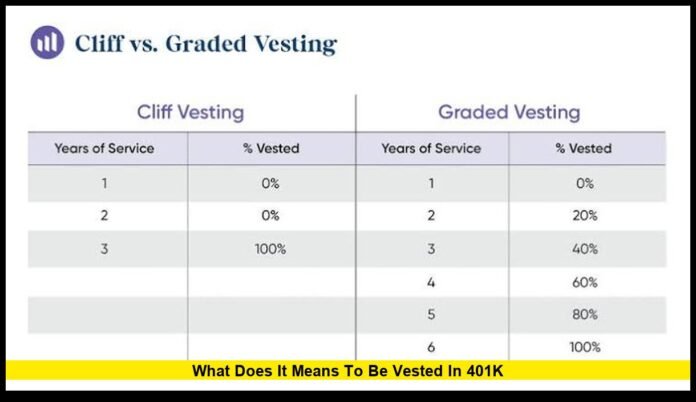
Traditional 401(k) plans commonly use two types of vesting schedules for employer matching contributions: cliff vesting and graded vesting. Federal law establishes minimum standards for many traditional arrangements, while employers can offer faster vesting.
Cliff Vesting: Full Ownership After a Required Period
Under cliff vesting, employees receive no vested ownership of the covered employer contributions until they reach the required service milestone. Once they satisfy that requirement, they become fully vested in those contributions.
A three-year cliff schedule is generally permitted for many traditional 401(k) matching contribution arrangements.
| Completed years of vesting service | Minimum vested percentage |
|---|---|
| Less than 3 years | 0% |
| 3 years | 100% |
An employee who leaves before completing the required three years may forfeit the covered employer contributions that remain unvested.
After completing three years of qualifying service, the employee becomes fully vested under this schedule.
The important detail is that the plan counts vesting service according to its governing rules. Three calendar anniversaries do not automatically establish the required service in every circumstance.
Graded Vesting: Ownership Increases Over Time
Graded vesting allows employees to gain ownership gradually as they complete additional years of qualifying service.
A standard six-year graded schedule for covered employer matching contributions uses the following minimum percentages:
| Completed years of vesting service | Minimum vested percentage |
|---|---|
| Less than 2 years | 0% |
| 2 years | 20% |
| 3 years | 40% |
| 4 years | 60% |
| 5 years | 80% |
| 6 years | 100% |
Suppose an employee has $15,000 in covered employer contributions. After three years under this schedule, the employee would generally have a vested interest equal to 40% of the applicable employer-funded amount, before accounting for investment gains or losses.
That percentage increases as the employee completes additional qualifying service. After six years, the employee reaches full vesting under the schedule.
Some employers provide more generous percentages or shorter vesting periods. The actual plan document determines the employee’s rights.
How Long Does It Take to Become Fully Vested?
The time required to become fully vested varies by employer, plan type, and contribution source.
Some plans provide immediate vesting of employer contributions. Others use a three-year cliff schedule or a six-year graded schedule for traditional matching contributions.
Certain retirement arrangements have different requirements. Safe harbor 401(k) plans generally require immediate full vesting of mandatory employer contributions. SIMPLE 401(k) plans also require immediate vesting of required employer contributions.
Qualified automatic contribution arrangements have special rules for certain required employer contributions. Other employer contributions may follow different permitted vesting schedules.
Federal law also protects employees’ rights to accrued benefits in circumstances such as reaching the plan’s normal retirement age or terminating a plan, subject to applicable requirements.
For these reasons, workers should not assume that a single vesting timeline applies to every account. The Summary Plan Description provides the key details about the plan’s vesting provisions.
How Years of Service Affect Your Vesting Percentage
Vesting usually depends on service credited under the retirement plan rather than simply the number of years shown on a calendar.
Many plans use hours of service to determine whether an employee has completed a year of vesting service. A commonly used standard is 1,000 hours during a 12-month period, although the applicable rules and plan provisions control.
Other factors may affect the calculation. Breaks in employment, changes in employment status, and special service-crediting provisions can influence how a plan recognizes service.
Employees should verify their employment start date, credited service, and the definition of a vesting year used by their plan.
If the information is unclear, the plan administrator or human resources department can explain the employee’s current service credit and expected vesting date.
What Happens When You Leave Before Becoming Fully Vested?
Leaving an employer before reaching full vesting does not mean losing the entire 401(k) balance.
You generally retain your personal contributions and associated investment results, along with the employer contributions you have already vested in. Only the eligible employer-funded portion that remains unvested may be forfeited under the plan’s rules.
For example, an employee might have a total account balance of $28,000, of which $22,000 is vested and $6,000 remains unvested. If the employee leaves before meeting the remaining vesting requirements, the employee generally retains the $22,000 vested balance. The unvested portion may be forfeited.
The final amount depends on the account’s contribution sources, investment performance, and the plan’s accounting provisions.
Before changing jobs, request your current vested balance. If you are close to an important vesting milestone, understanding the financial difference may help you evaluate your options.
Can You Roll Over Your Vested 401(k)?
Employees who leave a company can generally consider several options for eligible vested retirement savings, depending on the plan’s distribution rules.
These options may include leaving the money in the former employer’s plan when permitted, rolling eligible funds into a new employer’s retirement plan, or transferring the money to an individual retirement account.
A properly completed direct rollover can generally preserve the tax-deferred treatment of eligible traditional 401(k) assets. Roth 401(k) funds require appropriate Roth-account treatment.
Unvested employer contributions generally cannot be rolled over as if they were already owned by the employee.
Before moving the funds, check the vested balance, distribution eligibility, account fees, and any outstanding plan loans. A payment made directly to you can have different tax and withholding consequences from a direct rollover.
How to Check Your 401(k) Vesting Status
Finding your current vesting status can help you understand how much of your retirement savings you have earned the right to keep.
Start by signing in to your retirement plan account and reviewing the account details. Look for the vested balance, vested percentage, and information about employer contributions.
Next, read the Summary Plan Description. This document explains the schedule and the rules governing vesting service.
If you cannot determine your status, contact the plan administrator and ask these questions:
- What percentage of my employer contributions is currently vested?
- How many years of vesting service have I completed?
- When will I reach my next vesting milestone?
- Which employer contributions follow a different schedule?
- How would leaving my job affect my vested balance?
Request clarification if your account statement and service records appear inconsistent. Accurate information can help you avoid relying on the total account balance when estimating the amount you can retain.
Why Vesting Matters When Comparing Job Offers
Vesting can affect the actual value of an employer’s retirement benefits. Two companies may offer similar salaries and matching contributions but use different vesting schedules.
An employee who leaves one company after a short period might retain less employer-funded money than an employee whose plan provides immediate vesting.
When comparing opportunities, consider the matching formula, vesting schedule, salary, insurance coverage, and other benefits together. This provides a more realistic picture of total compensation.
Frequently Asked Questions
Does 100% vested mean I own my entire account?
It means you have a nonforfeitable right to the entire vested balance. Investment losses, fees, and applicable account rules can still affect the amount.
Can an employer take back vested contributions?
Generally, an employer cannot forfeit benefits that have become vested simply because you leave the company. Investment performance and permitted account charges can still change the balance.
Can I withdraw a vested 401(k) immediately?
Not necessarily. Vesting establishes ownership, while distribution rules determine when funds can be withdrawn. Taxes and possible early-distribution penalties may apply.
Is every 401(k) fully vested after six years?
No. Six years is the endpoint of a common graded schedule for certain employer contributions. Other plans may offer immediate vesting or follow different requirements.
Conclusion
Vesting determines when employer-funded retirement contributions become permanently yours. By understanding your plan’s schedule, tracking your credited service, and checking your vested balance, you can make more informed decisions about retirement savings and career changes.
Have you reviewed your 401(k) vesting schedule? Share your questions in the comments and stay informed about the retirement benefits that can shape your financial future.