
Commercial real estate is an important part of the U.S. economy, providing space for businesses, retailers, manufacturers, healthcare providers, and residential communities. Understanding how does commercial real estate work involves examining how properties are purchased, financed, leased, managed, and sold for potential profit. In 2026, investors continue to evaluate borrowing costs, tenant demand, property operating expenses, and differences between commercial property sectors when making investment decisions.
Unlike a personal residence, commercial property typically serves a business or income-producing purpose. Owners may collect rent from office tenants, lease warehouses to distribution companies, operate shopping centers, or manage apartment communities. The financial results depend on the property’s ability to attract tenants, generate consistent revenue, control expenses, and maintain its market value.
Commercial real estate is not simply about buying a building and waiting for its price to increase. It involves financial analysis, legal agreements, maintenance, risk management, and long-term planning. Investors must understand these elements before committing significant capital.
What Is Commercial Real Estate?
Commercial real estate, commonly known as CRE, includes properties used for business activities or held primarily to generate investment income. These properties range from small storefronts to large office towers, industrial campuses, and specialized facilities.
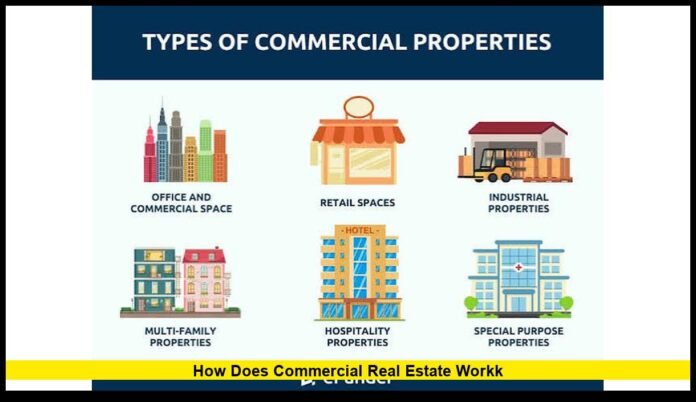
The principal categories include:
- Office buildings: Properties leased to corporations, professional firms, technology businesses, and other organizations.
- Retail properties: Shopping centers, restaurants, standalone stores, and other locations serving consumers.
- Industrial real estate: Warehouses, manufacturing plants, distribution centers, and logistics facilities.
- Multifamily housing: Apartment buildings and residential communities operated to generate rental income.
- Hospitality properties: Hotels and lodging facilities that earn revenue through accommodation and guest services.
- Healthcare buildings: Medical offices, outpatient facilities, and specialized healthcare properties.
- Special-purpose properties: Data centers, self-storage facilities, laboratories, and other buildings designed for particular uses.
Each category has different operating requirements and financial risks. An industrial warehouse may depend on access to highways and distribution networks, while a hotel relies on occupancy rates, room prices, and guest demand.
Multifamily properties also occupy an important position in commercial investment markets. Although their tenants use the units as homes, apartment communities are frequently treated as commercial assets for valuation, financing, and portfolio management.
How Commercial Real Estate Investments Begin
The process begins when an investor identifies a property and determines how it could generate revenue or increase in value.
Some buyers prefer buildings with established tenants and documented rental income. Others pursue properties that need renovations, improved management, or new leases. Developers may purchase land and construct buildings designed for anticipated demand.
Before selecting a property, investors examine its location, competing buildings, rental rates, tenant demand, physical condition, and expected operating expenses. They also evaluate local employment trends, transportation access, zoning restrictions, and future development activity.
A low purchase price does not automatically make a property attractive. A building may require substantial repairs, face persistent vacancies, or contain lease agreements that limit future rental income.
Buyers therefore review financial statements, lease documents, property tax records, insurance costs, maintenance histories, and inspection reports. Environmental assessments may also be necessary to identify contamination or other concerns.
After negotiating the purchase agreement, the buyer completes due diligence and secures the necessary financing. Once contractual conditions are satisfied, the transaction closes and ownership transfers to the buyer.
How Commercial Property Financing Works
Commercial properties often require substantial capital, so many investors use a combination of personal funds, investment partners, and borrowed money.
Banks, credit unions, commercial mortgage lenders, insurance companies, and specialized lending institutions may finance qualifying transactions. Each lender establishes its own eligibility requirements, loan terms, and underwriting standards.
Lenders generally assess the borrower’s financial condition, the property’s market value, existing leases, operating income, and ability to support debt payments. They may also consider the borrower’s experience and the amount of cash available for unexpected expenses.
Common financing options include:
- Commercial mortgages: Loans secured by commercial property, with negotiated repayment terms and interest rates.
- Bridge loans: Short-term financing for acquisitions, renovations, or properties that need time to establish stable occupancy.
- Construction loans: Funding for qualifying development projects, commonly released as construction milestones are completed.
- Commercial mortgage-backed securities financing: Loans that may be pooled into securities sold to investors.
- SBA 504 loans: Financing that eligible businesses can use for qualifying owner-occupied real estate and certain other fixed assets.
SBA 504 financing does not support passive investment in rental real estate.
Investors should compare more than monthly payments. Interest rates, closing fees, amortization periods, balloon payments, loan maturity dates, and prepayment restrictions all influence the financial outcome.
Leverage can increase potential returns when a property performs well, but it also increases risk. Lower rental income or higher borrowing costs can make debt payments difficult to maintain.
How Commercial Real Estate Generates Revenue
Rental income forms the foundation of many commercial property investments. Owners lease space to tenants under contracts that specify rent, lease duration, permitted uses, and responsibility for expenses.
Additional revenue may come from parking, storage, signage, or other services permitted by the property agreement. However, the amount collected depends on occupancy, tenant payment history, lease terms, and market demand.
For example, an office building may generate income from several businesses occupying different floors. If one large tenant moves out, the owner may experience a substantial revenue decline while continuing to pay insurance, property taxes, utilities, and maintenance expenses.
Vacancies can also create additional costs. Owners may need to renovate the space, hire a leasing broker, offer concessions, or pay tenant improvement expenses before securing a replacement occupant.
This is why experienced investors evaluate actual operating performance instead of relying only on advertised rents.
Understanding Net Operating Income
Net operating income, or NOI, measures the income a property produces after operating expenses but before mortgage payments and income taxes.
The basic formula is:
NOI = Operating Revenue − Operating Expenses
Operating revenue generally includes rental income and other property-related income, adjusted for vacancy and credit losses. Expenses may include property management, routine repairs, insurance, property taxes, utilities paid by the owner, landscaping, cleaning, and security.
Mortgage principal and interest are not included in NOI. Major capital improvements, such as replacing a roof or upgrading building systems, also require separate consideration.
NOI helps investors assess whether a building generates sufficient income to justify its market value. It also provides a useful way to compare properties with different sizes and operating structures.
A property can increase its NOI by improving occupancy, negotiating higher rents when market conditions support them, reducing unnecessary expenses, or improving management efficiency. However, cutting maintenance costs too aggressively can damage the building and increase future expenses.
How Commercial Property Values Are Calculated
Commercial property valuation frequently focuses on income potential. One widely used measurement is the capitalization rate, or cap rate.
The formula is:
Cap Rate = Annual NOI ÷ Property Value × 100
Consider a commercial building generating $450,000 in annual NOI with a market value of $9 million. Its cap rate is 5%.
The cap rate helps investors compare the income generated by different properties relative to their values. It does not represent a guaranteed return because it excludes financing costs, income taxes, capital improvements, and future changes in revenue.
Market conditions also influence valuation. If investors demand higher cap rates, property values may decline even when operating income remains stable. If demand strengthens and buyers accept lower cap rates, property values may increase.
Investors can also examine comparable sales, projected cash flows, lease quality, replacement costs, and the building’s physical condition when estimating market value.
How Commercial Leasing Works
Commercial leases establish the financial and legal responsibilities of property owners and tenants. The structure determines how rent is calculated and which party pays specific operating expenses.
A gross lease generally requires the landlord to cover specified operating costs from the rent received. Additional charges may apply if the agreement assigns particular expenses to the tenant.
A net lease shifts certain property expenses to the tenant in addition to base rent. Under a triple-net lease, tenants typically pay specified property taxes, insurance, and maintenance expenses.
A percentage lease, often used in retail settings, combines base rent with additional payments calculated using an agreed percentage of qualifying sales.
Lease agreements also address rent increases, renewal options, security deposits, permitted activities, repair obligations, and the length of occupancy.
Landlords must review lease expiration dates and tenant financial strength. A property with reliable tenants and staggered lease expirations may offer greater income stability than a building that depends heavily on one tenant whose contract expires soon.
Property Management and Maintenance
Commercial property ownership requires continuous attention after the purchase closes. Owners must collect rent, maintain building systems, address tenant concerns, and ensure compliance with applicable requirements.
Many investors hire professional property managers to coordinate daily operations. These managers may handle lease administration, maintenance requests, vendor contracts, inspections, and operating reports.
Owners must also budget for major capital expenses. Roof replacements, elevator repairs, heating and cooling upgrades, parking lot improvements, and other projects can require substantial spending.
Effective property management focuses on:
- Keeping buildings safe, functional, and attractive.
- Maintaining occupancy and collecting rent on schedule.
- Controlling operating costs without neglecting necessary repairs.
- Retaining tenants and addressing problems promptly.
- Planning for major repairs and equipment replacement.
- Reviewing insurance coverage and legal compliance.
Management fees and capital reserves must form part of the property’s financial plan. Regular performance reviews help owners identify declining revenue or rising expenses before these problems become more difficult to address.
Commercial Real Estate Market Conditions in 2026
The U.S. commercial property market does not move as a single unit. Office, industrial, retail, multifamily, hospitality, and specialized properties experience different levels of demand and financial pressure.
Borrowing costs remain an important consideration because they influence acquisition budgets, debt service, and refinancing decisions. Investors also monitor construction activity, tenant demand, operating expenses, and the availability of financing.
Office buildings face differences in demand based on location, building quality, amenities, and tenant requirements. Modern properties in desirable employment centers may attract businesses more successfully than older buildings requiring extensive upgrades.
Industrial facilities depend on distribution needs, manufacturing activity, transportation access, and the suitability of available buildings. Retail centers depend on local consumer spending, tenant sales, visibility, and competition.
Multifamily owners monitor occupancy, rent levels, maintenance expenses, and new apartment supply. Data centers and healthcare facilities require specialized infrastructure and careful assessment of tenant needs.
These differences make property-level research essential. A positive outlook for one sector does not guarantee strong performance for every building within that category.
Investors should also distinguish forecasts from confirmed results. Full-year 2026 performance will depend on actual transactions, financing conditions, rental activity, and broader economic developments.
Major Risks of Commercial Real Estate Investing
Commercial property investments can produce income, but they also carry risks that may reduce cash flow or market value.
Vacancy risk: Tenants may leave, default on rent, or reduce their space requirements.
Interest rate risk: Higher borrowing costs can make loans more expensive and reduce available cash flow.
Refinancing risk: A loan may mature when property values have fallen or lenders require more equity.
Operating expense risk: Taxes, insurance, labor, utilities, and repair costs can rise unexpectedly.
Market risk: Local economic weakness or excessive construction can reduce rental demand.
Capital expenditure risk: Major repairs and modernization projects may require significant investment.
Tenant concentration risk: Losing a major tenant can sharply reduce income when a building depends on a small number of occupants.
Investors can reduce exposure through careful due diligence, adequate reserves, conservative financial projections, regular maintenance, and close monitoring of lease expirations. Diversification across different properties and tenants can also help, although it does not eliminate the possibility of losses.
How Beginners Can Enter Commercial Real Estate
Beginners can access commercial property through direct ownership, investment partnerships, or real estate investment trusts.
Direct ownership provides control over acquisition, leasing, and management decisions, but it typically requires substantial capital and ongoing involvement.
Partnerships allow investors to share costs and responsibilities. Before entering an arrangement, participants should understand ownership percentages, voting rights, management fees, profit distributions, and exit provisions.
Real estate investment trusts, known as REITs, provide exposure to income-producing real estate without requiring investors to buy an entire building. Publicly traded REITs can be purchased through brokerage accounts, although share prices fluctuate and distributions are not guaranteed.
Every approach requires research into fees, financing, management quality, liquidity, investment duration, and potential losses. Investors should not confuse projected returns with guaranteed income.
Frequently Asked Questions
How do commercial property owners make money?
Owners earn rental income, may increase property value through improvements and better management, and can receive proceeds when selling. Final returns depend on operating expenses, debt, capital investments, and transaction costs.
Is commercial real estate different from residential property?
Commercial real estate generally serves business or investment purposes. Traditional residential property primarily provides housing, although apartment communities are commonly included in commercial real estate investment markets.
Can commercial real estate be purchased without a loan?
Yes. Buyers can pay entirely with cash or use financing to fund part of the acquisition. The appropriate approach depends on available capital, investment objectives, and risk tolerance.
Is commercial real estate profitable in 2026?
Some properties can produce attractive returns, but profitability varies by location, tenant demand, expenses, financing, and purchase price. Investors should evaluate individual opportunities rather than assume every property will appreciate.
Conclusion
Commercial real estate combines investment strategy, financing, leasing, property operations, and long-term financial planning. Understanding how income, expenses, lease agreements, and valuations interact can help investors assess opportunities more effectively. In the 2026 U.S. market, careful research, realistic financial projections, and disciplined management remain essential to navigating changing property conditions.
What are your thoughts on commercial real estate investing in the United States? Share your opinion in the comments and stay informed about the latest property market developments.