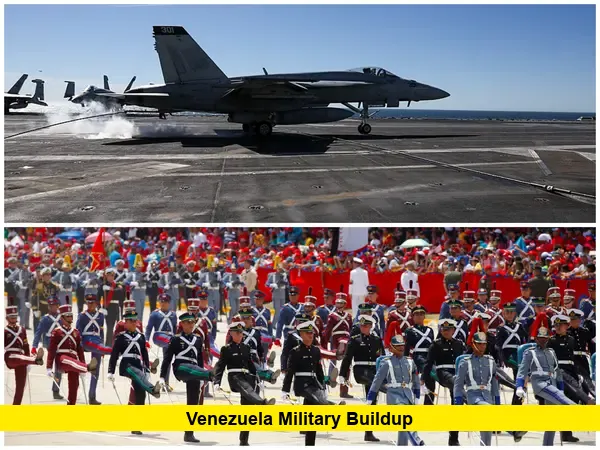

The venezuela military buildup has reached an unprecedented scale as the government of Nicolás Maduro mobilizes hundreds of thousands of troops in response to heightened U.S. military activity in the Caribbean. In recent weeks, both nations have taken significant steps that signal rising tensions across the region, with Venezuela showcasing its armed strength and the United States increasing its naval and aerial presence near Venezuelan waters.
Latest Developments in the Venezuela Military Buildup
Venezuela’s Defense Ministry has announced the deployment of roughly 200,000 military personnel across land, air, and naval divisions. The mobilization includes conventional forces, special units, and militia groups, signaling the largest Venezuelan show of military readiness in decades.
The Venezuelan government has emphasized that the move is “defensive,” claiming that the U.S. presence in the Caribbean threatens its sovereignty. The U.S., meanwhile, has positioned an aircraft carrier strike group in nearby waters, officially stating that the move is part of a regional operation against drug trafficking and organized crime.
The growing presence of military hardware on both sides — including advanced air defense systems, missile batteries, and increased naval patrols — has created what observers describe as the most serious military standoff in Latin America in recent memory.
Troop Movements and Weaponry
The mobilization is broad and strategic. Venezuela has placed troops near key coastal installations and along its western borders, preparing for potential maritime incursions or airspace violations. Military exercises have included live-fire drills, air defense simulations, and coastal defense rehearsals.
Reports from within the country suggest:
- 200,000 active personnel mobilized across all branches.
- 5,000 short-range air defense systems readied for rapid deployment.
- Enhanced air patrols near key oil and infrastructure zones.
- Civic militia participation, with tens of thousands of civilian volunteers receiving training.
The Venezuelan Navy has increased its activity in the Caribbean, focusing on anti-ship and anti-submarine operations, while the Air Force has conducted continuous aerial patrols using Russian-made fighter jets.
U.S. Response and Regional Implications
The U.S. military presence in the Caribbean has expanded in parallel. Naval and air assets, including a carrier strike group, have been stationed in international waters near Venezuelan territory. U.S. officials insist the deployments are part of broader security operations aimed at combating narcotics trafficking and maintaining freedom of navigation in the region.
However, Venezuela views these movements as provocative and has framed the U.S. buildup as an act of “imperial intimidation.” The country’s leadership argues that the United States is using anti-drug operations as a pretext for military pressure.
Neighboring nations have expressed concern about the potential for escalation. Colombia, Brazil, and several Caribbean states have all increased their border and coastal security operations to avoid being drawn into a wider conflict.
Political and Economic Context
The venezuela military buildup cannot be separated from the country’s internal political and economic situation. Years of sanctions, inflation, and political isolation have placed the Maduro administration under intense pressure. Strengthening the military serves both a strategic and symbolic purpose — projecting power abroad while reinforcing national unity at home.
The mobilization also comes at a politically sensitive time. With upcoming regional elections and international negotiations over sanctions, Venezuela’s leadership aims to display control and resilience. The government continues to highlight the “readiness of the Bolivarian Armed Forces” as proof of national strength and sovereignty.
Strategic Motivations Behind the Buildup
Analysts suggest several motivations behind Venezuela’s actions:
- Deterrence:
Caracas seeks to deter any perceived U.S. military action by displaying significant defensive capabilities. - Domestic Consolidation:
Large-scale mobilization reinforces the image of national unity and deflects public attention from economic challenges. - Regional Messaging:
Venezuela’s actions send a signal to neighboring countries that it remains a major military player in Latin America. - International Leverage:
Demonstrating readiness gives Caracas a stronger position in diplomatic talks, particularly in ongoing negotiations regarding sanctions and international trade.
Impact on U.S. Interests
For the United States, the situation poses complex challenges. While Washington’s official focus remains on combating drug trafficking, its broader regional objectives include maintaining influence in Latin America and countering external actors such as Russia and China, both of which maintain defense ties with Venezuela.
The U.S. administration is balancing deterrence with restraint — aiming to prevent escalation while ensuring regional allies feel protected. For American observers, the growing Venezuelan mobilization is a reminder of how quickly regional dynamics can shift when geopolitical tensions rise.
Risk of Escalation
While a direct military confrontation remains unlikely, the possibility of miscalculation is real. Increased military traffic, surveillance flights, and naval operations in close proximity raise the risk of an unintended clash.
Both nations have continued to issue strong statements, emphasizing readiness while avoiding outright threats. However, with tensions running high and communication channels limited, regional observers have warned that even a small incident could spiral into a broader crisis.
If conflict were to erupt, the humanitarian and economic consequences could be severe, potentially affecting migration flows, trade routes, and regional stability.
Outlook: What Lies Ahead
As of mid-November 2025, Venezuela remains on high alert. Its military buildup continues, with new rounds of exercises scheduled through the end of the year. The U.S. presence in the Caribbean shows no signs of diminishing, as American forces maintain operational readiness and intelligence monitoring in the region.
For now, the situation remains a standoff — tense but controlled. Both sides are watching each other closely, testing limits without crossing red lines. Whether this remains a show of force or escalates into confrontation will depend largely on the restraint and diplomacy of both governments.
The venezuela military buildup has become a defining moment for regional stability — a stark reminder that in today’s interconnected world, military posturing can quickly become a global concern. Stay tuned and share your thoughts on how this evolving situation might shape Latin America’s future.