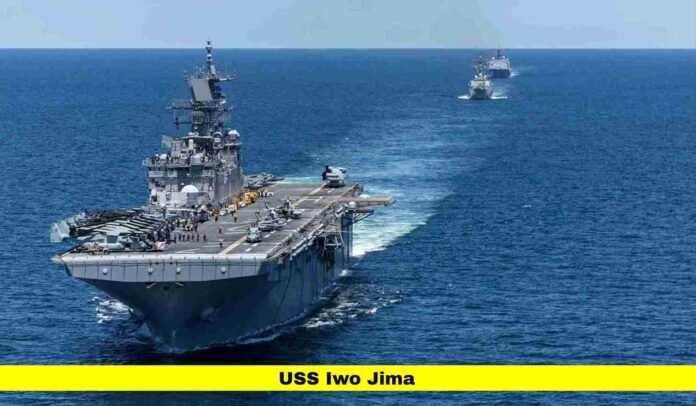

The USS Iwo Jima remains an active and highly significant amphibious assault ship in the United States Navy, continuing to support national defense objectives through deployment readiness, training operations, and global presence missions. As of today, the ship is fully operational, homeported in Norfolk, Virginia, and assigned to Atlantic Fleet tasking. Its role reflects the Navy’s emphasis on flexible, forward-deployed maritime forces capable of responding to crises, supporting allies, and sustaining combat readiness.
This article presents a fully factual, up-to-date overview written for a U.S. audience, focused entirely on the ship’s verified status, mission profile, capabilities, and strategic relevance.
Current Operational Standing
USS Iwo Jima is an active Wasp-class amphibious assault ship designated LHD-7. It continues to serve as a primary platform for amphibious operations and expeditionary missions. The ship remains part of the Atlantic Fleet and is routinely assigned to training, readiness, and deployment cycles that support U.S. global maritime strategy.
At present, the ship is not decommissioned, not laid up, and not undergoing long-term maintenance that would remove it from operational availability. Its readiness status allows it to deploy rapidly when directed by U.S. Fleet Forces Command.
Ship Class and Mission Purpose
As a Wasp-class amphibious assault ship, USS Iwo Jima is designed to project U.S. power from the sea. It functions as a floating base for Marine Corps forces and naval aviation units. The ship supports a wide range of missions, including amphibious assault, crisis response, evacuation operations, maritime security, and humanitarian assistance.
Its large flight deck enables sustained aviation operations, while internal well deck capabilities allow the launch and recovery of landing craft and amphibious vehicles. This design allows Marines and equipment to move from ship to shore without reliance on fixed ports or airfields.
Embarked Forces and Amphibious Role
USS Iwo Jima routinely embarks a Marine Expeditionary Unit during deployment cycles. A Marine Expeditionary Unit consists of a ground combat element, an aviation combat element, and a logistics combat element, forming a self-contained force capable of independent operations.
This integration enables the ship to serve as both a command platform and a launch point for Marine operations ashore. The embarked Marines train extensively with the ship’s crew to ensure seamless coordination during real-world missions.
Aviation Capabilities
The flight deck aboard USS Iwo Jima supports a variety of aircraft essential to amphibious and expeditionary warfare. These include helicopters used for troop transport and logistics support, as well as tiltrotor aircraft that extend operational reach and speed.
The ship is also capable of supporting short takeoff and vertical landing aircraft when mission requirements demand. Aviation operations are central to the ship’s mission profile and are conducted regularly during training and deployment periods.
Training and Readiness Cycles
USS Iwo Jima regularly participates in structured training programs designed to maintain combat readiness. These cycles include basic phase training, integrated exercises with other naval vessels, and full amphibious readiness evaluations.
Training focuses on navigation, damage control, aviation safety, amphibious assault coordination, and command-and-control operations. These exercises ensure that both sailors and Marines remain prepared for a broad range of scenarios, from combat operations to humanitarian response.
Amphibious Ready Group Integration
The ship typically operates as the flagship of an Amphibious Ready Group. An Amphibious Ready Group consists of multiple amphibious ships operating together to deliver Marines, aircraft, and equipment as a unified force.
This group structure enhances flexibility and allows U.S. naval commanders to position a capable force forward without requiring a carrier strike group. USS Iwo Jima’s role within this structure underscores its importance in modern naval planning.
Crew and Onboard Life
USS Iwo Jima carries a large crew of sailors, along with embarked Marines during deployments. Daily life aboard involves continuous operations, training drills, maintenance, and mission planning.
The Navy places strong emphasis on crew welfare, especially during extended periods at sea. Living spaces, medical facilities, and morale programs are designed to support the physical and mental well-being of those aboard.
Logistics and Sustainment at Sea
Sustaining operations at sea is a core capability of USS Iwo Jima. The ship conducts underway replenishment to receive fuel, supplies, and provisions without returning to port. This capability allows extended presence in operational areas.
Efficient logistics support ensures the ship can remain forward-deployed for prolonged periods, supporting U.S. strategic objectives without interruption.
Homeport and Atlantic Fleet Role
Homeported at Naval Station Norfolk, USS Iwo Jima operates primarily within the Atlantic Fleet area of responsibility. From this location, it can deploy to the Atlantic Ocean, Caribbean Sea, Mediterranean Sea, and other regions as directed.
Its presence contributes to deterrence, reassurance of allies, and rapid response capability across multiple geographic regions.
Historical Significance of the Name
The ship is named after the Battle of Iwo Jima, one of the most significant battles in U.S. Marine Corps history during World War II. The name reflects sacrifice, resilience, and commitment to mission, values that remain central to the ship’s identity.
This historical legacy continues to shape the culture aboard the ship and reinforces its symbolic importance within the Navy and Marine Corps.
Role in U.S. Military Strategy
USS Iwo Jima supports U.S. defense strategy by providing a mobile, flexible force capable of responding to unpredictable global events. Amphibious assault ships are particularly valuable in environments where access to land bases is limited or politically sensitive.
The ship’s ability to operate independently or as part of a larger naval force makes it a versatile asset in both peacetime presence missions and potential conflict scenarios.
Humanitarian and Non-Combat Missions
Beyond combat readiness, USS Iwo Jima is capable of supporting humanitarian assistance and disaster relief operations. Its medical facilities, aviation assets, and logistics capabilities allow it to deliver aid, evacuate civilians, and support recovery efforts after natural disasters.
These missions demonstrate the Navy’s role not only in defense but also in global humanitarian response.
Maintenance and Lifecycle Status
USS Iwo Jima continues to receive scheduled maintenance and modernization as part of its lifecycle management. These efforts ensure that the ship remains capable of meeting mission demands while extending its service life.
There are no confirmed plans for decommissioning in the immediate future, and the ship remains a key component of the Navy’s amphibious fleet.
Strategic Value in the Current Era
As global security challenges evolve, amphibious assault ships like USS Iwo Jima provide adaptable solutions. Their ability to project force, support diplomacy, and deliver aid makes them uniquely suited to modern military requirements.
The ship’s continued operational status reflects the enduring relevance of amphibious forces in U.S. naval doctrine.
Looking Ahead
USS Iwo Jima is expected to continue participating in training exercises, deployments, and readiness operations as assigned. While specific future missions are not publicly detailed in advance, the ship’s role as a front-line amphibious asset remains unchanged.
Its presence ensures that the United States retains a credible, flexible maritime force ready to respond wherever needed.
What do you think is the most important role this ship plays in today’s U.S. Navy? Share your thoughts and stay informed as its mission continues to evolve.
Meta Description
USS Iwo Jima overview covering current status, missions, capabilities, and strategic role in U.S. naval operations.
Tags
uss iwo jima, U.S. Navy ship, amphibious assault ship, Wasp-class, naval operations, Marine Corps, Amphibious Ready Group, Atlantic Fleet, military readiness, U.S. defense,
Rewrite the article with more detail for my other news website, The style should be fresh, natural, and not repetitive of the earlier draft. It should be longer (≈2500 words), structured for SEO, and focused entirely on key phrase provided earlier. Subheading in bold letter. End the blog with a natural, engaging closing line that invites readers to comment or stay informed [ In bold]. No sources. Donot use phrase with keyword. Donot use expanded word as it is a blog for publishing in website.
A Frontline Amphibious Assault Ship Shaping Modern Naval Operations
One of the most recognizable amphibious assault platforms in the United States Navy continues to play a critical role in global maritime operations, readiness missions, and force projection. This warship remains fully active within the Atlantic Fleet, serving as a powerful symbol of U.S. naval strength and operational flexibility. Its ongoing deployments, training cycles, and strategic assignments underline its importance in today’s rapidly evolving security environment.
Built to operate where airfields and ports may not be available, this vessel stands at the center of expeditionary warfare and crisis response planning. Its design, crew, and mission set reflect decades of naval evolution aimed at meeting both combat and non-combat challenges.
Active Status and Fleet Assignment
This amphibious assault ship remains in active service and is homeported in Norfolk, Virginia, under the command structure of the Atlantic Fleet. It is not in reserve status, nor is it scheduled for retirement in the near term. Its operational readiness allows it to deploy on short notice when directed by national leadership or naval command.
The ship regularly rotates through deployment preparation, operational tasking, and maintenance phases. These cycles ensure the platform remains mission-capable while allowing for upgrades and system evaluations that keep pace with modern warfare demands.
Design Philosophy and Core Mission
Designed as part of a class focused on amphibious dominance, the vessel functions as a mobile sea base capable of supporting large-scale landing operations. Its primary mission is to transport, deploy, and sustain Marine forces from sea to shore, even in contested environments.
The ship’s structure allows it to operate independently or as part of a larger task force. This flexibility enables commanders to tailor responses to a wide range of scenarios, from deterrence patrols to full-scale military operations.
Marine Corps Integration at Sea
A defining feature of this platform is its close integration with Marine Corps units. During deployments, it embarks a Marine Expeditionary Unit, a self-sustaining force composed of infantry, aviation, and logistics elements.
This integration allows rapid response to emerging crises. Marines train extensively aboard the ship, rehearsing amphibious landings, air assaults, and evacuation operations. The result is a seamless operational partnership between sailors and Marines, built through constant joint training.
Aviation Operations and Flight Deck Capabilities
The flight deck serves as a critical hub for aviation operations. It supports helicopters and tiltrotor aircraft that transport troops, equipment, and supplies over long distances. These aircraft extend the ship’s reach far beyond the horizon, allowing forces to project power deep inland.
Aviation crews conduct frequent launch and recovery operations, both day and night. These exercises ensure that air operations remain safe and effective under all conditions, reinforcing the ship’s role as an aviation-centric assault platform.
Well Deck and Surface Assault Functions
Below the flight deck, the well deck enables the launch and recovery of landing craft and amphibious vehicles. This capability allows Marines and equipment to move directly from ship to shore without relying on ports or established infrastructure.
The well deck plays a central role in amphibious assault planning. It supports both traditional beach landings and modern over-the-horizon operations, providing commanders with multiple options for inserting forces ashore.
Training as a Constant Mission
Training never stops aboard this ship. Sailors and embarked Marines participate in drills covering navigation, engineering, firefighting, damage control, and combat systems. These exercises are designed to simulate real-world emergencies and combat conditions.
Large-scale exercises often involve coordination with other naval vessels, aircraft, and allied forces. Such training reinforces interoperability and prepares crews for multinational operations that reflect modern coalition warfare.
Role Within an Amphibious Ready Group
The vessel frequently operates as part of an Amphibious Ready Group, a formation that includes multiple amphibious ships working together. This group provides a balanced mix of aviation, surface assault, and logistics capabilities.
Operating within this structure enhances operational reach and resilience. If one ship encounters limitations, others can compensate, ensuring mission continuity and sustained presence in key regions.
Life Aboard During Deployments
Life aboard the ship is demanding and highly structured. Sailors work long hours maintaining systems, standing watch, and supporting flight and well deck operations. Marines balance training with readiness tasks as they prepare for potential missions.
Despite the intensity, morale and welfare remain priorities. The ship includes medical facilities, fitness areas, and spaces designed to support mental health and resilience during extended deployments.
Logistics and Sustained Operations at Sea
Extended operations require robust logistics support. The ship regularly conducts underway replenishment, receiving fuel, food, and supplies while remaining at sea. This capability allows it to stay forward-deployed for long periods without returning to port.
Sustainment at sea is essential for maintaining presence in strategic areas. It ensures the ship can respond immediately to emerging events without delays caused by resupply constraints.
Command, Control, and Coordination
The vessel functions as a command platform during many operations. Its advanced communications systems allow coordination with joint forces, allied navies, and higher command authorities.
This command capability supports complex operations involving air, sea, and land components. It also allows the ship to serve as a coordination hub during humanitarian missions and evacuation efforts.
Strategic Presence and Deterrence
Forward deployment of amphibious assault ships contributes to deterrence by demonstrating U.S. commitment to regional stability. Their presence reassures allies and partners while signaling readiness to respond to threats.
This strategic visibility plays a crucial role in preventing conflicts before they escalate. The ship’s ability to operate in international waters while remaining close to potential hotspots makes it a valuable tool of maritime diplomacy.
Humanitarian Assistance and Disaster Response
Beyond combat operations, the ship is equipped to support humanitarian missions. Its medical facilities can treat injured civilians, while aviation assets deliver aid to areas cut off by natural disasters.
Such missions highlight the dual-use nature of amphibious platforms. They reinforce the Navy’s role as a global responder, capable of providing relief and stability during crises.
Maintenance and Modernization Efforts
Regular maintenance periods ensure the ship remains safe and effective. These intervals allow for inspections, repairs, and system upgrades that enhance performance and reliability.
Modernization efforts focus on communications, aviation support systems, and survivability enhancements. These updates keep the vessel aligned with evolving operational requirements.
Cultural and Historical Significance
The ship’s name honors a pivotal moment in U.S. military history, carrying forward a legacy of sacrifice and determination. This heritage influences the culture aboard, reminding crews of the responsibility that comes with service.
Ceremonies and traditions onboard reinforce this connection to history, strengthening esprit de corps and pride among sailors and Marines alike.
Contribution to Joint and Allied Operations
Joint operations with other branches of the U.S. military are a regular part of the ship’s mission profile. It also participates in exercises with allied navies, enhancing interoperability and mutual understanding.
These engagements strengthen partnerships and ensure that forces can operate together effectively during real-world contingencies.
Relevance in Modern Naval Strategy
Amphibious assault ships remain central to U.S. naval strategy because of their versatility. They can deter aggression, support allies, deliver humanitarian aid, and conduct combat operations from a single platform.
This adaptability ensures continued relevance even as warfare evolves. The ship’s design allows it to adjust to new technologies and mission requirements over time.
Looking Toward Future Missions
While specific deployments are not publicly detailed far in advance, the ship is expected to continue participating in training exercises and operational tasking. Its readiness posture ensures it can respond quickly when called upon.
Future missions will likely reflect the same balance of deterrence, presence, and response that has defined its service to date.
Why This Ship Still Matters
In an era of shifting global dynamics, platforms that combine flexibility, endurance, and power projection are invaluable. This amphibious assault ship embodies those qualities, serving as both a deterrent and a responder.
Its continued operation underscores the enduring importance of sea-based forces in protecting national interests and supporting global stability.
What aspects of modern naval operations do you think make amphibious assault ships so essential today? Share your perspective and stay informed as this vessel continues its service around the world.