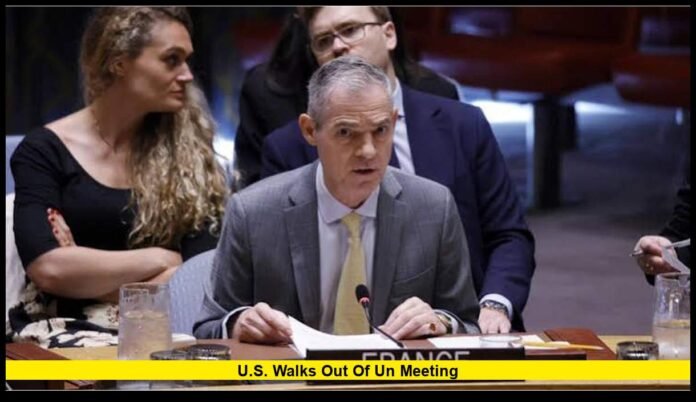

U.S. walks out of UN meeting became a striking diplomatic development after American representatives left the United Nations Security Council chamber while France delivered remarks during a session on Ukraine. The July 27, 2026, protest followed a public disagreement between Washington and Paris over U.N. human rights policy and the reappointment of Volker Türk as the organization’s top human rights official.
The incident placed two longtime allies in an unusually visible confrontation inside the Security Council. Both countries hold permanent seats and frequently cooperate on international security, making the decision to walk out particularly notable.
The disagreement developed after the United States opposed Türk receiving another four-year term. France criticized the American vote, while U.S. officials strongly rejected the way Paris characterized Washington’s position.
Days later, the dispute reached the Security Council chamber.
What Happened During the UN Security Council Meeting?
The walkout occurred on July 27 during a Security Council meeting concerning Russia’s war against Ukraine.
Before France delivered its remarks, senior U.S. diplomat Dan Negrea addressed the growing dispute between the two allies. He criticized French comments concerning Washington’s record and position on human rights.
Negrea argued that the United States had tolerated criticism from France because of the longstanding relationship between the countries. He made clear, however, that Washington considered the latest French rhetoric unacceptable.
American representatives then left the chamber as French Ambassador Jérôme Bonnafont began speaking.
The move turned a disagreement that had largely played out through diplomatic statements into a visible protest at the United Nations.
Although delegations sometimes leave international meetings to register objections, the countries involved made this incident especially significant. The United States and France are two of the five permanent Security Council members.
Why Did the United States Walk Out?
The immediate dispute centered on Volker Türk, the U.N. High Commissioner for Human Rights.
Türk, an Austrian diplomat and lawyer, began serving as high commissioner in October 2022. U.N. Secretary-General António Guterres later recommended him for another four-year term.
The General Assembly considered the matter on July 24, 2026.
The United States opposed granting Türk another full term and supported delaying the decision. The effort to postpone the matter did not prevail.
General Assembly members ultimately approved Türk’s second term by a wide margin.
The final tally was 144 countries in favor, 10 against and 13 abstaining.
His next term is scheduled to run from October 12, 2026, through October 11, 2030.
Washington was among the governments voting against the extension.
The vote itself did not trigger the Security Council walkout. Instead, the confrontation escalated after France publicly highlighted the U.S. position.
France Criticized the American Vote
France’s U.N. mission in Geneva responded to the General Assembly decision by drawing attention to the countries that opposed Türk’s reappointment.
French officials noted that the United States voted against the new term alongside governments including Russia, North Korea, Nicaragua and Mali.
That comparison prompted an angry reaction from Washington.
American officials viewed France’s characterization as an unfair attack on the United States and its human rights record.
U.S. Ambassador to the United Nations Mike Waltz responded publicly, defending the American position and criticizing France’s comments.
Washington also maintained its objections to Türk’s performance as high commissioner.
The disagreement therefore became about more than one General Assembly vote. It developed into a dispute over how one ally publicly described another and how both governments viewed the U.N. human rights system.
Why Washington Opposed Volker Türk
The Trump administration has expressed broader concerns about international human rights institutions and their treatment of the United States and Israel.
Türk’s role requires him to address alleged human rights violations in countries across the world. His office routinely comments on armed conflicts, government policies, civilian protection and other human rights matters.
During his first term, Türk criticized Russia over its invasion of Ukraine. He also raised concerns about Israel’s military operations in Gaza.
His office has addressed issues involving the United States as well, including immigration enforcement and deaths involving people in immigration custody.
Those positions have contributed to disagreements between Washington and the high commissioner.
The United States nevertheless failed to build enough international support to prevent another full term.
With 144 countries backing Türk, the General Assembly gave him a decisive mandate to continue in office.
U.S. Walks Out of UN Meeting During Ukraine Session
The timing of the protest attracted additional attention because the Security Council had gathered to discuss Ukraine rather than human rights leadership.
Russia’s invasion has remained a major subject before the council. Russia itself holds one of the five permanent seats and possesses veto power.
The American-French dispute nevertheless entered the proceedings before France spoke.
Negrea directly addressed the French criticism and signaled that Washington would not simply ignore what it considered inappropriate rhetoric from Paris.
The American delegation then left as Bonnafont delivered France’s remarks.
The U.S. walks out of UN meeting development demonstrated how quickly a disagreement over a General Assembly vote had moved into another part of U.N. diplomacy.
Washington used the walkout to make its objection highly visible.
Read More – Senate Walks Back Rebuke After Second Iran War Powers Vote: What Changed and Why It Matters
France Responds After the Walkout
France did not respond by leaving the chamber or abandoning its planned remarks.
Bonnafont proceeded with France’s intervention and emphasized his country’s commitment to the principles associated with the United Nations.
He highlighted international peace, security, development and human rights.
The French ambassador also referenced the longstanding relationship between France and the United States.
That relationship stretches back to the American Revolution, when France provided crucial assistance to the colonies fighting for independence from Britain.
The historical alliance has endured through major international conflicts and the creation of NATO.
The July 27 confrontation does not erase that relationship, but it revealed a sharp disagreement between the current governments.
Why a U.S.-France Walkout Matters
A diplomatic walkout often serves as a symbolic protest. It allows a government to reject another delegation’s remarks without preventing that country from speaking.
This incident carried greater weight because Washington and Paris hold unusually powerful positions within the United Nations.
The United States, France, Britain, China and Russia make up the Security Council’s five permanent members.
Each possesses veto authority over substantive council resolutions.
The United States and France also work closely through NATO and maintain extensive military, intelligence and diplomatic ties.
A disagreement between them therefore has implications beyond the symbolism of leaving a meeting.
At the same time, the walkout does not mean the U.S.-France alliance has ended or that formal diplomatic relations have been downgraded.
No such step had been announced as of July 28.
Trump and Macron Face Another Area of Disagreement
The U.N. confrontation emerged against a backdrop of policy differences between President Donald Trump and French President Emmanuel Macron.
Their governments remain allies, but Washington and Paris do not always share the same approach to international institutions, European security or defense policy.
Trump has repeatedly called on European governments to assume greater responsibility for their defense.
Macron has advocated stronger European military capabilities and greater strategic autonomy for Europe.
The dispute over Türk introduces human rights institutions as another area where the governments have openly disagreed.
What makes the latest confrontation unusual is its visibility.
Instead of handling the disagreement entirely through private diplomatic discussions, both sides publicly defended their positions.
The walkout made that tension impossible to miss.
What the 144-10 Vote Means
The General Assembly result remains central to understanding the controversy.
Türk secured support from 144 countries. Ten opposed another four-year term, while 13 abstained.
The United States had sought to delay the decision, while Russia pursued a different approach involving a shorter extension.
Neither effort prevented the General Assembly from approving the full term recommended by Guterres.
Türk is scheduled to begin that term on October 12, 2026.
The American walkout does not alter the vote or change the status of his appointment.
Instead, the dispute reflects competing views about Türk’s record and the credibility of the wider international human rights system.
Why the UN Human Rights Chief Attracts Controversy
The high commissioner holds one of the United Nations’ most politically sensitive positions.
The official must address human rights concerns while dealing with governments that may strongly reject international criticism.
That creates frequent tension.
Governments criticized by the high commissioner can challenge the office’s findings, methods or priorities. Other countries argue that independence requires the high commissioner to speak openly even when powerful governments object.
Türk has confronted criticism from governments on several sides of international conflicts.
His positions involving Ukraine, Gaza and other issues have generated strong reactions.
Despite those disputes, the General Assembly’s vote demonstrated broad international support for extending his tenure.
Could the United States Walk Out Again?
Washington’s comments during the July 27 session indicated that its objection to France had not ended.
Negrea suggested that American representatives would not listen to similar French interventions while Washington believes Paris continues using unacceptable rhetoric against the United States.
That leaves open the possibility of additional diplomatic protests.
As of July 28, however, there had been no confirmed announcement of a broader U.S. boycott of French speeches at the United Nations.
There was also no confirmed downgrade in diplomatic relations between Washington and Paris.
The dispute remained focused on the U.N. human rights debate and France’s public criticism of the American vote.
Does the Walkout Affect Volker Türk’s New Term?
The answer is no.
The General Assembly formally approved Türk’s second term, and the Security Council confrontation does not reverse that decision.
His new mandate is scheduled to begin after his current term concludes in October.
The distinction is important because the walkout represented a diplomatic protest, not a procedural challenge capable of canceling the General Assembly result.
Washington remains free to criticize Türk and his office.
It can also challenge specific U.N. human rights policies in the future.
However, Türk secured the required international backing for another term.
What the Incident Says About U.S. Policy at the UN
The confrontation also reflects the Trump administration’s broader skepticism toward parts of the multilateral system.
Washington has questioned international institutions when American officials believe those organizations operate unfairly or pursue policies inconsistent with U.S. priorities.
The dispute involving Türk follows that broader pattern.
France has taken a different position in this case, emphasizing the importance of international human rights mechanisms and defending the outcome of the General Assembly vote.
Those differences created the conditions for the July 27 confrontation.
Neither side has indicated that the disagreement ends their wider diplomatic partnership.
Still, the incident showed that even close allies can clash publicly when they hold sharply different views about the United Nations.
Where the U.S.-France Dispute Stands Now
As of July 28, 2026, the core facts remain unchanged.
The General Assembly approved Volker Türk for another four-year term by a 144-10 vote with 13 abstentions.
The United States opposed the decision.
France then publicly criticized Washington’s position, prompting strong objections from American officials.
Three days after the General Assembly vote, U.S. diplomats left the Security Council chamber as France spoke during the Ukraine meeting.
No formal break in U.S.-France diplomatic relations has followed.
The walkout instead stands as a highly visible sign of disagreement between two permanent Security Council members and longtime allies.
The next significant development will depend on how Washington and Paris handle future interactions at the United Nations while continuing to work together on wider security and diplomatic priorities.
The U.S. walks out of UN meeting story has put an unusually public disagreement between Washington and Paris in the international spotlight. Share your thoughts on what the confrontation could mean for diplomacy between the two longtime allies.