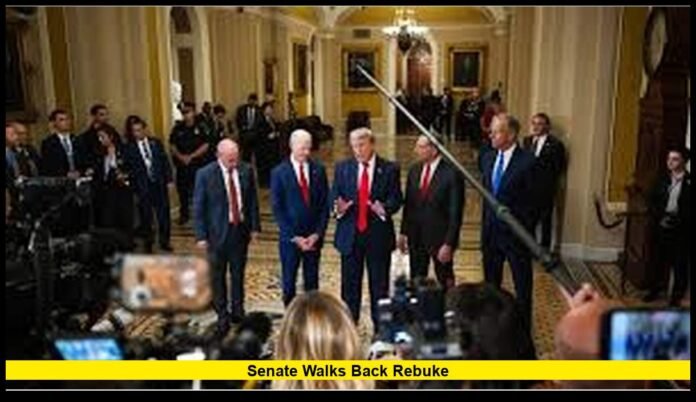

Senate walks back rebuke became one of the biggest political stories in Washington this week after the U.S. Senate reversed course on a closely watched measure involving presidential war powers and military action against Iran. Within just a few days, lawmakers shifted from approving a resolution that challenged President Donald Trump’s authority to rejecting a nearly identical proposal. The rapid change highlighted divisions within Congress and renewed debate over the balance of power between the legislative and executive branches.
The back-to-back votes drew national attention because they reflected changing political calculations, new intelligence briefings, and growing concern about how Congress should oversee military operations abroad. While the first vote was widely viewed as a bipartisan assertion of congressional authority, the second vote demonstrated how quickly support for the measure changed after discussions with senior administration officials.
A Dramatic Week on Capitol Hill
Congress has debated presidential war powers for decades, but few weeks have illustrated those disagreements as clearly as this one. Senators cast two votes on similar resolutions within days of each other, producing opposite outcomes.
The first vote approved a measure intended to require congressional authorization for certain military actions involving Iran. Several Republican senators joined Democrats in supporting the proposal, creating an unusual bipartisan coalition.
Only two days later, that coalition broke apart.
After private meetings with White House officials and additional briefings, enough senators changed their positions to defeat another resolution that closely resembled the earlier measure.
The reversal quickly became one of the most discussed political developments in Washington.
Understanding the First Vote
The Senate’s initial action surprised many observers because it attracted support from members of both political parties.
Lawmakers who voted in favor argued that Congress has a constitutional responsibility to determine when the United States enters extended military conflicts. They said the resolution reaffirmed Congress’s role rather than criticizing the nation’s armed forces.
Supporters maintained that any long-term military engagement should receive clear authorization from Congress whenever possible.
The proposal ultimately passed by a narrow margin, making headlines across the country.
Why the Senate Changed Course
The second vote told a different story.
Between the two votes, several Republican senators met with President Donald Trump and senior administration officials. Those conversations focused on national security, diplomatic negotiations, and classified intelligence regarding Iran.
Some lawmakers later explained that the additional information answered questions they had raised before the first vote.
Others emphasized that the administration was actively pursuing diplomatic efforts and argued that Congress should avoid actions that might complicate those negotiations.
Those developments reshaped the political landscape ahead of the second vote.
The Role of White House Briefings
Private briefings often influence congressional decisions, especially on national security matters.
During the meetings, administration officials discussed military operations, intelligence assessments, and ongoing diplomatic efforts involving Iran.
Several senators later indicated that the information provided greater confidence in the administration’s strategy.
Although classified details were not released publicly, lawmakers acknowledged that the discussions affected their decisions before returning to the Senate floor.
The meetings became one of the defining moments leading to the Senate’s reversal.
Key Senators Who Changed Positions
One of the most closely watched lawmakers was Senator Bill Cassidy.
Cassidy voted for the first resolution but opposed the later measure after attending the White House briefing.
His decision attracted attention because it represented one of the most significant changes between the two votes.
Senator Rand Paul also drew headlines.
Rather than supporting the second proposal, Paul voted “present,” reducing the measure’s chances of passing.
Those changes, combined with shifts by other senators, altered the final outcome.
How the Voting Results Compared
The two votes produced very different outcomes despite addressing similar issues.
| Senate Vote | Result |
|---|---|
| First Iran war powers resolution | Passed 50-48 |
| Second similar resolution | Failed 47-50-1 |
The comparison illustrates how rapidly congressional support shifted within a short period.
Why War Powers Continue to Spark Debate
The latest votes renewed discussion about one of the most important constitutional questions in American government.
The Constitution divides military authority between Congress and the president.
Congress possesses the power to declare war and provide funding for military operations.
The president serves as commander in chief of the armed forces.
Because those responsibilities overlap, disagreements often emerge whenever military operations begin without a formal declaration of war.
Congress attempted to clarify those responsibilities through the War Powers Resolution of 1973.
That law requires presidents to notify Congress after introducing American forces into hostilities and generally limits extended military action without congressional approval.
Presidents from both major political parties have questioned parts of that law over the years, arguing that it limits executive authority during national security emergencies.
As a result, debates over presidential war powers continue regardless of which party controls the White House.
Supporters Defended Congressional Oversight
Lawmakers who supported the first resolution emphasized constitutional oversight rather than partisan politics.
They argued that Congress should remain actively involved whenever American military operations could expand into a broader conflict.
Many supporters also said their vote reflected institutional responsibility rather than opposition to the administration.
They maintained that Congress has an obligation to debate major military decisions affecting the country.
Opponents Focused on National Security
Senators opposing the second measure presented a different perspective.
They argued that restricting presidential flexibility during sensitive international negotiations could weaken the United States’ position.
Several lawmakers also expressed confidence that the administration’s diplomatic efforts deserved additional time before Congress imposed further limitations.
Those arguments gained greater support after lawmakers received updated intelligence briefings.