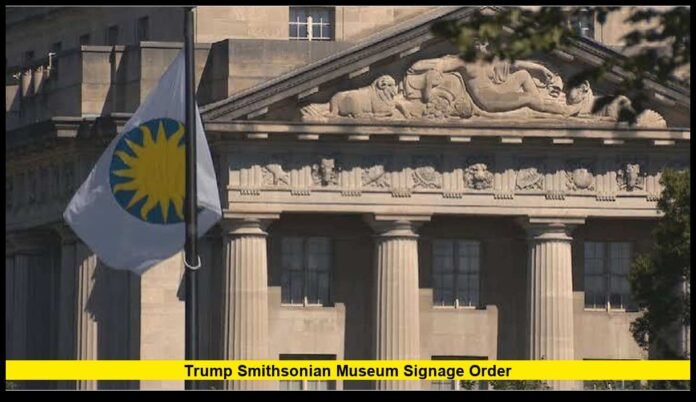

The trump smithsonian museum signage order has become one of the most closely watched cultural policy developments in the United States after President Donald Trump signed a new executive order on July 24, 2026. The order directs federal agencies to place temporary signs outside the Smithsonian’s National Museum of American History that explain the administration’s concerns about how parts of the museum present the nation’s history. The action has generated nationwide discussion about presidential authority, the Smithsonian’s independence, and the ongoing debate over how American history should be interpreted and shared with the public.
The executive order does not require immediate changes to museum exhibits. Instead, it focuses on federally managed public areas surrounding the museum and calls for informational signs that reflect the administration’s position. The decision has drawn support from some Americans who believe national museums should place greater emphasis on the country’s achievements, while others argue that historical institutions should remain free from political influence.
What Is the Trump Smithsonian Museum Signage Order?
President Donald Trump signed Executive Order 14415 as part of a broader effort to reshape how American history is presented in federally connected cultural institutions.
The order centers on the Smithsonian’s National Museum of American History in Washington, D.C. It directs federal agencies to install temporary signs outside the museum, explaining that the administration believes some exhibits require revisions to better represent the nation’s history.
Rather than changing exhibits directly, the order provides visitors with additional context before they enter the museum. The signs are intended to summarize the administration’s findings and encourage visitors to consider an alternative historical perspective.
The executive action follows months of review conducted by the White House Domestic Policy Council, which examined exhibits at the museum and issued recommendations regarding historical interpretation.
Why the Executive Order Focuses on Signage
Many people have wondered why the order focuses on signs instead of requiring the museum to change its displays.
The answer lies in the Smithsonian Institution’s unique legal structure.
Although Congress provides much of the Smithsonian’s funding, the institution operates independently and manages its own exhibits, collections, and educational programs. The president cannot simply direct museum officials to rewrite exhibit text or remove displays.
Instead, the administration used authority over federally managed property surrounding the museum. Sidewalks and public access areas maintained by federal agencies can legally accommodate temporary informational signs.
This approach allows the administration to communicate its position without directly altering the museum’s exhibits.
What the Temporary Signs Will Say
The executive order instructs federal officials to develop signage that informs visitors about concerns raised during the White House review.
According to the administration, the signs should explain that some museum exhibits present American history in a way that does not fully recognize the nation’s achievements and founding principles.
The signs will also point visitors toward information that the administration considers a more accurate representation of American history.
Officials are expected to install the signs near public walkways leading to the museum, making them visible before visitors enter the building.
Why the Administration Took This Step
The White House says the executive order is intended to restore confidence in national historical institutions.
Administration officials argue that museums should celebrate the country’s achievements while acknowledging difficult moments without allowing those events to dominate the overall story.
The White House believes some museum exhibits place excessive emphasis on conflict, inequality, and social division while giving less attention to constitutional government, economic opportunity, scientific innovation, military service, and democratic progress.
Supporters of the order say visitors deserve a broader understanding of the nation’s accomplishments.
The White House Review of the Smithsonian
The executive order follows the release of a lengthy White House report examining exhibits at the National Museum of American History.
The review concluded that several displays reflect an ideological perspective rather than presenting what the administration considers a balanced account of American history.
Officials stated that exhibits discussing race, politics, immigration, and social movements often emphasize national shortcomings without giving equal attention to historical achievements.
The report became the foundation for the executive order signed later in July.
What the Order Requires Federal Agencies to Do
Several federal agencies now have responsibilities under the executive order.
Their tasks include:
- Planning and installing temporary signs near the museum.
- Coordinating the wording and placement of informational displays.
- Ensuring signs remain within areas managed by the federal government.
- Supporting public education related to America’s 250th anniversary.
- Working together to implement the executive order within existing legal authority.
The National Park Service is expected to play a major role because it manages many public areas surrounding the museum.
Read More – Trump Revoke TPS: A Detailed Breakdown of Nations Losing Immigrant Protections Under Trump
Why the Smithsonian Cannot Be Directed to Rewrite Exhibits
One of the most important aspects of the executive order is what it does not do.
It does not require museum officials to rewrite exhibits, remove artifacts, or replace historical displays.
The Smithsonian Institution operates with significant independence despite receiving federal funding.
Museum leadership maintains authority over exhibitions, research, collections, and educational programming.
Because of this structure, any future exhibit revisions would remain decisions made through the institution’s own governance process.
Smithsonian Leadership’s Response
Museum leadership has consistently defended the institution’s approach to presenting American history.
Officials say exhibits are developed through years of scholarly research, historical documentation, and professional review.
They maintain that the museum seeks to present a complete picture of the American experience by highlighting both national achievements and difficult chapters.
According to museum leaders, understanding the country’s successes and challenges allows visitors to gain a deeper appreciation of American history.
The Smithsonian has emphasized that historical interpretation should remain grounded in evidence and professional scholarship.
Supporters Welcome the Executive Order
Many supporters believe the executive order represents an important effort to strengthen civic education.
They argue that national museums should inspire pride in the country’s history while recognizing mistakes that have shaped its development.
Supporters also believe visitors should encounter exhibits that celebrate the Constitution, the Declaration of Independence, military service, entrepreneurship, scientific discoveries, and democratic institutions.
For these Americans, the order helps ensure that patriotic achievements receive greater recognition.
Critics Raise Concerns About Political Influence
Not everyone agrees with the administration’s approach.
Many historians, museum professionals, and lawmakers argue that elected officials should avoid influencing how museums interpret historical events.
Critics say museums should remain independent so historians can present evidence without political pressure.
Some also believe that adding government-approved signs outside the museum could blur the line between public education and political messaging.
The debate has become part of a larger national discussion about history education and the role of public institutions.
Why This Issue Matters Beyond One Museum
The National Museum of American History welcomes millions of visitors each year.
Families, students, tourists, veterans, educators, and researchers visit the museum to learn about the nation’s past.
Because of its national importance, any policy affecting the museum attracts widespread attention.
The executive order also highlights broader questions about who shapes public understanding of history and how national institutions balance different historical perspectives.
Those discussions extend far beyond Washington, D.C., influencing schools, libraries, museums, and public conversations across the country.
The Connection to America’s 250th Anniversary
The order arrives during the celebration of the 250th anniversary of American independence.
The administration argues that this historic milestone provides an opportunity to emphasize the country’s founding ideals and the individuals who signed the Declaration of Independence.
Federal officials have been instructed to consider additional educational displays connected to the anniversary.
The administration believes this celebration should focus on the principles of liberty, self-government, and constitutional democracy that have shaped the United States for two and a half centuries.
What Visitors Can Expect
Visitors planning a trip to the National Museum of American History should not expect major changes inside the museum immediately.
Existing exhibits continue to operate under Smithsonian management.
The most noticeable change will likely be the installation of temporary signs near entrances or public walkways surrounding the museum.
Visitors will still be able to explore the museum’s collections, permanent exhibitions, and educational programs as usual.
The executive order primarily affects the information presented before visitors enter the building.
How the Order Fits Into Broader Policy
The administration has made cultural policy and civic education important priorities during President Trump’s current term.
Previous executive actions encouraged reviews of historical presentations at federally connected institutions.
The Smithsonian review and the resulting executive order reflect those broader policy goals.
Rather than focusing only on one museum, the administration says it wants national institutions to emphasize the country’s founding principles and achievements while presenting history in a way that strengthens civic understanding.
Legal Limits of Presidential Authority
The executive order also demonstrates the limits of presidential authority over independent institutions.
While the president can direct executive branch agencies, independent organizations like the Smithsonian retain substantial authority over their internal operations.
That distinction explains why the order focuses on federal property surrounding the museum instead of requiring immediate exhibit changes.
Legal experts note that executive orders cannot override statutes establishing independent governance structures.
As a result, the Smithsonian continues to control exhibit development even as federal agencies carry out responsibilities assigned under the order.
Public Debate Continues
The executive order has sparked conversations across the political spectrum.
Supporters believe it promotes a more positive presentation of American history.
Opponents argue that historical interpretation should remain free from political influence.
Others view the issue as an opportunity for broader public discussion about how museums present complex historical events.
Regardless of differing opinions, the executive order has brought renewed attention to the Smithsonian Institution and its role in preserving and explaining the American story.
What Happens Next
Federal agencies are expected to coordinate installation of the temporary signs in accordance with the executive order.
Visitors will likely begin seeing the informational displays outside the National Museum of American History once implementation is complete.
Meanwhile, the Smithsonian continues operating under its existing governance structure, with museum officials maintaining responsibility for exhibits and educational programming.
As discussions continue, the order is expected to remain an important topic in debates about government authority, public history, and cultural institutions in the United States.
The trump smithsonian museum signage order has become a significant part of the national conversation about American history, public education, and the role of federal institutions. As implementation moves forward, many Americans will continue following how the policy affects one of the country’s most recognized museums and the way its history is presented to future visitors.