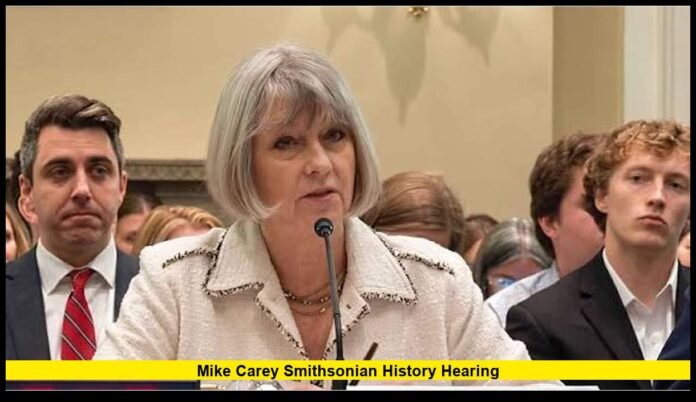

Mike Carey Smithsonian history hearing became a major topic in Washington after lawmakers questioned Smithsonian officials about how American history is presented to millions of visitors each year. Members of Congress examined museum exhibits, educational materials, and historical interpretation during a hearing that focused on the National Museum of American History. The discussion reflected a broader national debate about history education, federal oversight, and the role of publicly funded cultural institutions.
Why the Hearing Became National News
Congressional hearings involving the Smithsonian rarely attract widespread public attention, but this one generated significant interest because it addressed how one of the nation’s most respected museums presents American history.
Republican lawmakers argued that some museum exhibits and educational resources place too much emphasis on themes involving race, identity, and inequality while giving less attention to America’s founding ideals, constitutional system, and historical achievements.
Smithsonian officials strongly defended the institution’s work. They told lawmakers that exhibits are developed through historical research, expert review, and years of planning. Museum leadership also emphasized that presenting difficult periods in American history does not diminish the nation’s accomplishments.
The hearing became another chapter in the continuing national discussion over how history should be taught, preserved, and displayed for future generations.
Mike Carey’s Role During the Hearing
Representative Mike Carey of Ohio participated in the House hearing as lawmakers questioned Smithsonian leadership about historical interpretation and public accountability.
Throughout the proceedings, Carey focused on congressional oversight responsibilities involving federally supported institutions. He joined other Republican members in asking whether exhibits maintain historical balance while accurately reflecting America’s development.
His questions centered on transparency, educational priorities, and whether museums supported by taxpayer funding should avoid political bias.
Carey stressed that Americans expect national institutions to present history in a way that is factual, balanced, and accessible to visitors from every background.
His participation reflected broader concerns among House Republicans regarding the role of federal cultural organizations.
What the Hearing Was Designed to Examine
The congressional hearing reviewed several areas connected to the Smithsonian’s operations and educational mission.
Lawmakers discussed:
- Historical interpretation within exhibits
- Educational materials available to visitors
- Development of permanent and temporary exhibitions
- Internal review procedures
- Federal oversight
- Public accountability
- Museum leadership decisions
Rather than focusing on a single exhibit, committee members examined how the museum develops historical narratives and whether those presentations accurately reflect America’s past.
The hearing formed part of Congress’s ongoing responsibility to oversee institutions receiving federal funding.
Why the Smithsonian Holds Such an Important Position
The Smithsonian Institution occupies a unique place in American public life.
It operates museums, research centers, libraries, archives, and educational programs that attract millions of visitors from across the United States and around the world.
Among its most visited attractions is the National Museum of American History, where visitors can explore artifacts connected to the nation’s political, military, scientific, cultural, and social development.
Because of its influence, decisions about exhibit content often receive close attention from lawmakers, historians, educators, and the public.
The museum’s exhibits shape how many visitors understand key events throughout American history.
Smithsonian Officials Defended Their Historical Approach
During testimony, museum leadership explained that exhibits rely on established historical scholarship rather than political ideology.
Officials described the lengthy process used to create exhibitions, noting that historians, researchers, conservators, designers, and educators all contribute before exhibits open to the public.
The Smithsonian maintained that museums have a responsibility to tell complete historical stories.
That includes celebrating American achievements while also explaining difficult periods involving conflict, discrimination, political disagreement, and social change.
Officials rejected suggestions that the institution intentionally promotes partisan viewpoints.
Instead, they argued that presenting multiple perspectives allows visitors to develop a fuller understanding of historical events.
Major Issues Raised During the Hearing
Several themes appeared repeatedly throughout the hearing.
America’s Founding Principles
Republican lawmakers questioned whether exhibits sufficiently highlight the country’s founding documents, constitutional government, individual liberty, and democratic institutions.
Some members expressed concern that visitors could leave with an incomplete understanding of America’s founding if exhibits place greater emphasis on later conflicts than earlier achievements.
Museum officials responded that exhibits devoted to the nation’s founding remain central parts of the museum’s collections.
Race and Civil Rights
Another major topic involved exhibits discussing slavery, segregation, civil rights, and race relations.
Lawmakers questioned whether these exhibits present American history fairly.
Museum leaders answered that these topics represent essential chapters of the nation’s story and must be included to provide historical accuracy.
They explained that acknowledging difficult events strengthens historical understanding rather than weakening it.
Educational Materials
Committee members also discussed educational resources connected with museum programming.
Questions focused on how educational materials are selected, reviewed, and updated before being shared with visitors or staff.
Smithsonian representatives described internal review processes designed to ensure accuracy and consistency with historical research.
Temporary Exhibitions
Several lawmakers asked about rotating exhibitions covering contemporary cultural topics.
Museum officials explained that temporary exhibits often explore subjects receiving increased scholarly attention while remaining grounded in documented historical evidence.
Congressional Oversight and Public Accountability
Congress regularly reviews agencies and institutions that receive federal funding.
The Smithsonian operates under a distinctive structure that combines federal support with private donations, making congressional oversight an established part of its governance.
Lawmakers used the hearing to ask how museum leadership evaluates exhibits before public display.
Questions included:
- Who approves exhibit content?
- How are historians selected?
- How often are exhibits updated?
- What review standards exist?
- How are public concerns addressed?
These questions reflected broader oversight responsibilities rather than direct involvement in museum operations.
How Smithsonian Exhibits Are Created
Creating a national museum exhibit often requires years of preparation.
Museum staff generally follow several stages before exhibits open to visitors.
These include:
- Historical research
- Artifact conservation
- Expert consultation
- Script writing
- Exhibit design
- Educational review
- Accessibility planning
- Final approval
Every exhibit undergoes extensive planning before becoming part of the visitor experience.
Officials explained that historical scholarship continues evolving, which means museums periodically update exhibits as new research becomes available.
Why Historical Interpretation Often Creates Debate
History involves more than collecting artifacts.
Museums must decide how events connect, which stories deserve emphasis, and how visitors can understand complex developments.
Reasonable historians sometimes disagree about interpretation while relying on the same historical evidence.
Congressional hearings like this illustrate how historical interpretation can become part of broader public discussions.
Supporters of expanded historical storytelling believe museums should include a wider range of experiences.
Others believe institutions should devote greater attention to traditional narratives involving the nation’s founding, military service, constitutional development, innovation, and democratic progress.
The hearing reflected those competing viewpoints.
Public Trust Remains a Central Issue
Throughout the hearing, lawmakers repeatedly discussed public confidence.
Because millions of Americans visit Smithsonian museums every year, committee members argued that the institution carries significant educational responsibility.
Museum leadership agreed that public trust remains essential.
Officials stated that maintaining scholarly integrity, protecting historical artifacts, and presenting carefully researched information remain the institution’s highest priorities.
Both lawmakers and museum representatives emphasized the importance of preserving confidence in one of America’s best-known cultural organizations.
The National Museum of American History
The National Museum of American History preserves artifacts representing nearly every period of the nation’s development.
Visitors can view collections connected to:
- The American Revolution
- The Constitution
- U.S. presidents
- Military history
- Civil Rights Movement
- Transportation
- Technology
- Business
- Popular culture
- Scientific innovation
These collections attract families, students, teachers, researchers, veterans, and international visitors throughout the year.
The museum’s educational influence explains why congressional oversight receives substantial public attention.
Broader Debate Over American History
The hearing also reflected wider discussions occurring across the country.
School districts, universities, museums, libraries, and historical organizations have all debated how best to present American history.
Some educators believe historical education should emphasize multiple perspectives to create a more complete understanding of the past.
Others argue institutions should avoid interpretations they believe introduce unnecessary political viewpoints.
The Smithsonian hearing demonstrated how these conversations continue beyond classrooms and into Congress.
Federal Funding and Oversight
Federal support gives Congress authority to conduct oversight hearings involving the Smithsonian.
Lawmakers noted that taxpayer-funded institutions should remain accountable to the American public.
Museum officials agreed accountability matters but stressed that scholarly independence remains equally important.
They argued that historians must be able to present documented evidence without political influence.
Balancing oversight with academic independence became one of the hearing’s recurring themes.
Reactions Beyond Capitol Hill
The hearing attracted attention from historians, museum professionals, educators, veterans, and visitors.
Many praised Congress for examining how public institutions operate.
Others supported Smithsonian officials for defending historical scholarship and professional museum standards.
The discussion reached audiences well beyond Washington because the Smithsonian represents one of the nation’s most recognizable cultural institutions.
Its exhibits help shape how countless visitors understand American history.
What Happens After the Hearing
Congressional hearings do not automatically change museum exhibits.
Instead, they provide lawmakers with opportunities to ask questions, gather testimony, and evaluate how institutions operate.
Future oversight efforts may continue examining museum policies, educational programming, and federal accountability.
Smithsonian leadership has continued emphasizing its commitment to historical accuracy, public education, and preservation of America’s cultural heritage.
Meanwhile, lawmakers have indicated that oversight of federally funded institutions will remain an important responsibility.
Why the Mike Carey Smithsonian History Hearing Matters
The discussion reached beyond museum walls.
It addressed larger questions about national identity, civic education, historical scholarship, and the responsibilities of publicly funded institutions.
For supporters of stronger oversight, the hearing reinforced the importance of transparency and accountability.
For museum leaders, it provided an opportunity to explain how exhibits are researched, reviewed, and presented to millions of visitors each year.
Regardless of political viewpoints, the hearing demonstrated that American history continues to generate passionate public interest. Museums preserve the nation’s past, while Congress exercises oversight over institutions supported by taxpayers. Those two responsibilities occasionally intersect, as they did during this widely watched hearing.
As conversations about education, history, and public institutions continue across the country, the Smithsonian will remain an important part of those discussions because of its influence on how Americans and international visitors learn about the nation’s story.
What are your thoughts on the Mike Carey Smithsonian history hearing and the broader debate over how American history should be presented? Share your perspective in the comments and follow future developments as this conversation continues.